
What Repels Bees? Six Popular Fixes, Tested Against Reality
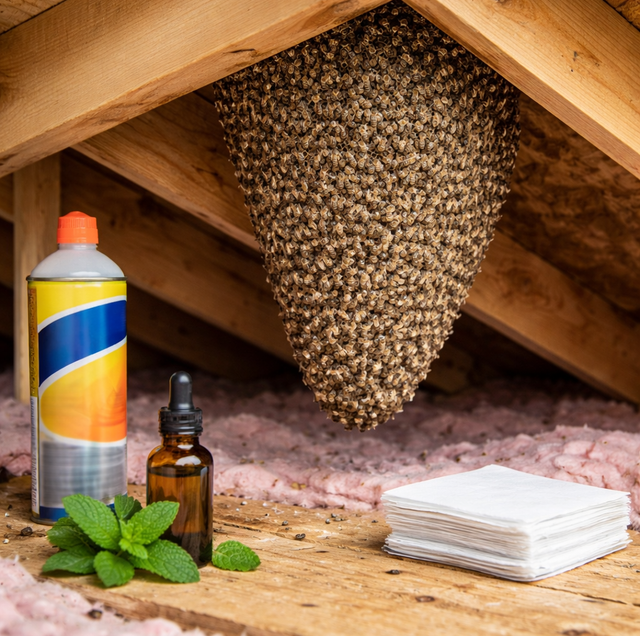
The hardware store aisle for this problem is a small, confident lineup: a can of wasp-and-hornet spray, a box of dryer sheets, a bottle of peppermint oil, a plug-in ultrasonic pest repeller, and, on the seasonal shelf, a gray paper decoy shaped like a nest. Search for the same problem online, and the same set comes back with additions: cinnamon, citrus peel, a homemade dish soap spray, and a bundle of sage or newspaper meant to be burned near an opening. Between the shelf and the search results, that's six distinct claims, each with its own logic, and almost none tested against what happens when a colony settles inside a wall, attic, or roofline rather than passing through a yard.
What follows goes through each one on its own terms: what the claim is, what it does at best, and where it falls apart against an established colony.
Strong Scents: Peppermint, Citrus and Cinnamon
The claim is that a strong, unfamiliar scent overwhelms a bee's sense of smell, pushing it elsewhere. There's a real mechanism underneath it. Bees constantly read scent, marking flowers and communicating through pheromones, so a concentrated essential oil can make a bee steer around a treated surface for a while. The trouble is durability. Bottled essential oils are volatile by design, and on a hot, sun-exposed surface the scent is gone in hours rather than days. They also act only on bees moving through open air. Nothing about a surface scent reaches into a wall cavity or attic void, where the workers drawing comb aren't smelling the yard at all. What that leaves is a brief nuisance for foragers outdoors and no reach whatsoever into a colony already inside.
Dryer Sheets
The claim is that a dryer sheet's fragrance keeps bees from investigating a small opening. The narrow version of that claim is the one with the least against it: a scout bee still weighing an opening may skip one carrying a strong synthetic fragrance, for as long as the fragrance lasts. That is the entire scope of what it can do, and it applies only before a colony commits. Once bees have moved past scouting and started drawing comb inside a void, fragrance at the entrance changes nothing about what is already established several feet deeper in the cavity. The sheet is acting on a decision that has already been made.
Homemade Sprays and Aerosol Cans
The claim is that a soap-and-water mix is a non-toxic way to kill bees without buying pesticide, and the wasp-and-hornet aerosol on the shelf beside it makes the same offer with a longer stream. Soap does kill on contact. The popular shorthand for why is suffocation; the more careful account is that surfactants strip the waxy layer on the cuticle and drop the surface tension of water enough for liquid to enter the spiracles, the breathing openings set along a bee's thorax and abdomen. Whatever the precise mechanism, it only kills what the spray physically reaches. A stream aimed at an entrance hits the workers standing guard; it never touches the comb, the queen, or the bulk of the colony deeper in the cavity. What's left afterward is a smaller, badly disturbed colony, plus dead bees and residue that resolves nothing about what is living in the wall.
Smoke
Beekeepers really do use smoke, which is where the myth borrows its credibility. Cool smoke masks the alarm pheromone that bees release, which buys a suited, supervised handler a calmer working window inside a deliberately opened hive. That is a controlled, close-range technique performed on comb the handler can see and reach, not a way to drive a colony out of a structure. Smoke directed at a wall or an attic vent from outside mostly stays at the opening, and a colony sitting several feet in never registers it.
Burning sage, newspaper, or smoker fuel next to a vent, soffit, or siding puts smoldering material against framing and insulation. Those materials retain heat long after the visible smoke has stopped, and the colony inside remains unaffected.
Ultrasonic Devices
These plug-in units are sold across almost every pest category: rodents, roaches, spiders, and bees, with the same generic claim: a frequency insects supposedly can't tolerate. No published testing specific to honey bees shows they respond to the frequencies these devices produce. Bees do register vibration, but they register it through physical contact, passed along the comb and the structure holding it, which is a different channel from airborne tone crossing a room from a hallway socket. A device broadcasting into the open air isn't touching the comb, nor is its signal.
Decoy Nests
The idea borrows from real wasp behavior: some wasp species are territorial toward their own kind and avoid building close to what looks like an occupied nest, which is where fake-nest decoys sold at hardware stores get their pitch. Honey bees don't share that instinct. Scouts inspect a candidate cavity itself before the swarm commits, and nothing in that inspection involves checking the eave for a rival colony's paper shell. Nothing published suggests a honey bee's house-hunting changes because of a decoy shaped and marketed for wasps.
Each Claim Against What Actually Happens
| Remedy | What It Claims To Do | What Actually Happens |
|---|---|---|
| Peppermint, citrus, cinnamon oils | Strong scent drives bees off | Steers some foragers outdoors while the scent lasts; never reaches a colony inside a cavity |
| Dryer sheets | Fragrance keeps bees from entering small gaps | May put a scout off one opening before it commits; no effect on bees already established |
| Soap spray and aerosol cans | Kill bees without a professional treatment | Kill only what the spray directly hits; leave the queen, comb, and rest of the colony untouched and agitated |
| Smoke | Calms or drives bees out | Works at close range on a hive a handler has opened; a fire risk when improvised against siding |
| Ultrasonic devices | High-frequency sound repels insects | No published bee-specific testing, and no contact with the comb where bees actually read vibration |
| Decoy (fake wasp) nests | Bees avoid nesting near a rival colony | Exploits wasp territorial behavior; honey bees show no comparable reaction |
The Two Moves That Make an Established Colony Worse
Two of the remedies above stop being a wasted afternoon and become a real hazard once a colony has settled in, and each fails in different ways.
Spraying the colony itself: The limits described above don't change when the can gets bigger or the stream gets longer. A partial knockdown at the entrance leaves an intact colony that is now agitated, and a disturbed colony can stay more defensive for days afterward. A feral colony's temperament cannot be read from the yard, so provoking one without removing it raises the odds of a serious sting event.
Sealing an active entry: Caulking or foaming over a gap while bees are still living behind it doesn't remove the colony; it traps it. Sealing belongs at the end of a removal rather than in place of one, and a colony that dies sealed inside a void is a second problem, not a solved one.
Frequently Asked Questions
Not quite. Citronella's active compounds differ from those in peppermint or citrus oil, and it's marketed almost entirely against mosquitoes, with no separate bee-specific testing to back the bee-repellent claim some sellers add on. It's usually sold as a candle or a torch, which narrows it further: the plume drifts with any air movement and does little beyond the still air immediately around it.
Unlikely to matter. A living plant releases far less concentrated oil than a bottled extract, and it releases it from the leaf surface rather than from the point you want protected. A border planting also sits out in the open yard, which is not where the decision that matters gets made.
The vinegar claim is borrowed from a different pest. Against ants trailing across a hard surface, wiping with vinegar works by erasing the pheromone trail the line is following, and there's no equivalent trail to erase at a nest entrance in a wall. Acetic acid is also more volatile than an essential oil, so whatever it does outdoors it does briefly, with the same result as any other spray at an entrance. The residue is the part that lasts longest: acidic liquid left standing on stucco, painted trim, or an anodized window frame is the practical cost of the attempt.
Not for nesting. A scout is judging the cavity itself, and paint on the outside surface says nothing about what's inside it. Color does matter in a different context. Bees near a disturbed nest respond more strongly to dark, moving objects than to pale ones, which is why protective bee suits are white rather than a matter of style.
No. Foragers that were out working when the spray hit return through the same gap the same day and start defending it again, which is why an entrance can look busy by the next morning after everything visible was knocked down. Traffic at the doorway is a poor measure of what was actually reduced.
Very little, which is the honest answer. Two things refill the doorway. Foragers that were away came back to a gap they still recognize, and capped brood already sealed in the comb keeps producing replacement workers on its own schedule, well out of reach of anything sprayed from outside. Traffic returning to normal is not evidence the colony recovered from a setback; it's evidence most of it was never affected.
Reading the Label Versus Reading the Structure
A scent, a sheet, or a decoy can plausibly steer a bee that still has a choice to make about where to land, and the packaging is accurate about that much. What it never states is where the boundary sits, and the boundary is the moment that choice is over. Once a comb is drawn into a cavity, the issue is a physical object several feet inside a wall, reachable only by opening it. That's the real reason this list keeps circulating: the remedies do what their labels describe, and the problem in the wall is a different size than the one on the label.
Have a suspected colony assessed before trying another remedy — an on-site look tells you whether it's a passing swarm or bees established inside a wall, and what actually gets them out. Russell Pest Control serves the Phoenix Valley. Call (623) 469-7583.
