
Scorpion Sealing in Phoenix, AZ: Close the Routes Bark Scorpions Actually Use
If scorpions keep turning up inside a home you thought was tight, the sealing wasn't built for scorpions. One call fixes that, and a real person answers.
Sealing Built Around How Scorpions Climb, Hunt, and Hide.
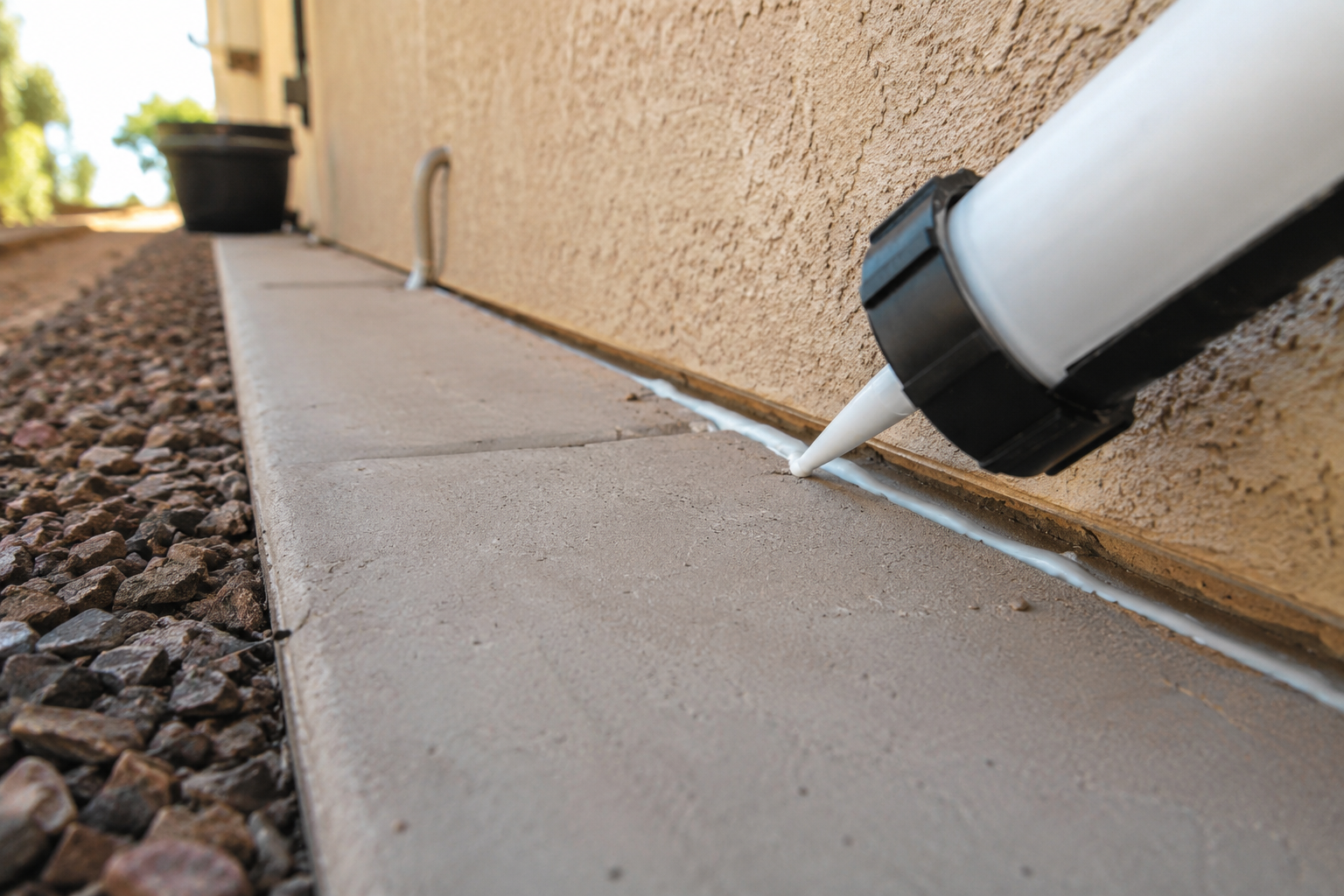
Sealing a home against scorpions is a different job than sealing it against anything else, because the bark scorpion is a different animal. It climbs stucco. It hangs upside down. It enters at door tops as readily as thresholds, and it fits through gaps most sealing jobs never measure. Scorpion sealing is the discipline our entire Home Seal service grew out of, and this page is the scorpion-specific version of the story: which routes they use, how we close them, and what sealed homes actually experience afterward.
The short version: most of the Valley's "pest proofing" is done at ankle height by people who've never watched a scorpion walk up a wall. Ours is mapped (often literally, with an after-dark black light search showing which routes your population uses), then sealed in priority order and backed by the same 1-2 year warranty as every Home Seal. Sightings on sealed homes drop to a fraction; the midnight bathtub discoveries are usually the first thing to stop.
Sealed to the Bark Scorpion's Standard
Built Around the Climber
Bark scorpions enter high and low. We seal door tops, wall junctions, and head gaps, not just thresholds.
Mapped Before Sealed
An after-dark UV search shows which routes your scorpions use, so sealing follows evidence.
The 1/16-Inch Standard
Our pass/fail bar is the gap a bark scorpion can flatten through. Everything bigger gets closed.
Treat First, Seal Second
Sealing an untreated home traps the problem. We sequence the work so it actually ends.
Part of Home Seal
Scorpion sealing is the heart of our signature Home Seal: same craft, same materials, same warranty.
Honest About Results
Sealed homes see sightings collapse. Outdoor populations still need managing; we'll always say which is which.
Three Ways Scorpions Defeat Ordinary Sealing
They Enter Where Nobody Seals: Up High
Crickets and roaches enter at floor level, so that's where most sealing ends. Bark scorpions climb textured stucco and block effortlessly and prefer hanging upside down, which puts door head gaps, patio ceiling edges, garage door top corners, and the wall-to-eave line on their route map. A scorpion-grade seal works the full height of every opening; it's the single biggest difference between our checklist and a standard one.
They Exploit the Gaps a Caulk Gun Skips
The failures we're called to redo follow a pattern: thresholds caulked but weep screed untouched, front door swept but the garage-to-house door ignored, slider tracks left open at the ends. A bark scorpion needs about 1/16 of an inch, so a sealing job that closes ninety percent of the gaps hasn't reduced entry by ninety percent. It's left the door open with extra steps. We seal to a measured standard, checkpoint by checkpoint, or it isn't done.
They Make "Sealed" Feel False When the Order Is Wrong
Seal a home while a breeding population sits in the block wall beside it, and two things happen: outdoor pressure keeps testing every joint, and anything already staged in wall voids is now living with you. The sequence that works is the one we run: knock the population down, map what remains, then seal, so the wall is closing an emptying room, not a full one.
Scorpion Entry Routes: High, Low, and the Ones In Between
Every route below comes from three decades of finding out exactly how a scorpion ended up in someone's hallway.
Climbing Routes (the Ones Standard Sealing Misses)
- Door head gaps and upper jamb corners: climbers enter at the top
- Wall-to-house junctions where block fence lines meet the structure
- Patio ceiling edges, viga and beam penetrations, and porch light cutouts
- Garage door top corners and side-gap upper runs
- Vegetation bridges: branches and vines touching walls or roofline
Ground Routes
- Thresholds and door sweeps with daylight under them
- Weep screed perforations at the stucco base
- Stem-wall cracks and slab expansion joints
- Slider door tracks: especially the open track ends
- Exterior plumbing, hose bibs, and AC line-set penetrations
The Garage: Their Favorite Staging Ground
- Garage-to-house interior door (we seal it like a true exterior door)
- Bottom-seal contact along the full width of the big door
- Water heater base, drain lines, and stem-wall gaps inside the garage
Signs Your Existing "Pest Proofing" Wasn't Scorpion-Grade
- Indoor sightings continue in the same rooms after sealing
- Scorpions still appearing in tubs, sinks, and ceilings (water routes still open)
- Sealing done entirely at ground level, nothing above the threshold
- Weep screed caulked solid (a moisture problem) or skipped entirely
- No one measured anything: "we caulked the cracks" isn't a standard
Evidence In, Sealed Home Out: the Process
Free Inspection, Scorpion Lens On
We walk the home, reading it the way a bark scorpion would: climbing faces, water sources, staging grounds, and every opening over 1/16 of an inch. You get the route list, in priority order, with the price.
Map the Population (Recommended)
On active properties, we recommend the after-dark black light search first: $125 per hour, 7-11 PM. Watching where your scorpions actually glow turns the sealing scope from a good checklist into a targeted strike. It's the difference between sealing a house and sealing YOUR house.
Treat First if the Property Needs It
Heavy population in the walls or yard? Treatment and prey-based control come first, and we'll tell you why with the map in hand. Sealing is the closing move, not the opening one.
Seal the Routes, High and Low
Full-height doorway systems, screened weep screed, junction and joint work, garage treated as the airlock it should be, the same Arizona-rated materials and craft standards as every Russell Home Seal, applied in scorpion-priority order. (The full craft detail, backer rod, silicone, screening technique, lives on the Home Seal page.)
Walkthrough and the Honest Expectations Talk
We show you every closed route and tell you what to expect: indoor sightings should collapse; the outdoor population doesn't vanish because of caulk. If your property's pressure calls for a maintenance cadence, you'll hear it straight, with numbers from your own map.
Warranty, Notes, and Verification
Sealed checkpoints carry the 1-2 year Home Seal warranty and live in your account notes for every future visit. Want proof instead of trust? Book a follow-up black light night a month later and watch the difference, it's the most satisfying $125 most customers ever spend.
Black Light Scorpion Search
Map your routes before sealing - $125 per hour - After dark, 7-11 PM
Home Seal: the Parent Service
The whole-home craft: materials, era checklists, and the full checkpoint scope - $600-$2,500 typical
What Scorpion Sealing Costs
Scoped Within Home Seal
- Scorpion sealing is scoped within our Home Seal service: typically $600-$2,500 for a Phoenix-Valley home, from a free inspection
- Targeted scopes (when the map shows entry concentrated at a few routes) come in at the lower end; whole-home jobs at the upper end
- Optional black light mapping: $125 per hour, after dark
- 1-2 year warranty on sealed work - no contracts - no initial fees
- Fall and winter book first, sealing season runs while scorpions hold in harborage
Start With a Free Inspection
One walk-through with the scorpion lens on, and you'll have the route list in priority order, with the price.
No initial fees. No contracts. Sealing scoped to the routes your scorpions actually use.
Book a Free Sealing InspectionThe Patterns We See After Sealing: Again and Again
Three recurring storylines from thirty years of scorpion-driven sealing work, patterns, not one-off promises.
The Bathtub House Goes Quiet
The classic call: scorpions in the tub and sinks, every few weeks, in a home that "should" be tight. The map almost always shows the same thing: water routes open at plumbing penetrations and a doorway system past its prime. Those homes are our most dramatic before-and-after: close the water-seeking routes, and the bathroom discoveries stop being part of the family routine, usually immediately.
The Re-Do of the "Already Sealed" Home
We're regularly the second sealing crew on a house. The first one caulked at ankle height, skipped the weep screed or (worse) sealed it solid, and never touched a door top. Redoing it isn't about more caulk; it's about the other half of the route map, the climbing half. The homeowner's usual reaction when we seal a door head gap: "They come in at the TOP?" They do. That's the job.
The Preserve-Edge Truce
Hard-pressure homes against the mountains don't get fairy-tale endings; they get truces that hold. Sealed routes, a seasonal program, prey-based control, and a black light check when the homeowner wants proof. Indoor encounters drop from monthly to almost never, and "almost never" on a preserve edge is a result worth exactly what it costs.
Scorpion-Grade Sealing vs. a Chain's "Pest Proofing" Add-On
| The Difference | Russell Scorpion Sealing | Generic Pest-Proofing Add-On |
|---|---|---|
| Designed around | How bark scorpions climb, hunt, and enter | How a caulk gun reaches |
| Coverage height | Full height: thresholds to door tops to junctions | Ankle level |
| Evidence | Black light map of your actual routes (optional) | None, same checklist for every house |
| The standard | Measured 1/16-inch pass/fail on every checkpoint | "Looks closed" |
| Weep screed | Screened to breathe | Skipped, or caulked into a moisture problem |
| The garage | Treated as an airlock: interior door fully sealed | Usually ignored |
| Sequencing | Treat, map, then seal | Seal whenever it's on the schedule |
| Verification | Follow-up UV night available, see the difference | Take their word for it |
| Warranty | 1-2 years, in writing | Whatever the fine print says |
| Who built the method | A family that's chased Valley scorpions since 1996 | A corporate add-on menu |
Scorpion Sealing Across the Valley: Where the Stakes Change
The same sealing standard applies everywhere; what changes by location is which routes carry the traffic.
Preserve and Wash Edges: Seal Like It Matters
Against the Phoenix Mountains Preserve, the McDowells, South Mountain, and the Cave Creek desert line, the outdoor population is permanent, sealing is the only line you fully control. These homes get the whole playbook: mapped routes, full-height systems, and the honest talk about pairing the seal with a seasonal program.
Block-Wall Neighborhoods: the Junction Is the Gate
Where fence walls tie into the house (most of Phoenix, Mesa, Glendale, and Peoria), the wall-to-structure junction is the busiest scorpion on-ramp on the property. Scorpions travel the wall voids, exit at the junction, and meet your stucco. That joint gets priority sealing on nearly every block-wall home we touch.
Pool Homes: Seal the Equipment Side First
Pool equipment pads hum, drip, and shelter: a scorpion resort a few feet from the house. On pool properties, the wall and penetrations nearest the equipment pad get sealed tightest, because that's the staging ground the evening hunt launches from.
Mature-Landscape Streets: Cut the Bridges
In older Scottsdale, Arcadia-side Camelback East, and central Phoenix, the trees finally touch the house, and a branch on stucco is a scorpion bridge over every ground-level seal you bought. Our inspection flags vegetation contact as a sealing issue, because it is one: the best door sweep in Arizona can't help if traffic is arriving at the eaves.
Monsoon Weeks: the Seal's Annual Exam
Post-storm weeks flush scorpions from flooded harborage and throw them at every structure in the Valley; it's when unsealed homes get their indoor surprises, and sealed homes prove the investment. If your home fails the monsoon test two Augusts in a row, the routes are findable. Bring us the pattern.
Older Stucco: More Routes, Better Payoff
The Valley's older stucco homes carry more open checkpoints per wall than anything built this decade: aged weep screed, original door hardware, decades of settling cracks. They're also where sealing buys the most dramatic indoor change, because the before state was so open. Era details live on the Home Seal page; the scorpion lens just sets the order we close things in.
New Builds Near Fresh Grading
Construction on the Valley fringe displaces desert populations into brand-new neighborhoods, and new landscaping imports its own. A tight new home usually needs only the short list (garage airlock, door systems, slab joint), but it needs it the first year, before the displaced population finds the gaps for you.
Technical Details: Sealing Against an Animal That Climbs
What They Can Climb: and What They Can't
Bark scorpions grip textured surfaces: stucco, block, wood, brick. They cannot climb clean glass or smooth sealed metal; their claws need texture. Good scorpion sealing uses that physics: smooth, tooled silicone transitions and slick threshold surfaces aren't just closed gaps, they're unclimbable ones. It's also why a glass jar holds a captured scorpion and a textured cup doesn't.
Sealing for Negative Geotaxis
Bark scorpions prefer to rest and travel inverted: under ledges, under door heads, along ceiling lines. Translation for sealing: the TOP of every opening matters as much as the bottom, and the undersides of patio structures, pot shelves, and entry alcoves are route surfaces, not decoration. Our checklist reads every opening upside down on purpose.
The Wall-to-House Junction, Done Right
Where a block fence meets the structure, the wall's hollow cores effectively plumb scorpion traffic straight to your stucco. The junction fix is layered: close the accessible core openings, seal the joint full height, and treat the adjacent wall run so the junction no longer acts as a terminal. Sealing it without treating the wall behind it is half a fix.
The Garage Airlock Strategy
No garage door seals to scorpion standard, physics says no. So we flip the goal: make the garage an airlock. The big door gets its bottom-seal contact and side gaps tightened to reduce traffic; the door INTO the house gets sealed to full exterior standard: sweep, jamb pads, head gap, threshold. Scorpions may visit your garage; they stop commuting to your kitchen.
Water Routes Get Sealed Against the Seeker
Scorpions track moisture with a sense that borders on uncanny, which is why tubs, sinks, and water heaters headline so many sighting stories. Plumbing penetrations get double attention in scorpion work (under-sink chases, escutcheon gaps, water heater bases) because they combine the two things a bark scorpion wants most: a route and a reason.
Why Sightings Collapse, but Warranties Stay Honest
Sealing closes routes; it doesn't evict the block wall next door. That's why our warranty covers the work (sealed checkpoints staying sealed for 1-2 years) rather than promising you'll never see a scorpion again. The properties that get to "never" pair the seal with treatment and prey-based control. Most get there; the honest ones among us decline to guarantee it in writing, and we'd rather be the honest ones.
Verification Beats Reassurance
A month after sealing, an after-dark UV walk answers the only question that matters: Is the activity now outside the line? Population still glowing on the wall, but the house staying quiet, that's the system working exactly as designed. We offer the follow-up search because measured results beat warm feelings, and because on this pest, proof is cheap at $125.
Scorpion Sealing Questions, Answered Straight
What's the Difference Between Scorpion Sealing and Home Seal?
Same craft, same materials, same warranty, different lens. Home Seal is the whole-home service against everything that crawls; scorpion sealing is that service aimed at scorpion behavior: climbing routes, water routes, the garage airlock, and (when you want evidence) a black light map deciding the priorities. If scorpions are your reason for sealing, this is the version you're buying.
Will Sealing Alone Get Rid of My Scorpions?
It will usually collapse indoor sightings, that's what closing routes does. It won't erase the population in the block wall or the preserve behind you, which is why heavy-pressure properties pair sealing with treatment and cricket control. We'll tell you which side of that line your property is on after one inspection.
Can't Scorpions Just Climb Over Whatever You Seal?
They climb texture, not physics. A sealed gap isn't a wall they can find a way around; it's a route that no longer exists, and smooth, tooled transitions are literally unclimbable for them. The honest version of your worry is different: an unsealed route elsewhere will keep working. Which is why we seal to a measured standard at every checkpoint instead of caulking the obvious three.
How Much Does It Cost?
Scoped within Home Seal pricing: typically $600-$2,500 from a free inspection, with mapped, targeted scopes landing at the lower end. Black light mapping is $125 per hour if you want the evidence first. No initial fees, no contracts.
Do You Seal the Block Walls Themselves?
We close the accessible core openings at the wall-to-house junction and seal the joint full-height, and we treat the wall run, because a junction seal with an untreated wall behind it is half a job. Sealing every void in a hundred feet of fence line isn't realistic or necessary; cutting the route into your house is.
What Do You Do About the Garage?
The airlock strategy: tighten the big door's bottom and side gaps, then seal the garage-to-house door to full exterior standard. The garage may stay desert-adjacent; your hallway stops being part of the route.
How Soon After Treatment Can Sealing Happen?
Usually, within days, the point is simply that knockdown comes first on active properties, so we're not sealing live pressure into wall voids. On light properties, sealing can lead. The inspection (or better, the search) tells us the order.
Does a Brand-New House Really Need This?
Newer homes need a shorter list, not a no list: slab joint, garage airlock, door systems. If you're near fresh grading or first-year landscaping, do it before the displaced population finds the gaps; sealing a new home is the cheapest version of this work you'll ever buy.
What Warranty Comes With It?
The Home Seal warranty: 1-2 years on the sealed work, in writing, with checkpoints logged in your account and re-checked at every service visit if you're on a plan.
How Do I Know It Actually Worked?
Two ways: your hallway, and a flashlight. Indoor sightings collapsing is the lived answer; a follow-up black light night a month later is the measured one, activity glowing outside the line while the house stays dark is the result, visible from your own patio.
What Our Customers Say
Real reviews from homeowners and businesses across the Phoenix Valley.
Seal the Routes. Keep the Desert on Its Side of the Wall.
One free inspection (or one mapped search night) and you'll know every route scorpions have into your home, what closing them costs, and what to honestly expect after. Built by the family that's been answering the Valley's midnight scorpion calls since 1996.
Expect the best from Russell Pest, and have a bug-free day.
Hours
- Monday-Friday: 8:00 AM - 5:00 PM
- Same-day & emergency service available, after hours and weekends, owner-answered
- Sealing season (fall-winter) books ahead, call early
Scorpion Sealing Service Area
Phoenix (HQ), North Mountain Village, Camelback East, Moon Valley, Ahwatukee, Scottsdale and North Scottsdale, Paradise Valley, Cave Creek, Carefree, Fountain Hills, Mesa, Gilbert, Chandler, Tempe, Glendale, Peoria, Surprise, Goodyear, and Avondale.