
What Happens to Relocated Bees — and the Comb They Leave Behind
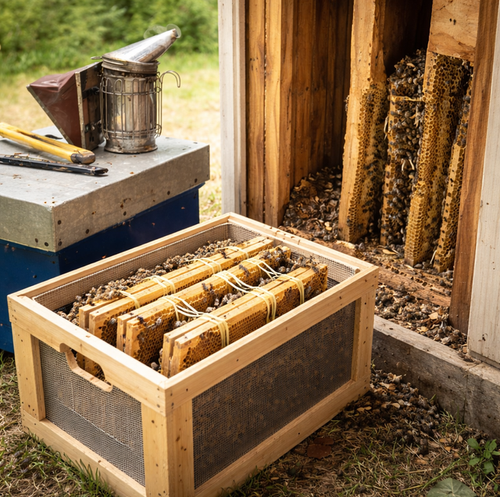
The last you see of a colony that lived in your wall is a technician carrying a box out to a vehicle. What is in that box, what stayed behind in the cavity, and what becomes of either one are the parts of a bee removal nobody narrates while it happens.
The Box a Colony Actually Leaves In
That box is a screened transport crate, or a stack of empty frames with cut sections of comb banded onto them, built to keep a live cluster calm and ventilated through a drive. It marks the end of a job most people assume concludes the moment the buzzing stops, and it concludes at a vehicle: bees, a queen if she was found, and a fraction of what was inside the wall.
That "if she was found" is the whole game. Once a colony is judged worth saving, the work narrows to one problem: getting the queen into that box. Workers stay with her scent, so a caged queen gives the cluster a reason to settle around her instead of drifting back toward the gap. If she is never located, the work changes shape.
Getting the comb out is a separate problem. Comb built onto a frame in a managed hive lifts out cleanly. Comb built inside a wall cavity is fused to studs, sheathing, and whatever insulation sits behind it, and it breaks apart the moment it is pried free. A technician salvages what holds it together, cuts it to size, and bands it into empty frames, using rubber bands the bees chew through and discard within a few days, once they have re-anchored it with fresh wax. Most of the cavity never makes that cut.
Why Timing and Distance Decide Whether the Move Sticks
Honey bees find their way home by memorizing landmarks around the entrance, which is why moving a colony a short distance across the same property tends to fail. Foragers out during the move fly straight back to the old opening out of habit, to a spot that no longer holds a hive. Beekeepers generally solve this by moving a colony far enough that the old flight pattern stops applying, or close enough- a few feet at most by the usual rule of thumb- that returning bees notice the entrance has shifted. The middle distance is what strands workers.
Time of day works on the same principle from the other direction. A colony gets boxed at dusk or after dark, once the day's foragers are back in the cluster. A box lifted at noon leaves behind every bee in the field at that moment, splitting the colony before it has gone anywhere. If your removal gets scheduled for an evening rather than a convenient midday slot, that is the reason.
The entrance on a transport box stays screened for the whole drive. A confined cluster needs air moving through it, which is why a beekeeper plans a route around shade and ventilation before focusing on speed.
What a Receiving Beekeeper Is Actually Taking On
A beekeeper who agrees to take the colony out of your wall accepts a stack of unknowns. Temperament is one: a colony pulled from a cavity might settle into a calm, ordinary hive, or it might turn defensive enough to be a problem in a residential yard, with no reliable way to tell which until it is already in a box behind someone's house. Genetics sits underneath that, since a feral colony carries whatever stock the founding swarm brought, from a parent hive nobody has seen. Health is the third unknown: the colony could be carrying varroa mites or a brood disease serious enough that a beekeeper keeps the comb well away from the apiary, or destroys it rather than gamble the rest of the yard on it.
The queen is an unknown of her own: her age, how well she was mated, and how much longer she will lay are all things a beekeeper guesses at on day one. So most receiving beekeepers keep a relocated colony apart from their established hives for a period, watching for disease and a fading queen. If she is old, or was lost during the extraction, requeening, replacing her with a new mated queen raised elsewhere, is often the only way to keep the colony viable. None of that arrives as a guarantee. It is a bet a beekeeper makes because the alternative is a colony that does not survive at all.
What Happens to the Comb and the Honey
This is the part most homeowners picture least accurately. If you have watched a removal, you probably assumed the honey rode away with the bees. Almost none of it does. Wax is absorbent by nature, which is what makes it useful to a colony and useless to a salvager: it takes up dust and oily residue from whatever it has been pressed against for months, and rendering it concentrates what it absorbed into the wax that remains rather than driving it off.
Only comb that comes out clean, holds its shape, and is small enough to transfer onto a frame is worth saving, usually a minority of what was in the cavity. The rest, with any honey still in it, gets bagged and hauled off as debris rather than kept for eating.
Do not set salvaged comb or honey out in the yard or drop it in an open bin. Exposed honey at the same address pulls foragers back in numbers and can touch off a robbing frenzy after the colony is gone.
Leaving old honey-soaked comb inside the cavity carries its own cost. Over time it draws a new swarm to the same opening, because residual wax and honey scent reads to scout bees as a cavity worth checking. That is the practical case for a full cleanout, and it is why the entry gap gets closed once the cavity is clear.
How a Relocated Colony Settles, or Doesn't
A relocated colony is not guaranteed to thrive, and a beekeeper who claims otherwise is skipping a step. Some reject the box within a day or two and abscond, the whole cluster leaving together to look for another cavity and taking whatever honey it can carry in its crops. Others stay and dwindle over the following weeks, when too much of the foraging force was lost in the move or too little brood came along to replace aging workers as they die off.
A colony that keeps its queen, holds onto a workable amount of comb and brood, and gets into a permanent hive body quickly after arrival has a real shot at building into an established hive within a season. That is why relocation is the first option worth trying whenever a colony is reachable, and the bees are behaving as ordinary honey bees: the best outcome available is a working hive in somebody's yard, and the alternative has no best outcome at all. The transfer usually happens the same night or the next morning: banded frames of salvaged comb go into a standard hive body first so the brood stays clustered, empty frames fill out the rest, and the queen cage sits between frames so the workers release her themselves. Lose any two of those three, and it becomes a much longer shot, and beekeepers who take on cutout colonies regularly describe losing a share of them.
Frequently Asked Questions
No, and dust and residue are only part of it. Comb pulled from a wall usually has brood cells, propolis, and bee waste worked into the same slab of wax that holds the honey, and a cavity colony stores honey at whatever moisture the wall allowed, so some of it has already begun to ferment by the time anyone reaches it.
For a day or two, and it is normal rather than a sign something failed. Foragers that were in the field when the box was loaded come back to an address that no longer holds a colony: a few dozen on the first morning, easing off over the following day or two. None can find a hive box they have never seen, so their fate gets decided at other people's entrances. A stranded forager arriving with a nectar load is generally let in at a strange hive rather than turned back at the door, so some get absorbed into a nearby colony, and the rest run out of time in the field. Bees at that spot a week later are common enough to mean little on their own. What points at comb left in the cavity is traffic running both ways through the gap, in and back out with purpose, rather than a few stragglers landing on a closed face and lifting off again.
Often several weeks to a full season. Many beekeepers use a newspaper combine, stacking the two colonies with a sheet of newspaper between them so the bees chew through it gradually and merge scents before the two groups of workers meet directly, which cuts down on fighting.
The colony's remaining option is to make one. If comb holding young larvae came along in the salvage, workers can raise an emergency queen from a larva under roughly three days old, feeding and capping it as a queen rather than a worker. That takes weeks, and she still has to mate successfully before she lays, so the odds run well behind a colony that kept its own.
Rendering is the usual suggestion, and it is misleading here. Melting wax in a double boiler and straining it does drop out the solid debris, so what comes out looks clean, and that appearance is the trap: solids separate, absorbed residues stay put, and no home test tells you which you are holding. Wax off a managed hive frame gets reused because the beekeeper knows its history.
Often, yes. Because most of the honey stores remain in the wall, many beekeepers feed sugar syrup for the first several weeks after a relocation, supporting the colony while new comb is drawn and before natural forage alone can carry it.
The Part You Can Actually Judge
Whether that colony is alive next spring gets settled miles away, in somebody else's yard, on evidence that never comes back to you. Nobody will send a report, and a beekeeper who offered a confident one would be guessing. What stays at your house is the half you can check yourself, and it takes longer than most people expect: watch the old entry point over the following month. Scouts looking over a cleared, closed cavity lose interest after a few visits. Scouts still landing on the same square foot of wall week after week are reading something in there, and they are usually right. A removal that looked finished on the day gets graded a season later by whether anything moves back in.
Get a free estimate on bee removal or relocation — a technician can walk the property and explain what to expect for your specific situation. Russell Pest Control serves the Phoenix Valley. Call (623) 469-7583.
