
Bees in the Attic: Why Nothing Up There Stops Them
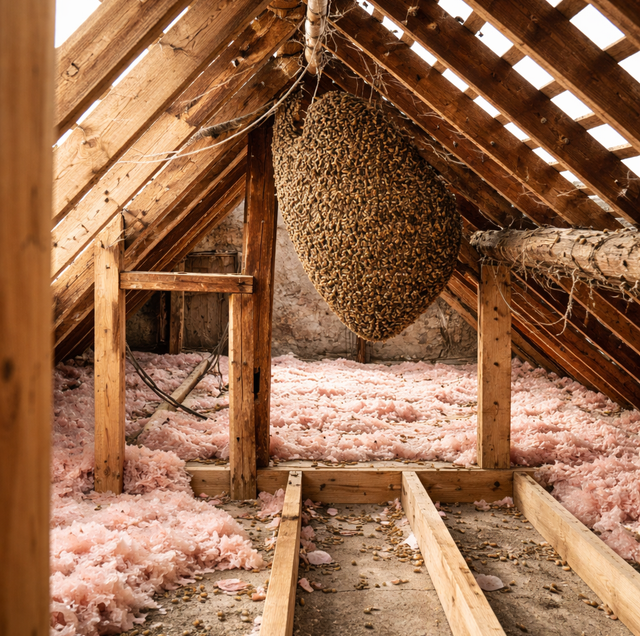
Push the access hatch up, get your head and shoulders through the opening, and the attic reads nothing like the hallway below it. There is no room shape up there, no corners doing any work, just a long open run of framing and insulation going off into the dark as far as the roof allows. Most people make that trip once every few years, for a box or a wire. A colony that moves in has the run of it the rest of the time.
The first hint downstairs is usually a smell before a sound: a faint waxy-honey note drifting out of a ceiling vent or a bathroom fan housing on a warm afternoon. Sound arrives duller and harder to place than it would through a single sheet of drywall, because a foot or more of insulation sits between the comb and the room, softening and scattering whatever hum makes it through. Neither detail says how large the colony has gotten. What they do confirm is that the space overhead has no natural edge to stop one.
Nothing Up There Divides the Space Into Compartments
An attic is a single volume. Trusses and rafters cross it, and joists run beneath it, but none of that closes it into separate rooms. Air, light, and a bee all travel from one end of it to the other without passing through anything. Comb built against one truss can extend along the underside of the roof deck, drape over the top of the blown-in insulation, and continue past the next several framing members without the colony changing how it works.
A wall behaves the opposite way. Each stud bay is a narrow, bounded column, and a colony that outgrows one has to work sideways through the openings already in the framing: the holes drilled for wiring, the gaps at the blocking, the seam where the top plate meets the sheathing. That gets it into the bay next door, then sometimes the one after that, one constrained step at a time and always through a bottleneck. Growth in a wall is not capped so much as metered. An attic provides no equivalent metering, so nothing in the structure slows the spread or marks where it should end.
The practical effect lands on what "found it" means. An attic colony first noticed at one point in the ceiling may already extend several feet in more than one direction from where the smell or sound is strongest, with no framing member anywhere along that run to interrupt it. A wall job inherits a stopping point from the way the house was built. An attic job has to establish one.
Heat Does More to the Comb Than It Does to the Bees
A wall cavity runs warm through the hottest part of the year. An attic runs hotter and holds it longer, because it sits directly under a roof deck absorbing sun most of the day while a wall gets relief from shade, siding, and conditioned air on its interior face.
Beeswax has a true melting point that beekeeping references commonly put in the mid-140s Fahrenheit, and comb never gets near that inside a house. It does not stay rigid up to that line, though. Wax begins losing stiffness well below it, and comb held soft for hours at a stretch sags, distorts, and holds its contents less reliably than comb in a cavity that sheds its heat overnight. Honey stored at those temperatures for weeks can thin, weep out of open cells, or ferment rather than staying capped and stable.
Check the ceiling under an attic entrance on the hottest afternoon, not in the morning. A stain that darkens and spreads only in peak heat points to weeping honey rather than a roof leak, which behaves the opposite way.
The colony answers sustained heat by shifting where it clusters inside the space and by spending more of its effort on keeping the interior survivable than on foraging or building. That is a different set of pressures from what a wall colony faces, and it is one reason an attic colony that has been through a full hot season looks and behaves differently from one still working its first.
The Weight Sits on a Ceiling, Not a Wall
A wall colony builds comb hanging from a horizontal top plate, down along a vertical stud face, so its weight transfers straight down through the framing, the way the wall's own structure does. An attic colony typically builds against the underside of the roof deck or drapes over the ceiling joists, which means the weight of that comb, brood, and honey bears down on the drywall ceiling below rather than being carried by a vertical member built to hold a load.
A ceiling failing under a colony rarely gives way without notice. A soft or spongy patch of drywall, a slow amber stain, or nail heads pushing through the paint are the sequence that precedes it. Stay out from under a sagging section.
That is a mechanical difference a wall colony never presents. A stud bay holds its contents against gravity the same way it holds insulation or wiring, indefinitely and without added strain. A ceiling carrying the same weight from above is doing something the drywall was never sized for, and the longer a colony sits there, the more that gap between design and load matters.
Removal Scope Changes Because of Access and Insulation
Pulling comb out of a wall means opening one bay, working in a space bounded by two studs, and patching one rectangle of drywall when the work is done. An attic job starts from a different problem: getting a person, gear, and containers into a space rarely built for a return visit, then working around or removing insulation that sits between the access point and the comb. Batt insulation can sometimes be lifted aside and reinstalled if it has not been damaged; loose blown-in material is harder to work around and often cannot go back exactly as it came out once it has been disturbed.
Because the void is not boxed into a single bay, the working scope has to widen as well. A crew checks a broader stretch of ceiling and roof deck for comb that spread past the spot where the smell or sound was loudest. Framing members, duct runs, and roof vents narrow the physical path through the space, which is a constraint a wall cavity does not add. None of that makes the work impossible. It makes the scope a different shape from a single-bay wall job, decided by the space rather than by the size of the colony alone.
Frequently Asked Questions
Weight tracks stored honey far more than bee count, and honey runs roughly twelve pounds to the gallon. A colony through one season may hold a few pounds of comb and little stored weight above that. One that has stored through several seasons can carry many times as much in a similar footprint, because it keeps filling cells rather than adding area. The load question scales with how long the colony has been there, not with how many bees are visible at the entrance.
It is uncommon for the first colony to be alive: a resident colony defends its entrance, and scouts testing an occupied cavity are driven off. Once a colony dies out or is removed, the reverse applies. Old comb left in place makes the space more attractive to the next swarm rather than less, which is why an emptied attic that still holds wax is a likelier repeat than one that never held bees at all.
Because the working window closes quickly. An attic under a sun-loaded roof deck climbs through the morning and holds that heat well past sundown, so the practical stretch for anyone in a sealed suit and respiratory protection is early. Heat changes the material, too: a comb that is cool and firm at seven in the morning is soft and prone to tearing by mid-afternoon, harder to lift out in one piece, and messier when it fails. The same arithmetic applies to a homeowner's look through the hatch, since heat exhaustion up there is a hazard separate from the bees.
Yes, and it also changes what the colony did before anyone arrived. Loose blown-in fiberglass compresses under a colony's weight, so bees work down into it and build comb against the joists underneath, out of sight from the hatch. Batts laid between joists leave the ridge and the rafter bays open, which is where comb usually ends up instead. Either way, insulation depth over the access hatch is a poor guide to where the comb actually sits, and removing loose fill means lifting saturated material along with the comb rather than cutting a clean opening.
Roughly, and from the comb rather than the bees. New wax is pale, near-white to light yellow, and it darkens with use: comb that has raised repeated rounds of brood turns tan, then brown, then nearly black, because each cycle leaves cocoon material behind in the cells. A uniformly pale comb indicates a young colony. Dark comb at the center with pale comb at the edges means one that has been building outward for a while, and that gradient tells a crew which direction to keep opening.
Typically just the section directly beneath the comb rather than the full ceiling. Crews work from the attic side wherever framing and insulation allow, and a drywall cut is usually reserved for whatever has to be reached from below, then patched afterward.
What the Space Decides
None of this makes an attic colony automatically more urgent than one in a wall. A resting swarm overhead is still a resting swarm, whichever surface it hangs from. What changes is what "established" means once a colony is working an attic in earnest: the size of the void it occupies, not only its location, sets the scope of dealing with it. A wall cavity limits growth by accident of construction. An attic supplies no such accident, and that missing boundary is worth weighing before deciding how close a look the space needs.
Have an attic colony assessed by a licensed crew — full protective gear and an inspection-first approach replace guesswork about what's overhead. Russell Pest Control serves the Phoenix Valley. Call (623) 469-7583 or request a free estimate.
