
Pest Control in Tempe, AZ: Old Bones, Town Lake Water, and Rental-Turn Realities
Maple Ash bungalow, Warner Ranch family home, or a twelve-unit building off Apache, one call gets Steve, Steven Jr., or the office. Never a call center.
The Valley's Most Built City, Aging in Place.
Tempe is the Valley's most built-up city: forty square miles, landlocked on every side by Mesa, Scottsdale, Phoenix, Chandler, and the Salt River Pima-Maricopa Community, with nowhere to grow but inward. That maturity is its pest story: early-1900s bungalows in Maple Ash (the city's oldest neighborhood), historic districts like University Park and Mitchell Park, mid-century blocks across Holdeman and Escalante, The Lakes' 1970s waterfront streets, and the dense rental country around ASU (one of the largest public universities in the country by enrollment) where unit turnover moves pests the way moving trucks move furniture.
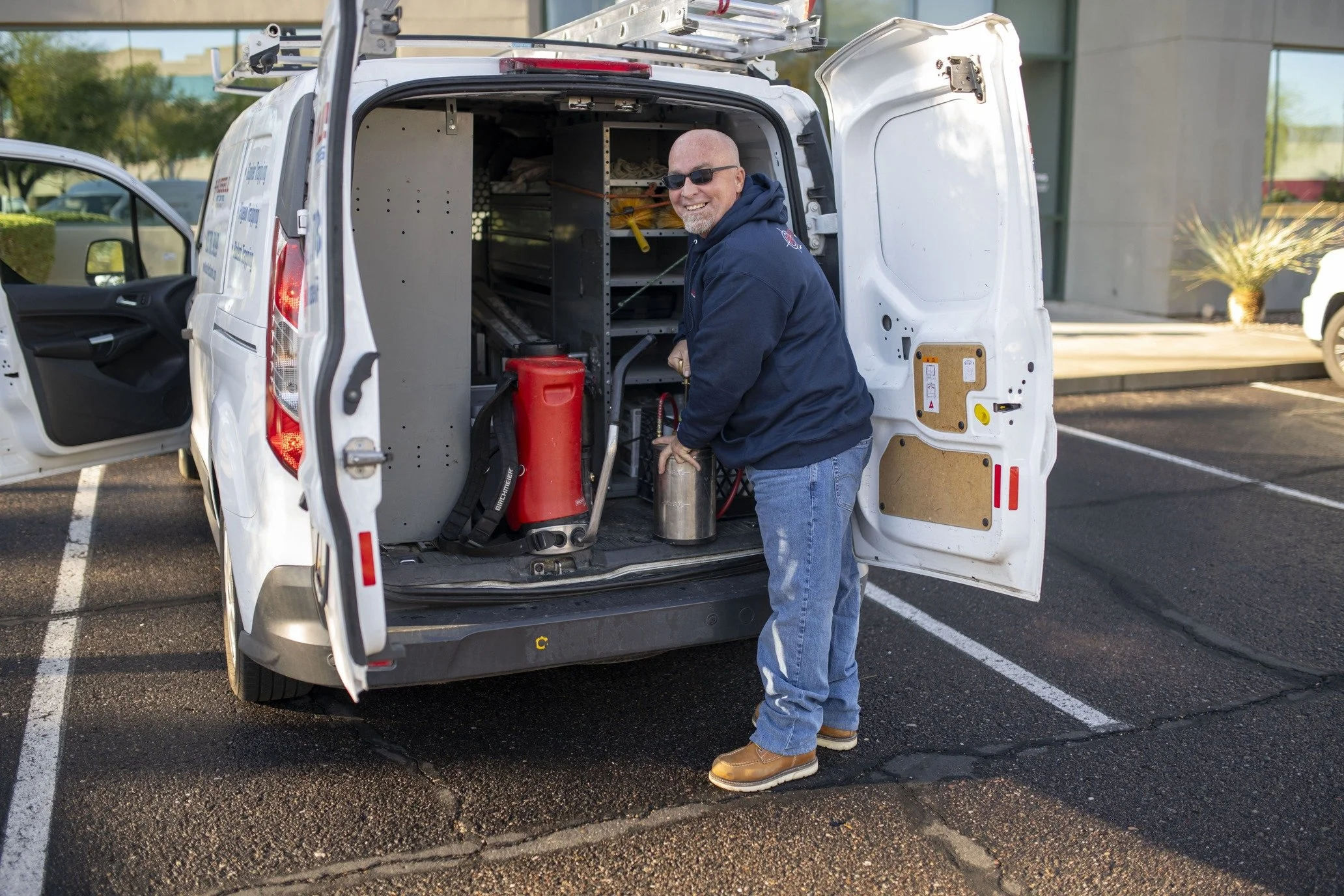
Russell Pest Control has worked Tempe since 1996, and we treat its three realities for what they are: old construction that leaks desert through century-seasoned gaps; an urban water spine (Town Lake on the dammed Salt River, The Lakes' man-made shorelines, Kiwanis Park's 12-acre lake) that keeps mosquito and moisture-pest pressure structural; and a rental economy where German roaches commute between units and a property manager's response speed is the whole game. Same technician every visit, honest answers, and a real person on the phone.
Historic Districts, ASU Rental Country, The Lakes' Waterfronts
Old-Bones Specialists
Maple Ash to University Park: historic Tempe gets craftsman sealing, not a caulk pass.
Rental-Turn Fluent
Unit turns, shared walls, German roach pressure. We run the building-level playbook landlords need.
Water-Spine Smart
Town Lake, The Lakes, Kiwanis: Tempe's urban water means structural mosquito pressure, treated at the source.
Property-Manager Responsive
Same-day tenant work orders: the commercial signature that keeps managers loyal.
Infill-City Knowledge
A landlocked city renovates instead of expanding, and every remodel seam is an entry we know to check.
A Real Person Answers
Owner or office, every call. After hours, the line reaches Steve's cell.
Three Things About Tempe Every Homeowner (and Landlord) Should Know
A Landlocked City Ages in Place
Tempe can't sprawl (every border is spoken for), so the city renovates, infills, and ages in place, which makes it the East Valley's deepest inventory of older construction: early-1900s bungalows, the 1924 Park Tract, mid-century blocks, and seventies planned communities, each with its era's entry points seasoned by decades of settling. Sealing in Tempe is era-reading work, and it pays back more visibly here than almost anywhere we serve.
The University Economy Moves Pests With the Leases
Hundreds of buildings around ASU turn their units every semester and every summer, and German roaches, the great hitchhikers, ride the furniture, boxes, and shared plumbing walls from unit to unit. Rental-country pest control is building-level work: treat the structure, not just the complaining unit; time the work to the turn calendar; and respond same-day, because a tenant complaint aging on a manager's desk is how one unit's problem becomes a building's. Nobody in this market runs that playbook better than a company built on the same-day tenant work orders.
Tempe Put Water Back in the Desert, on Purpose
Town Lake dammed the Salt River and made it the city's centerpiece (beach park, Ironman Arizona, festival calendar) while The Lakes built one of Arizona's first man-made lake communities in the seventies, and Kiwanis Park added a 12-acre lake to south Tempe. Deliberate urban water is wonderful city-building and permanent mosquito-and-moisture infrastructure: pressure near the water spine is structural, not seasonal bad luck, and the honest answer is water-aware treatment rather than wishful fogging.
What Tempe Calls Us About, and Where
Tempe's calls follow its three economies: rental-turn roaches around campus, old-bones entries in the historic core, and water-spine mosquitoes from Town Lake south. The list below is the territory.
The Tempe Pest Lineup
- German roaches: the rental economy's signature pest; building-level control
- Roof rats: mature canopy in the historic districts and older blocks
- Mosquitoes: the Town Lake/The Lakes/Kiwanis water spine
- Scorpions: moderate citywide, higher near the Papago buttes and desert remnants
- Black widows: block walls, alley storage, pool equipment
- Ants and crickets: irrigated older landscaping
- Bees and wasps: spring swarms; wall colonies in older structures
- Pigeons: Mill Avenue commercial, apartment rooflines
- Flies: restaurant rows and shared-dumpster corridors
- Termites: identified honestly and referred to a licensed termite specialist (we don't treat termites)
Tempe Neighborhoods and Areas We Serve
- Maple Ash (the city's oldest neighborhood), plus University Park and Mitchell Park's historic blocks
- Clark Park, Holdeman, Escalante, Hudson Manor, and Optimist Park Southeast
- Broadmor, Hughes Acres, Daley Park, and Tempe Royal Palms
- The Lakes, the seventies waterfront community
- Warner Ranch and south Tempe's Kiwanis Park area
- Downtown, Mill Avenue, and the ASU rental country
- Plus, the apartment corridors and commercial rows citywide
Property Types We Know Cold
- Early-1900s bungalows and historic-district homes
- Mid-century block construction across central Tempe
- 1970s lake-community homes (The Lakes)
- South Tempe family neighborhoods (Warner Ranch era)
- Student rentals, multi-unit buildings, and apartment communities
- Commercial: Mill Avenue restaurants and bars, offices, multi-tenant
Our Services in Tempe
Every Russell service runs in Tempe. Here's the map, tuned to what Tempe actually needs.
General Pest Control Plans
Monthly, bi-monthly, or quarterly. Older irrigated lots and water-adjacent homes usually run heavier cadences. No contracts, 15-day re-treat warranty.
View ServiceCockroach Control
Tempe's defining indoor work: German roach gel-bait programs at building level for rentals, and post-monsoon sewer-roach defense for everyone. Restaurant-grade discipline, brought to apartment country.
View ServiceRodent Control & Exclusion
Roof rats in the historic canopy: trap-first removal so nothing dies in your walls, mature-tree canopy flagging, and roofline screening that makes it permanent.
View ServiceMosquito Control (In2Care)
Built for the water spine: stations that recruit mosquitoes to poison their own breeding sites, compounding all season near permanent water.
View ServiceHome Seal
Tempe is the sealing capital of the East Valley: century bungalows to seventies waterfronts, era-appropriate craft, $600-$2,500 typical, 1-2 year warranty.
View ServiceScorpion Control & Black Light Search
Moderate citywide pressure, higher near the buttes: programs and $125/hour UV mapping where the terrain calls for it.
View ServiceBee & Wasp
Older structures mean wall-void colonies: relocation when a beekeeper can take them, safety-first removal when they can't.
View ServiceFly Control
Restaurant rows and shared dumpsters are fly economics: source-based control, drain treatment, restaurant-grade programs.
View ServiceCommercial Pest Control
Mill Avenue food service, apartment communities, offices: food-safe programs, documentation, and same-day tenant work orders.
View ServiceWhat Tempe Service Costs
The Standing Russell Promises, Priced for Tempe
- Plans priced per property: home size, era, water proximity, and pressure level set the number
- Multi-unit and building-level programs scoped per property for landlords and managers
- No initial fees, no contracts, 15-day re-treat warranty: the standing Russell promises
- Published anchors: Black Light Scorpion Search $125/hour, Home Seal typically $600-$2,500
- Commercial and property-management accounts on simple 30-day terms with same-day tenant work orders
Get a Tempe Quote in One Call
A real person scopes it on the phone: homeowner, landlord, or manager, the price and expectations are set before the first visit.
No initial fees. No contracts. Same-day service is often available.
Call or Text (623) 780-9099Three Tempe Stories That Repeat Every Year
The Semester-Turn Roach Cycle
Every August and January, the rental country churns, and German roaches ride the turnover into buildings that were clean in July. The losing move is treating the one unit that complained; the winning one is the building-level program: gel-bait precision through the shared walls and plumbing chases, unit turns timed into the service calendar, and same-day response when a tenant reports. Managers who run the playbook stop having building-wide problems; managers who don't, call us in October.
The Bungalow That Finally Sealed
A Maple Ash or University Park bungalow that's leaked desert for a century (original thresholds, settled foundations, remodel seams from four different decades) gets the craftsman treatment: era-appropriate sealing that respects the historic fabric while closing the routes. The before-and-after on hundred-year-old housing is the most dramatic we see anywhere in the Valley, and Tempe has the East Valley's deepest supply of it.
The Waterfront Dusk Problem, Tempe Edition
The Lakes' shoreline patios and the homes around Kiwanis Park's lake meet the same physics as every Valley lake community: permanent water means permanent mosquito pressure, and fogging fades in days. In2Care stations work with the geography instead of against it, and the seventies waterfront streets that installed them get their evenings back. The water stays beautiful; the bites stop.
Russell in Tempe vs. the National Chains
| What Tempe Needs | Russell Pest Control | National Chains |
|---|---|---|
| Rental buildings | Building-level programs + same-day tenant response | Unit-by-unit ticketing |
| Historic homes | Craftsman sealing, era-read first | Same caulk pass as a tract home |
| Water-spine mosquitoes | In2Care built for permanent water | Fogging that fades by Friday |
| German roaches | Gel-bait precision, restaurant-grade | Surface spray that scatters them |
| Mill Ave food service | Food-safe, documented, discreet | Route-schedule service |
| Who answers | Owner or office; after hours, Steve's cell | National call center |
| Contracts | None residential; 30-day commercial | 12-month lock-ins |
| First-visit fee | Never had one | $150-$400 "initial service" |
| Manager relationships | The referral engine we're built on | A vendor number |
| Tenure | East Valley customers measured in decades | Whatever the contract forces |
The Conditions That Drive Tempe's Pest Pressure
Town Lake and the Water Spine
Tempe dammed the Salt River and built its identity around the result (Town Lake's beach park hosts dozens of events a year, Ironman Arizona and Oktoberfest among them), and the lake anchors a water spine running through The Lakes' man-made shorelines to Kiwanis Park's 12-acre lake in the south. Permanent urban water in a desert is permanent mosquito and moisture-pest infrastructure; homes near the spine carry structural pressure, and water-aware treatment is simply the local standard of care.
The Oldest Bones in the East Valley's Core
Maple Ash's early-1900s bungalows, the 1924 Park Tract, University Park's historic district, and two hundred-plus historic buildings citywide make central Tempe the East Valley's heritage housing capital, and heritage housing is permeable housing: original thresholds, settled gaps, seasoned wood, and remodel seams stacked across a century. Craftsman sealing pays back dramatically here, and the mature canopy overhead runs the roof rat routes all historic districts share.
Rental Density and the Turnover Engine
The blocks around ASU hold the Valley's densest rental economy, and turnover is the pest engine: every semester's moving trucks redistribute German roaches through shared walls and plumbing chases, while vacant units between leases give populations quiet time to establish. Building-level programs, turn-calendar timing, and same-day tenant response are what keep multi-unit Tempe clean. Unit-by-unit reaction never catches up.
The Buttes and the Desert Remnants
Hayden Butte ("A-Mountain") rises beside the stadium, the Papago Park buttes hold the city's northwest corner, and Twin Buttes and Bell Butte mark the western edge: pockets of original desert embedded in a built-out city. The blocks around them run higher scorpion and rodent pressure than central Tempe's average, the way every desert remnant radiates into its surroundings. Butte-adjacent homes get the edge treatment, scaled to urban reality: harborage work at the rock line beats wondering why the block behind "A-Mountain" sees more glowing tails than the rest of the zip code.
The Lakes' Seventies Waterfront
One of Arizona's first man-made lake communities put hundreds of homes on private shorelines in the 1970s, and a half-century later, the combination of aging seventies construction and permanent waterfront makes The Lakes its own pest profile: slider-era hardware due for sealing, moist shoreline soil for ants, and the mosquito math of living on water. We treat it as the hybrid it is: era sealing plus water-aware placement.
Mill Avenue's Commercial Intensity
Mill Avenue packs bars, restaurants, and nightlife into a few walkable blocks between campus and the lake, one of the Valley's densest food-service corridors, with the shared dumpsters, drains, and late hours that make fly and roach pressure a district-wide reality. Food-safe German roach programs, drain-based fly control, and discreet before-open service are the standard here, and a single bad review costs more than a year of doing it right.
An Infill City's Remodel Seams
With no open land left, Tempe grows by renovation (additions, ADUs, flips, and infill builds stitched onto older structures), and every remodel leaves seams where new construction meets old: the classic entry points of a city that rebuilds itself in place. Our inspections read the remodel history alongside the original era, because in Tempe, the gap is as likely to be 2015-meets-1955 as it is original hardware.
The Russell Method, Applied to Tempe
Era-Reading as the First Step
A 1910s bungalow, a 1955 block ranch, a 1975 Lakes waterfront, and a 2020 infill build fail in four different places, and Tempe has all four on the same street sometimes. The inspection reads the era (and the remodel seams) before anything gets treated; the sealing follows the diagnosis.
Building-Level Thinking for Multi-Unit
Rental Tempe gets treated as structures, not units: gel-bait programs through the shared infrastructure, turn-calendar coordination with managers, documentation for the file, and same-day tenant work orders that keep complaints from aging into vacancies. It's the property-management playbook our commercial side is known for, applied to the Valley's densest rental market.
Water-Aware Along the Spine
Town Lake to Kiwanis, treatment follows the water map: In2Care, where water is permanent, granules, where shoreline moisture cycles, placement that defends homes without touching the amenity. Urban water is Tempe's signature; water-aware control is ours.
Craftsman Sealing in the Historic Districts
Maple Ash, University Park, and Mitchell Park get restoration-grade sealing: original fabric respected, thresholds rebuilt rather than smeared, weep paths preserved, and the century's accumulated routes closed properly. Old bones deserve craftsmen, and Tempe's are the best old bones in the East Valley.
Butte-Adjacent Edge Treatment
Homes around Hayden Butte, Papago's corners, and the western buttes get desert-remnant treatment scaled to the city: harborage work at the rock line, cricket control, and sealing to the scorpion standard. Urban edges are smaller than preserve edges. The method is the same, sized honestly.
Family-First and Tenant-Fair Application
Low-drift targeted placement, clear dry times (15 minutes outside, 30-35 inside), kid-height window sweeps in family yards, and in rentals, scheduling and communication that respect tenants' homes as homes. Pest control that treats everyone in the building like a customer is rarer than it should be.
Straight Lanes, Straight Answers
Termite evidence gets identified honestly and referred to a licensed termite specialist. We don't hold that license and won't pretend to. And the scary spider is almost never a brown recluse (not established in Arizona); you'll hear the truth for free, landlord or homeowner alike.
Tempe Pest Questions, Answered Straight
I Manage Rentals Near ASU. How Do I Stop the Roach Cycle?
Go building-level: gel-bait programs through the shared walls and plumbing, unit turns folded into the service calendar, and same-day response on tenant reports so one unit's problem never becomes the building's. Unit-by-unit reaction is why the cycle exists; the structural program is why it ends. Same-day tenant work orders are literally our commercial signature.
Why Does My Older Tempe House Get More Pests Than My Friend's Newer One?
Age is access: original thresholds, settled gaps, and remodel seams accumulate routes that newer construction hasn't earned yet. The fix is era-appropriate sealing, and on Tempe's older stock, the before-and-after is dramatic. Your house isn't worse; it's just had a century to open doors.
Is Town Lake Why We Have So Many Mosquitoes?
Living near permanent urban water raises mosquito pressure. That's desert physics, not a knock on a great lake. The answer is water-aware control: In2Care stations that recruit the mosquitoes themselves to poison their breeding sites, built exactly for homes near water nobody's going to drain.
Do You Service The Lakes?
Yes, and it's a profile we know well: seventies-era hardware due for sealing plus permanent waterfront mosquito math. The combination treatment (era sealing + In2Care + shoreline-aware placement) is the play, and the waterfront patios that run it get their evenings back.
Are Scorpions a Big Problem in Tempe?
Moderate by Valley standards. Central Tempe's built-out blocks see less pressure than desert-edge cities, but the buttes (Hayden, Papago's corners, the western pair) radiate higher pressure into their surrounding streets. Butte-adjacent homes benefit from the edge program; most of the city does fine with solid general service and sealing.
What's Eating the Oranges on Our Old Neighborhood's Trees?
Roof rats. Hollowed fruit still hanging is their signature, and the historic districts' mature canopy is their habitat. Trap-first removal, canopy clearance, and roofline screening end the commute; the trees stay.
Do You Work With Apartment Communities and HOAs?
All the time. Building-level programs, common-area service, documentation for the file, and the same-day tenant work-order response are what property managers build their reputations on. A third of our company is commercial, and multi-unit is core to it.
Can You Handle Mill Avenue-Area Restaurants and Bars?
Yes, food-safe German roach and fly programs, drain treatment, monitoring, documentation for inspections, and before-open scheduling that customers never see. Dense food-service corridors are exactly what our restaurant-grade discipline is for.
Can You Do Same-Day Service in Tempe?
Usually, yes. Tempe routes with our Mesa and Chandler coverage daily, and urgent calls (roaches in a rental, bees at a door, anything indoors) get priority. After-hours calls reach Steve's cell for honest triage.
Do You Treat Termites in Tempe?
No, and we're straight about it. We'll identify termite signs honestly and refer you to a licensed termite specialist, then handle everything else on the property. Straight lanes, straight answers.
What Our Customers Say
Real reviews from homeowners and businesses across the Phoenix Valley.
Tempe's Family Pest Company Since 1996
From Maple Ash's century-old porches to The Lakes' shorelines, from Mill Avenue's kitchens to the rental blocks around campus: thirty years of reading Tempe properties and keeping them quiet, with a second generation now on the routes. No contracts, no initial fees, building-level thinking for landlords, and a real person on the phone.
Expect the best from Russell Pest, and have a bug-free day.
Hours
- Monday-Friday: 8:00 AM to 5:00 PM
- Same-day & emergency service available, after hours and weekends, owner-answered
Nearby Areas We Also Serve
Mesa, Chandler, Scottsdale, Ahwatukee, and the rest of the Valley from our Phoenix headquarters.