
Pest Control in Mesa, AZ: Thirty Years in the East Valley's Biggest City
Whatever corner of Mesa you're in (and whatever's crawling, scratching, or glowing under a black light) one call gets you a real person. Steve, Steven Jr., or the office. Never a call center.
Several Cities, Wearing One Name.
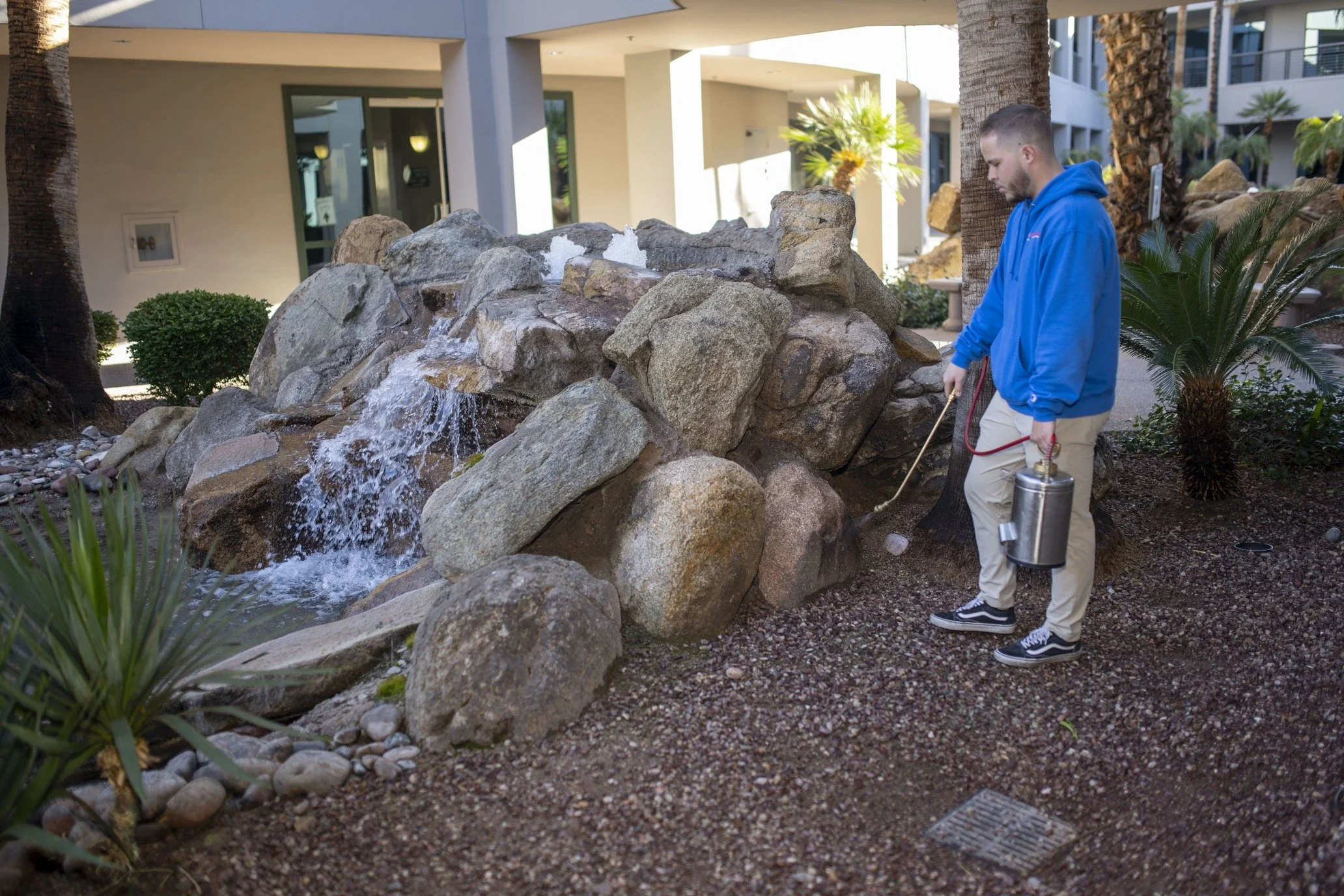
Mesa is Arizona's third-largest city, and from a pest control standpoint, it's really several cities wearing one name: a historic core with flood-irrigated lots and mature citrus, post-war neighborhoods with block walls and decades of settled gaps, lake-community suburbs like Dobson Ranch, hillside desert-edge communities like Las Sendas and Mountain Bridge backing Usery Mountain and the Tonto National Forest, and the brand-new master-planned spread of Eastmark rising on the old GM proving grounds. Each of those Mesas grows a different pest problem, and Russell Pest Control has worked on all of them since 1996.
What that means in practice: we know that a roof rat call near the Citrus Sub-Area's big irrigated lots is a different job than a scorpion call backing the Usery preserve, that flood-irrigated central Mesa feeds ants and crickets in ways a xeriscaped Eastmark yard never will, and that the 55+ communities along the Power Road corridor want a technician who shows up on time, knows the gate procedure, and remembers the resident's name. Same tech, same route, every visit: it's how we've kept East Valley customers for decades.
From the Usery Desert Edge to the Flood-Irrigated Citrus Lots
All of Mesa's Mesas
Historic Lehi to brand-new Eastmark: we've treated every era of Mesa housing since 1996.
Desert-Edge Ready
Las Sendas, Mountain Bridge, Red Mountain Ranch: preserve-edge scorpion country gets program-level control.
Citrus & Flood-Irrigation Smart
Mesa's irrigated lots and mature citrus drive roof rats and moisture pests: we treat the cause, not just the visitor.
55+ Community Trusted
East Mesa's active-adult communities get the on-time, same-tech, know-your-name service they expect.
Tight East Valley Routes
Mesa, Gilbert, and Chandler route together: it's how same-day service actually happens.
A Real Person Answers
Owner or office, every call. After hours, the line reaches Steve's cell.
Three Things About Mesa Every Homeowner Should Know
Mesa Was Built on Water, and the Pests Know It
Mesa's story starts with canals: the Hohokam built the prehistoric New World's largest canal network here two thousand years ago (Park of the Canals preserves a piece of it), and modern Mesa still runs on that inheritance, including the flood irrigation that older central neighborhoods enjoy to this day, with the city itself serving a flood-irrigation zone between Mesa Drive and Country Club. In a desert, every flood-irrigated lot is an oasis, and oases feed ants, crickets, roaches, and the moisture-loving pests that drier suburbs rarely see. If your Mesa neighborhood floods its lots, your pest pressure changes, and your treatment should, too.
The East Edge Is a Desert Interface, and It Acts Like It
Northeast Mesa runs straight into Usery Mountain Regional Park and the Tonto National Forest, which means communities like Las Sendas, Mountain Bridge, and Red Mountain Ranch live on the desert's doorstep, with the scorpion, packrat, and snake pressure that comes with hillside lots backing open desert. These are the Mesa addresses where black-light searches earn their fee fastest and where view-fence screening stops being a luxury. The desert was there first; the program is how you negotiate with it.
Every Growth Ring Grows Something Different
Mesa's housing spans nearly 150 years: Lehi settled in 1877, the downtown townsite was platted in 1878, Dobson Ranch opened as Mesa's first master-planned community in 1973, and Eastmark rose on the former GM Desert Proving Ground in the 2010s. Each era has its signature: historic-district and post-war homes carry decades of settled gaps and original thresholds; 1970s lake-community suburbs have mature landscaping and aging weather stripping; brand-new Eastmark builds are tight but sit on freshly disturbed desert that's still redistributing its scorpions and rodents. We read the era before we treat the house, because the era usually wrote the problem.
What Mesa Calls Us About, and Where
The Mesa Pest Lineup
- Scorpions: heaviest on the NE desert edge and anywhere block walls meet mature landscaping
- Roof rats: Mesa's citrus heritage means citrus-line rodent pressure; hollowed fruit on the tree is the classic tell
- Ants and crickets: flood-irrigated lots and lake communities feed them year-round
- Roaches: German roaches indoors; sewer and desert roaches surging after monsoon storms
- Black widows: block-wall weep holes, pool equipment, garage corners
- Bees and wasps: spring swarms and tile-roof nests across the city
- Mosquitoes: flood-irrigated yards and lake-adjacent lots are the East Valley's wettest habitat
- Pigeons: commercial rooftops and 55+ community tile roofs
- Termites: we'll identify the signs honestly and refer you to a licensed termite specialist (we don't treat termites)
Mesa Neighborhoods and Communities We Serve
- Northeast Mesa: Las Sendas, Mountain Bridge, Red Mountain Ranch, Alta Mesa
- Southeast Mesa: Eastmark (including Encore at Eastmark), Augusta Ranch
- East Mesa: Superstition Springs area, Leisure World, Sunland Village
- Southwest Mesa: Dobson Ranch and the Fiesta-district neighborhoods
- Central & North Mesa: downtown's historic districts, the Citrus Sub-Area's big irrigated lots, and Lehi: Mesa's oldest settlement
- Plus, the Falcon Field corridor's commercial and industrial parks
Property Types We Know Cold
- Historic-district and pre-war homes (eight locally designated districts: sealing is structural work here)
- Post-war block-construction neighborhoods
- 1970s-80s master-planned suburbs (Dobson Ranch era)
- Hillside desert-edge custom homes
- New-build master-planned (Eastmark era): tight envelopes, fresh-desert pressure
- 55+ and active-adult communities: gate-friendly, on-time, same-tech service
- Commercial: Superstition Springs retail, Falcon Field industrial, multi-tenant across the city
Our Services in Mesa
Every Russell service runs in Mesa: here's the short list, tuned to what Mesa actually needs. Each links to its full page.
General Pest Control Plans
Monthly, bi-monthly, or quarterly: flood-irrigated lots and lake communities usually run heavier cadences than xeriscaped new builds. No contracts, 15-day re-treat warranty.
View ServiceScorpion Control, Black Light Search & Sealing
The NE desert edge is program country: treatment, cricket control, an after-dark UV search to map the population, and sealing to the 1/16-inch standard.
View ServiceRodent Control & Exclusion
Roof rats run Mesa's citrus lines and tile rooflines. Trap-first indoors, citrus harvest-hygiene coaching, and roofline screening that ends the repeat business.
View ServiceHome Seal
Mesa's older housing stock is sealing's best customer: historic-district thresholds, post-war block gaps, and 70s-era sliders all leak desert. $600-$2,500 typical, 1-2 year warranty.
View ServiceBee & Wasp
Spring swarms, wall colonies, and tile-eave wasp nests: relocation when a beekeeper can take them, safety-first removal when they can't.
View ServiceMosquito Control (In2Care)
Flood-irrigated yards are the East Valley's mosquito nurseries: the In2Care station system beats fogging exactly here.
View ServiceView Fence & Snake Screening
For the Usery-edge and hillside communities where the yard meets the open desert.
View ServiceWeed Control
Pre-emergent timed to both desert weed seasons: gravel yards and HOA streets stay clean year-round.
View ServiceCommercial Pest Control
Superstition Springs retail, Falcon Field industrial, multi-tenant, and restaurants across Mesa: same-day tenant work orders, our commercial signature.
View ServiceWhat Mesa Service Costs
The Standing Russell Promises, Priced for Mesa
- Plans priced per property: home size, yard, irrigation, and pressure level (a flood-irrigated half-acre and an Eastmark patio lot are different jobs)
- No initial fees, no contracts, 15-day re-treat warranty, the standing Russell promises
- Published anchors: Black Light Scorpion Search $125/hour - Home Seal typically $600-$2,500
- Tight East Valley routing means Mesa gets genuine same-day availability
- Commercial scoped per facility on simple 30-day terms
Get a Mesa Quote in One Call
A real person scopes it on the phone: price and expectations set before the first visit, honored every time.
No initial fees. No contracts. Same-day service is often available.
Call or Text (623) 780-9099Three Mesa Stories That Repeat Every Year
The Citrus-Line Roof Rats
Mesa's citrus heritage survives in its officially designated Citrus Sub-Area and on mature lots across the older city, and where the citrus is, the roof rats are. The call usually starts with hollowed oranges still hanging on the tree or scratching over a bedroom ceiling; the fix is trap-first removal, harvest-hygiene coaching (pick ripe fruit, clear the drops, trim canopies off the roofline), and screening the roof entries. On citrus lots, rodent control and orchard care are the same conversation, and we've been having it with Mesa homeowners for decades.
The Eastmark First-Year Surprise
A brand-new Eastmark home shouldn't have scorpions, and then the first summer arrives. New construction on the former proving-ground desert displaces the existing population, new landscaping imports hitchhikers from the nursery, and tight building envelopes still leave the garage and slab-joint routes open. First-year Eastmark calls are some of our most predictable work: a perimeter program, a garage-airlock seal, and honest reassurance that this is the desert redistributing, not a defect in the house. Catch it in the first season, and it never becomes a tradition.
The 55+ Community Standard
East Mesa's active-adult communities (Leisure World's 2,664 homes, Sunland Village, Encore at Eastmark) run on schedules, gates, and trust, and they're some of our favorite routes: the same technician, on time, who knows the gate procedure and the resident's name. The pest work itself leans on tile-roof pigeon pressure, packrats in mature landscaping, and block-wall black widows, but the service standard is the real product. Communities have made us a preferred vendor for exactly that reason.
Russell in Mesa vs. the National Chains
| What Mesa Needs | Russell Pest Control | National Chains |
|---|---|---|
| Flood-irrigation knowledge | Treatment tuned to irrigated-lot moisture | Same spray plan as a Tucson tract home |
| Citrus roof-rat experience | Decades of citrus-line trapping + coaching | A bait box and an invoice |
| Desert-edge programs | Usery-edge scorpion programs with UV searches | Generic perimeter spray |
| Housing-era reading | 1877 Lehi to 2020s Eastmark: era drives treatment | One checklist for everything |
| 55+ community fit | Same tech, on time, gate-procedure fluent | Rotating strangers |
| Who answers | Owner or office, after hours, Steve's cell | National call center |
| Contracts | None residential; 30-day commercial | 12-month lock-ins |
| First-visit fee | Never had one | $150-$400 "initial service" |
| Routes | Tight East Valley clustering = real same-day | Whenever the region's truck swings by |
| Tenure | East Valley customers measured in decades | Whatever the contract forces |
The Conditions That Drive Mesa's Pest Pressure: Block by Block
Flood Irrigation: the Desert's Loophole
Older central and north Mesa neighborhoods still flood their lots on SRP and city irrigation (the city itself serves a flood zone between Mesa Drive and Country Club), and every irrigation day turns those lots into temporary wetlands. The payoff is glorious shade trees and real lawns; the cost is ant colonies, cricket populations, roach pressure, and mosquito habitat that xeriscaped Mesa never deals with. On flood-irrigated lots, we treat around the water schedule, target the post-flood surge, and put granules where the moisture cycle works for us instead of against us.
The Citrus Sub-Area and the Rodent Line
Mesa preserves its citrus-farming roots in an official Citrus Sub-Area of large irrigated residential lots: beautiful, productive, and the East Valley's most reliable roof rat habitat. Mature citrus offers food, water, and an elevated highway in one tree, and the rodent pressure radiates outward into every adjacent neighborhood. If you live near big citrus lots, your rodent prevention should assume traffic; if you own one, harvest hygiene is half your pest control.
Usery Mountain and the Tonto Edge
Northeast Mesa ends at Usery Mountain Regional Park, whose trails run into the Tonto National Forest: a permanent, protected desert reservoir of scorpions, packrats, rabbits, and snakes pressed directly against Las Sendas, Mountain Bridge, and Red Mountain Ranch. Preserve-edge pressure never goes to zero; it gets managed. These communities are where our scorpion programs, black-light searches, and view-fence screening are concentrated, and where "we can't remember the last one" is a realistic win.
Eight Historic Districts and the Old Bones Problem
Mesa's eight locally designated historic districts (Evergreen, Fraser Fields, Glenwood/Wilbur, Robson, Temple, West Second Street, West Side-Clark, and Flying Acres) plus Heritage Neighborhoods like Lehi, hold some of the Valley's most charming and most permeable housing. Original thresholds, settled foundations, decades of remodels: old bones leak desert. Sealing here is careful, structural work, and it pays off more dramatically than anywhere else in the city.
Monsoon Season on Canal-Veined Ground
Mesa's monsoon surge runs through its canal and irrigation infrastructure: storm water moves through the same channels and low spots the Hohokam engineered around, flushing roaches and crickets toward structures and leaving the standing water that breeds the late-summer mosquito wave. The post-storm weeks are Mesa's busiest pest weeks, every year, on schedule. A property already on service rides it out as a spectator.
Eastmark and the Southeast Growth Front
Southeast Mesa is the city's construction frontier (Eastmark's 3,200 acres rising on the former GM Desert Proving Ground, with Phoenix-Mesa Gateway Airport anchoring the corridor), and construction is pest displacement at an industrial scale. Grading evicts established desert populations into adjacent finished neighborhoods, and each new landscaping installation imports its own. If you live within a mile of an active building in southeast Mesa, assume elevated first-year pressure and get ahead of it.
Falcon Field and the Commercial Corridors
From the Falcon Field industrial corridor (where Boeing builds the Apache) to the Superstition Springs retail district along US 60, Mesa's commercial zones run the full pest gauntlet: rodents at roll-up doors, pigeons on big rooftops, fly pressure in shared waste corridors. Our commercial programs (same-day tenant work orders included) cover Mesa's business landscape from industrial park to strip center.
The Russell Method, Applied to Mesa
Reading the Era Before Treating the House
A Lehi-era farmhouse, a Dobson Ranch 1970s lake home, and an Eastmark new build fail in completely different places: original wood thresholds, aging slider tracks, and unsealed garage slab joints, respectively. Our first walk reads the construction era and its signature gaps, because in Mesa, the year a home was built predicts its pest entries better than almost anything else. The era is the diagnosis; the treatment follows it.
Working the Water Map
Flood-irrigated lot or xeriscape? Lake community or desert edge? Mesa pest control is hydrology first: we map where your property's water lives (irrigation schedule, valve boxes, pool, drainage) and put treatment where the moisture concentrates the pests. It's the same biology-first rule Steve teaches every technician, applied to the most water-diverse city in the East Valley.
The Citrus Protocol
On citrus lots: trap-first rodent control, harvest-hygiene coaching, canopy-clearance flagging, and roofline screening: the full sequence, because citrus rodent pressure is permanent and the only durable answer is making your trees a worse deal than the neighbor's. We've run this protocol across Mesa's citrus neighborhoods for decades, and it's why our citrus-lot customers stop being repeat rodent customers.
Desert-Edge Program Discipline
Usery-edge homes get the program, not the spray: black-light mapping, harborage treatment, cricket (food-supply) control, sealing to the scorpion standard, and view-fence screening where the yard meets open desert. Preserve-edge pressure is permanent, so the program is built for maintenance, honesty, and measurable quiet: the same discipline our preserve-edge customers across the Valley rely on.
55+ Service the Way Communities Want It
Gate procedures followed, appointment windows kept, the same technician every visit, and communication through whatever channel the community prefers, plus the specific pest emphases active-adult Mesa needs: tile-roof pigeon management, packrat prevention in mature landscaping, and low-disruption service. It's relationship pest control, which has been the whole company since 1996.
Commercial Mesa, Handled Like Commercial
Mesa businesses get the commercial playbook: documented programs, food-safe products where food is handled, roll-up-door rodent protocols in the industrial corridors, and the same-day tenant work orders that property managers across the Valley know us for. From Falcon Field to Superstition Springs, the standard doesn't change.
Honest Referrals Where We Don't Play
Termite signs on your Mesa property get identified honestly and referred to a licensed termite specialist; we don't hold a termite license and won't pretend otherwise. The same straight talk applies everywhere: if your problem needs a different trade, you'll hear it from us first.
Mesa Pest Questions, Answered Straight
Why Does My Older Mesa Neighborhood Have So Many More Bugs Than My Friend's New Build?
Water, mostly: older central Mesa runs flood irrigation and mature landscaping, which feed ants, crickets, roaches, and mosquitoes at levels a xeriscaped new build never sees. Add decades of settled gaps in older construction, and you get more pests with more ways in. The plan: treatment tuned to the irrigation cycle plus sealing tuned to the construction era.
I Keep Finding Hollowed-Out Oranges on My Tree. What's Eating Them?
Roof rats: that's their signature, and Mesa's citrus neighborhoods are their favorite habitat in the East Valley. They're nesting nearby (often your attic or a neighbor's palm) and commuting along the canopy. Trap-first removal, harvest hygiene, and roofline screening are the sequence that ends it.
Are Scorpions Worse in Northeast Mesa?
Generally, yes, Las Sendas, Mountain Bridge, and Red Mountain Ranch back directly onto Usery Mountain and the Tonto Desert, the Valley's most reliable scorpion reservoir. Preserve-edge homes need program-level control (treatment, food-supply management, sealing, often a black-light search), not a one-time spray. It's manageable, it's just not casual.
We Just Moved Into Eastmark, and We're Seeing Scorpions. Is Something Wrong With Our New House?
No, it's the desert redistributing. Southeast Mesa construction displaces established populations into finished neighborhoods, and new landscaping imports hitchhikers. First-year pressure around active building is normal and very treatable: perimeter program, garage, and slab-joint sealing, and it typically settles. Your house is fine; the desert is just renegotiating.
Why Do Roaches Show Up After Monsoon Storms in Mesa?
Storm water moves through Mesa's canals, drains, and low spots and flushes sewer and desert roaches toward structures: it's a geography event, not a housekeeping one. The post-storm surge is annual and predictable; exterior defense and sealed entry routes are what keep it outside.
Do You Service the 55+ Communities in East Mesa?
Yes, Leisure World, Sunland Village, Encore at Eastmark, and others, with the service style those communities expect: gates handled properly, appointments kept, and the same technician every visit. We're a preferred vendor in a number of Valley communities for exactly that reliability.
Can You Do Same-Day Service in Mesa?
Usually, yes, Mesa routes tightly with our Gilbert and Chandler coverage, so same-day is realistic for most urgent calls, especially scorpions, bees, and rodents indoors. After-hours calls reach Steve's cell for honest triage.
Mosquitoes Are Eating Us Alive on Our Irrigated Lot. Is There a Real Fix?
Yes, and it's built for exactly your situation. Flood-irrigated lots are the East Valley's best mosquito habitat, and fogging alone can't keep up with water that returns on schedule. The In2Care station system works with your irrigation reality: mosquitoes carry larvicide to the standing water you can't eliminate, and the protection compounds through the season instead of evaporating between sprays.
Pigeons Have Taken Over Our Tile Roof. Can You Help?
Yes, tile rooflines, especially across east Mesa's 55+ communities, are classic pigeon territory, and our Bird-Barrier-certified program handles it properly: trapping, removal, high-heat cleanup of the contamination, and deterrents fitted to your tile profile. Commercial rooftops run on monthly programs; residential tile-roof bird problems get scoped honestly after a look.
Do You Treat Termites in Mesa?
No, and we won't pretend to. We'll identify termite signs honestly during any inspection and refer you to a licensed termite specialist, then handle everything else on the property. Straight lanes, straight answers.
What Our Customers Say
Real reviews from homeowners and businesses across the Phoenix Valley.
Mesa's Family Pest Company Since 1996
From Lehi's historic lots to Eastmark's newest streets, from the flood-irrigated citrus blocks to the Usery desert edge: thirty years of reading Mesa properties and keeping them quiet. No contracts, no initial fees, and a real person on the phone. That's the whole offer, and it's kept East Valley families with us for decades.
Expect the best from Russell Pest, and have a bug-free day.
Hours
- Monday-Friday: 8:00 AM - 5:00 PM
- Same-day & emergency service available, after hours and weekends, owner-answered
Nearby Areas We Also Serve
Gilbert, Chandler, Tempe, Scottsdale, Fountain Hills, and the rest of the Valley from our Phoenix headquarters.