
Pest Control in Camelback East, Phoenix: Arcadia to the Biltmore
Arcadia to the Esplanade, one call gets Steve, Steven Jr., or the office. Never a call center.
Home Turf, Minutes From the Shop.
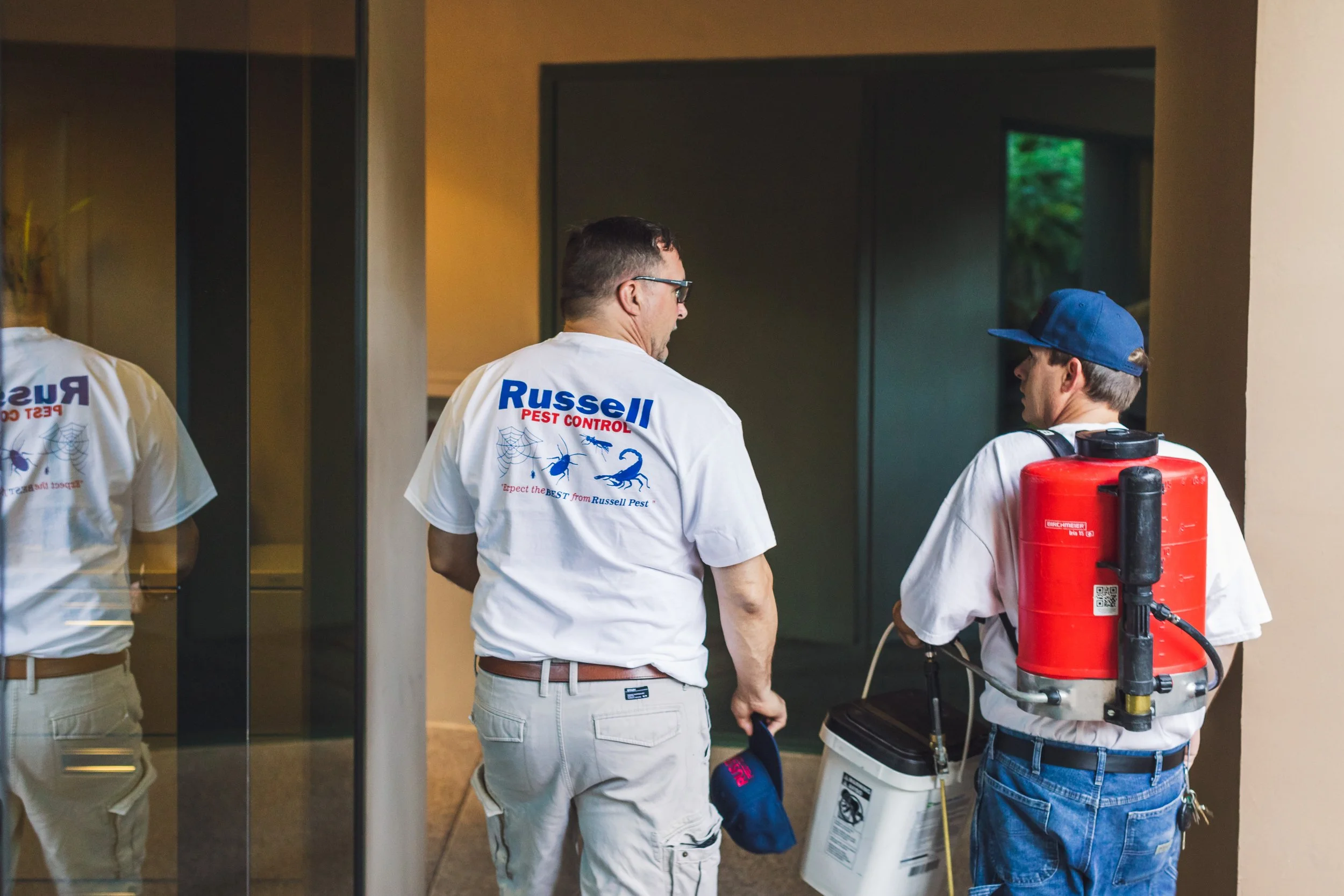
Camelback East is one of Phoenix's fifteen urban villages, the stretch between Piestewa Peak and Camelback Mountain that runs from Arcadia's flood-irrigated citrus streets to the Biltmore's resort lawns and the office towers at 24th and Camelback. It's also where the Valley's most famous pest story begins: roof rats were first identified in Arcadia in 2002, announced by hollowed-out oranges under the trees, and they've been part of the neighborhood's reality ever since. Russell Pest Control runs its routes from our 7th Avenue headquarters, a few minutes west: this village is home turf, and we've been reading its canopy, its preserve edges, and its midcentury attics since 1996.
The village stacks three different service maps on one page of the city: Arcadia's lush, flood-irrigated half-acres with their 1950s ranch attics, the preserve edges at Echo Canyon and Cholla where the desert never left, and the corridor's condo towers, five-star resorts, and restaurant rows that run on discretion and documentation. Same technician every visit, kid-and-pet-conscious defaults, honest answers everywhere.
Citrus-Canopy Streets - Mountain Preserve Edges - Corridor Towers
Arcadia Roof-Rat Fluent
Trap-first removal, canopy strategy, and roofline exclusion, built for the neighborhood where the Valley's roof rats started.
Citrus-Canopy Smart
Flood irrigation and mature fruit trees feed a year-round food web, and we treat the property that the canopy actually creates.
Preserve-Edge Ready
Echo Canyon and Cholla edges resupply scorpions and packrats; edge homes run programs, not one-time sprays.
Midcentury Sealing Craft
1950-1970 ranch homes fail in vintage places, era-read inspections before any checklist.
Corridor-Discreet
Resorts, restaurants, towers, and HOAs get unmarked-level discretion with documented, food-safe programs.
A Real Person Answers
Owner or office, every call. After hours, the line reaches Steve's cell.
Three Things About Camelback East Every Homeowner Should Know
Arcadia Is the Roof Rat's Valley Beachhead, and the Citrus Tells You First
Roof rats were first identified in the Arcadia area in 2002 (hollowed-out oranges under the trees gave them away), and the neighborhood's citrus-grove heritage explains why they chose it: fruit on the branch, flood-irrigated moisture, palms and oleanders for cover, and miles of connected canopy running to the rooflines. They're most active from November through May, they nest in attics, and they never really leave. If you garden under mature citrus anywhere from 44th Street east, the hollowed orange is the sign worth knowing, and the roofline is the door worth closing.
The Mountain Edges Never Surrendered
Camelback Mountain's Echo Canyon and Cholla trailheads anchor city preserve land along the village's northern rim, and Papago Park's nine hundred fourteen acres hold the southeast, permanent desert pressing against some of the most expensive streets in Phoenix. Preserve edges work the way they do everywhere in the Valley: continuous resupply of scorpions, packrats, and the insect base that feeds them, indifferent to the zip code. Edge homes here run the same programs the desert demands anywhere (treatment, food-supply control, sealing, screening) just with nicer views.
Most of the Village Was Built Between 1950 and 1970
The city's own village profile says it plainly: the major portion of the housing stock went up between 1950 and 1970. That's seventy years of settling for the ranch homes under Arcadia's canopy: original construction gaps, vintage door hardware, additions meeting old slabs, exactly the openings a roof rat or a bark scorpion exploits. The corridor's condo towers are the opposite era and the opposite problem set. One village, two failure maps, and the inspection names which one of your address lives on before the checklist comes out.
What Camelback East Calls Us About, and Where
The village's calls track its three maps: roof rats and canopy pests under Arcadia's citrus, preserve-edge pressure along the mountain rims, and discretion-first commercial and condo work on the corridor. Wherever yours falls, the list below is the territory we work in daily.
The Camelback East Pest Lineup
- Roof rats: Arcadia's citrus canopy, palm skirts, oleander hedges, and midcentury attics (most active November-May)
- Scorpions: the Echo Canyon and Cholla preserve edges and Papago-adjacent streets
- Packrats: preserve rims, pool equipment, engine bays
- Ants: flood-irrigated lawns and every moisture line in the village
- Black widows: block walls, play structures, pool gear
- Roaches: sewer and desert species surging post-monsoon; older plumbing penetrations in midcentury homes
- Crickets: the scorpion food supply, thickest where irrigation meets desert edge
- Bees and wasps: spring swarms; nests in block walls, irrigation boxes, and mature trees
- Mosquitoes: flood-irrigation cycles and over-watered lawns
- Pigeons: corridor rooftops, towers, and resort-adjacent commercial (commercial service)
- Termites: identified honestly and referred to a licensed termite specialist (we don't treat termites)
Camelback East Neighborhoods and Areas We Serve
- Arcadia (the Phoenix side): citrus-grove streets from the 1910s tracts, flood-irrigated lots
- The Biltmore Area: including the streets around Biltmore Fashion Park at 24th and Camelback
- The Camelback Corridor: the office, retail, and tower spine along Camelback Road
- The Esplanade and the corridor's condo towers
- Preserve-edge streets at Echo Canyon and Cholla
- Papago Park-adjacent neighborhoods near the zoo and Desert Botanical Garden
- The 44th Street and Van Buren core
Property Types We Know Cold
- Midcentury ranch homes (1950-1970) under a mature canopy
- Flood-irrigated half-acre lots
- Preserve-edge and view properties
- Luxury condos and high-rise units (HOA-coordinated)
- Commercial: resort-adjacent hospitality, restaurant rows, corridor offices, retail
Our Services in Camelback East
Every Russell service runs in Camelback East: here's the map, tuned to what the village actually needs.
Rodent Control & Exclusion
The village's headline service. Trap-first removal so nothing dies in your walls, cleanup included in scope, canopy and palm-skirt strategy on the commute lines, and roofline exclusion that closes the attic for good: the complete Arcadia roof-rat protocol.
View ServiceHome Seal
Built for the 1950-1970 housing stock: era-read sealing of original construction gaps, vintage hardware lines, and addition joints to the bark scorpion's 1/16-inch standard, which is also the roof rat's favorite door. $600-$2,500 typical, 1-2 year warranty.
View ServiceScorpion Control, Black Light Search & Sealing
For the preserve edges and Papago-adjacent streets: targeted treatment, cricket (food-supply) control, $125/hour after-dark UV mapping that shows you the population glowing, and sealing to the 1/16-inch standard.
View ServiceGeneral Pest Control Plans
Monthly, bi-monthly, or quarterly: flood-irrigated and preserve-edge lots usually run heavier cadences, and the price is set on the sizing call before anyone rolls a truck. No contracts, no initial fees, 15-day re-treat warranty doing the promising.
View ServiceMosquito Control (In2Care)
Flood-irrigation neighborhoods carry real mosquito math in season: stations that recruit mosquitoes to poison their own breeding sites, compounding all season where fogging fades in days.
View ServiceBee & Wasp
Spring swarms and colonies in mature trees and block walls: relocation when a beekeeper can take them, safety-first removal when they can't. Swarm photo triage by text is free.
View ServiceView Fence & Snake Screening
For the preserve-edge yards where the village meets the mountain, keep the view, lose the ground-level visitors.
View ServiceWeed Control
Pre-emergent timed to both desert weed seasons: gravel-scape and HOA streets stay clean, and the violation letters stop coming.
View ServiceCommercial Pest Control
Resort-adjacent hospitality, restaurant rows, corridor offices, and tower HOAs: documented, food-safe, discreet programs with same-day tenant work orders, our commercial signature.
View ServiceWhat Camelback East Service Costs
The Standing Russell Promises, Priced for the Village
- Plans priced per property: lot size, canopy, irrigation, and edge exposure set the number
- No initial fees, no contracts, 15-day re-treat warranty, the standing Russell promises
- Published anchors: Black Light Scorpion Search $125/hour - Home Seal typically $600-$2,500
- Minutes from our 7th Avenue headquarters: genuine same-day availability on the village's routes
- Commercial scoped per facility on simple 30-day terms
Get a Camelback East Quote in One Call
A real person scopes it on the phone: price and expectations set before the first visit, honored every time.
No initial fees. No contracts. Our shop is minutes from Arcadia, so we reach your door fast and treat the citrus-canopy roof-rat pressure this area is known for.
Call or Text (623) 780-9099Three Camelback East Stories That Repeat Every Year
The Hollowed Orange
An Arcadia homeowner rakes under the citrus in January and finds oranges that look intact until they turn, hollowed from one neat hole, peel left like a shell. That's the roof rat's signature, the same sign that announced the species' Valley arrival in this very neighborhood in 2002. The calls that follow the discovery run a known arc: scratching in the attic at night, droppings along the patio beam, a chewed irrigation line. The protocol is equally known: trap-first removal inside, canopy and palm-skirt work on the commute lines, fruit management honesty, and roofline exclusion to the gap standard. Arcadia households that finish the exclusion step stop being annual callers; the ones that only trap meet the next generation by spring.
The Echo Canyon Edge Tax
A preserve-edge family near the trailheads pays the mountain's tax every summer: bark scorpions down the wash lines, a packrat midden behind the pool equipment, crickets singing the buffet open. The desert doesn't read property values, preserve edges or resupply continuously, which is why edge homes run programs, not one-time sprays. Treatment plus cricket control plus sealing, with after-dark UV mapping when the family wants to see exactly what the mountain is sending. Managed edges genuinely go quiet; unmanaged ones reload monthly.
The Corridor Standard
A restaurant off the corridor calls mid-service-week: evidence in the dry storage, an inspection on the calendar, a dining room that absolutely cannot host a technician in a logo shirt at noon. Corridor work runs on discretion and documentation: early-morning or off-hours service, food-safe placements, paperwork an inspector respects, and the same-day response that keeps a small problem from becoming a review. Resort-adjacent hospitality, tower HOAs, office suites: the village's commercial spine gets the program built for businesses whose brand is the point.
Russell in Camelback East vs. the National Chains
| What Camelback East Needs | Russell Pest Control | National Chains |
|---|---|---|
| Arcadia roof rats | Trap-first + canopy strategy + roofline exclusion | Bait boxes on a route schedule |
| The citrus canopy | Fruit-and-irrigation honesty, commute-line work | Generic perimeter spray |
| Preserve edges | Programs built for continuous resupply | One-time sprays that reload |
| Midcentury homes | Era-read sealing of vintage failure points | One checklist for every house |
| Corridor businesses | Discreet, documented, food-safe, same-day | Logo trucks at lunch hour |
| Tower and HOA work | Coordinated, scheduled, building-fluent | Whoever the route sends |
| Who answers | Owner or office, after hours, Steve's cell | National call center |
| Contracts | None residential; 30-day commercial | 12-month lock-ins |
| First-visit fee | Never had one | $150-$400 "initial service" |
| Proximity | Headquartered minutes west on 7th Avenue | Dispatched from wherever |
The Conditions That Drive Camelback East's Pest Pressure
Arcadia's Citrus Bones
The land south of Camelback Mountain sold as citrus acreage starting in the 1910s, and when the ranch homes arrived, they kept the trees and the flood irrigation that watered them. The result is the Valley's most distinctive residential ecology: mature fruit canopy, palms and oleanders, and soaked-soil cycles on SRP water, a food web that runs year-round in a city that's supposed to be a desert. It's beautiful, it's the whole point of Arcadia, and it's the reason the neighborhood's pest profile reads more like a coastal grove than a Phoenix suburb.
The 2002 Beachhead
Roof rats were first identified in the Arcadia area in 2002: the Valley's first established population, flagged by hollowed-out citrus, and the neighborhood association's own guidance says what we say: they're not going away. They favor palms, oleanders, and attics, feed happily on the fruit, and run most actively from November through May. Two decades on, Arcadia roof-rat work is a permanent service category, and the households that treat it as exclusion work rather than trapping work are the ones that exit the cycle.
Flood Irrigation's Moisture Math
Many Arcadia lots still flood-irrigate, and every cycle resets the moisture clock: soaked soil for ant colonies, standing pockets for mosquitoes, soft thatch for crickets, and drinking water for everything bigger. Flood-irrigated properties aren't worse-maintained, they're differently watered, and they need treatment timed to the irrigation calendar rather than a generic monthly pattern. We schedule around the water, not despite it.
Two Mountains and a Park on the Rims
Echo Canyon and Cholla hold the Camelback Mountain preserve edge on the north; Papago Park's nine hundred fourteen acres (with the Phoenix Zoo and Desert Botanical Garden) anchor the southeast. Preserve and park edges resupply scorpions, packrats, and snakes continuously, and the streets that border them carry desert pressure no matter how irrigated the lawns between. Edge addresses run edge programs; it's the oldest rule in Valley pest work.
The 1950-1970 Housing Stock
Phoenix's village profile puts the major portion of Camelback East's housing between 1950 and 1970: pre-modern-code ranch construction now sixty-plus years into settling. Vintage failure points are predictable: original eave and weep details, addition seams, painted-over hardware, and seal what the era actually leaves open, to the 1/16-inch standard that stops both the scorpion and the rat.
The Biltmore and the Corridor Towers
The Biltmore Area, anchored by the Frank Lloyd Wright-influenced Arizona Biltmore and the shops at Biltmore Fashion Park, and the corridor's condo towers run a different physics: shared walls, central trash, loading docks, landscaped grounds irrigated like resorts, and pigeon pressure on every high ledge. Tower and HOA work is coordination work (scheduled, documented, discreet), and the grounds-level program has to respect that luxury landscaping is irrigation-intensive landscaping.
A Resort Village's Commercial Spine
The city counts three five-star resorts inside the village, and the corridor stacks restaurant rows, hotel grounds, and Class-A offices along Camelback Road. Hospitality at that tier runs on documentation and discretion: food-safe placements, inspection-ready paperwork, off-hours service windows, and on speed, because a pest sighting in a five-star context is a same-day problem by definition. That's the commercial program we run, minutes from our own front door.
The Russell Method, Applied to Camelback East
The Arcadia Roof-Rat Protocol
Trap-first removal inside (nothing dies in your walls), droppings and insulation cleanup in scope, canopy and palm-skirt strategy on the commute lines, honest guidance on fruit timing and harvest hygiene, and roofline exclusion to the gap standard as the finishing move. Trapping without exclusion is a subscription; exclusion is an exit.
Scheduled for the Irrigation Calendar
Flood-irrigated lots get treatment timed to the water cycle: granules and barriers placed to survive the flood, moisture-pest work scheduled for the post-irrigation window, and mosquito stations where the math demands them. The generic monthly route ignores the calendar that actually drives these properties.
Preserve-Edge Programs on the Rims
Echo Canyon, Cholla, and Papago-adjacent streets run the edge playbook: perimeter treatment, cricket control to starve the food supply, sealing, view-fence screening where yards meet preserve land, and UV mapping when the household wants the population shown rather than described.
Era-Read Sealing for the Midcentury Stock
A 1958 ranch and a 2006 tower unit fail in completely different places. We read build dates like odometers: vintage weep and eave details, addition seams, painted-over hardware, and seal what the era actually leaves open, to the 1/16-inch standard that stops both the scorpion and the rat.
Tower, HOA, and Corridor Discretion
Condo and commercial work in this village is coordination work: building management looped in, service windows honored, unmarked-level discretion available, documentation that satisfies boards and inspectors alike. The brand standard of the address sets the service standard of the visit.
Family-First Application, Always
Low-drift targeted placement, clear dry times (15 minutes outside, 30-35 inside), the kid-height black widow sweep around play equipment and pool gear, and natural-oil options with honest summer trade-offs. Arcadia's yards are lived-in yards; the defaults assume kids, dogs, and citrus picked by hand.
Straight Lanes, Straight Answers
Termite evidence gets identified honestly and referred to a licensed termite specialist; we don't hold that license and won't pretend to. And for the record: subterranean termites seek moisture, and the scary spider is almost never a brown recluse, which is not established in Arizona. The local concern is the black widow, and that one we handle thoroughly.
Camelback East Pest Questions, Answered Straight
I Found Hollowed-Out Oranges Under My Citrus Tree. What Does That Mean?
That's the roof rat's signature: one neat hole, fruit emptied, peel left like a shell. It's the same sign that announced the species' Valley arrival in Arcadia in 2002. Take it seriously but not fearfully: trap-first removal, canopy work, and roofline exclusion close the story. The orange is the early warning; the attic is what it's warning you about.
Why Is Arcadia THE Roof-Rat Neighborhood?
Because it offers everything the species wants in one place: fruit on the branch, flood-irrigated moisture, palm and oleander cover, connected canopy to the rooflines, and midcentury attics with vintage gaps. Roof rats were first identified here in 2002, and the population is established, which is why exclusion, not just trapping, is the real fix.
When Are Roof Rats Most Active?
November through May in the Valley: cooler months, citrus season. That makes fall the smart time for the exclusion inspection: close the roofline before the season starts, and the winter stays quiet. We run the full protocol year-round, but the calendar favors the prepared.
Does Flood Irrigation Make Pests Worse?
It changes the math rather than simply worsening it: every cycle resets soil moisture, which feeds ants, crickets, and mosquito pockets, which feed everything that hunts them. The fix isn't abandoning the irrigation that makes Arcadia green; it's timing treatment to the water calendar and placing products that survive the flood.
We're Near Echo Canyon: Is Scorpion Pressure Really Higher Here?
Structurally, yes. Preserve land resupplies scorpions, packrats, and their insect food base continuously, and bordering streets carry that pressure regardless of price point. Edge homes run programs: treatment, cricket control, sealing, screening where yards meet the preserve, and managed edges genuinely go quiet.
Is a 1950s or 1960s Ranch Home Sealed Differently Than a Newer House?
Very differently. Midcentury homes fail at vintage points: original eave and weep details, addition seams, painted-over hardware, that a new-build checklist never inspects. We read the era first, then seal what that era leaves open, to the 1/16-inch standard that stops both scorpions and rats.
Can You Treat a Condo in One of the Corridor Towers?
Yes, coordinated through your building or HOA where required, scheduled to the building's windows, documented for the board, and discreet by default. Shared-wall buildings need unit and common-area logic working together; we're fluent in both.
Can You Handle a Restaurant or Resort-Adjacent Business Discreetly?
That's our corridor standard: off-hours windows, food-safe placements, inspection-ready documentation, and same-day response when something's been sighted, because in five-star territory, a pest issue is a same-day problem by definition.
Can You Do Same-Day Service in Camelback East?
Usually, yes, our headquarters is minutes west on 7th Avenue, and the village sits on our daily central-Phoenix routes. Scorpions, bees, rodent evidence, anything indoors: call before noon, and same-day is realistic. After-hours calls reach Steve's cell for honest triage.
Do You Treat Termites in Camelback East?
No, and we're straight about it. We'll identify the evidence honestly (subterranean termites seek moisture, so irrigated Arcadia soil suits them fine) and refer you to a licensed termite specialist, then handle everything else on the property. Straight lanes, straight answers.
What Our Customers Say
Real reviews from homeowners and businesses across the Phoenix Valley.
Camelback East's Neighborhood Pest Company Since 1996
Arcadia's citrus rows to the Biltmore's lawns, from the Echo Canyon edge to the corridor towers: thirty years of reading Valley properties and keeping them quiet, with a second generation now on the routes. No contracts, no initial fees, a 15-day re-treat warranty, and a real person on the phone.
Expect the best from Russell Pest, and have a bug-free day.
Hours
- Monday-Friday: 8:00 AM - 5:00 PM
- Same-day & emergency service available, after hours and weekends, owner-answered
Nearby Areas We Also Serve
Scottsdale, Paradise Valley, North Mountain Village, Ahwatukee, and the rest of the Valley from our Phoenix headquarters.