
Spider Control in Phoenix, AZ: Cut the Food Supply, Clear the Webs
Webs taking over the eaves, or a black widow where the kids play? Call, a real person answers, and we'll start by identifying what you've got.
Black Widows - Desert Spiders - The Ones in the Garage Corner.
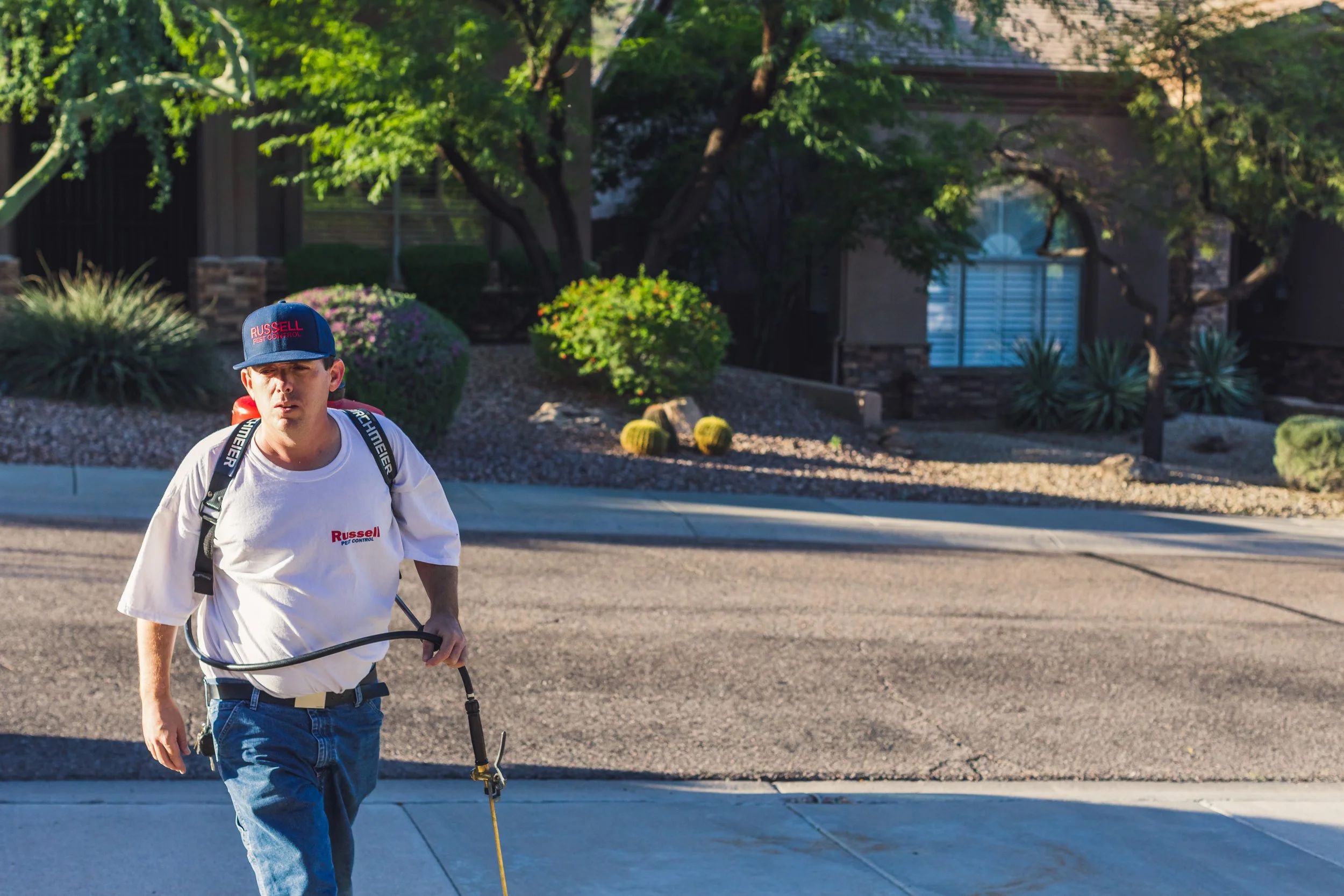
Spiders are predators, which is the single most useful fact about controlling them: a property with lots of spiders is a property with lots of insects for them to eat. Russell Pest Control has controlled Phoenix Valley spiders since 1996 by treating the whole picture (knocking down the webs, controlling the crickets, flies, and other prey that draw spiders in, and sealing the gaps they enter through) instead of just spraying the spider you can see and watching three more move into the vacancy. Spray-only spider control is a treadmill; cut the food supply, and the spiders relocate to a better-stocked yard.
Most Valley spiders are harmless and genuinely useful, but two matter for safety: black widows, common around block walls, pool equipment, and garage corners, and the brown spiders people worry about. We identify what you actually have, treat the dangerous species seriously where families and pets are, and tell you honestly when a spider is doing you a favor. The goal isn't a sterile, spider-free desert; it's a home where the dangerous ones are controlled, and the webs are gone.
The Complete Solution, Not a Scare Tactic
Cut the Food Supply
Spiders follow prey. Control the insects they eat, and the spiders move on. The durable fix spray-only misses.
Web Patrol
Physical web removal every visit, it's control and intelligence: where webs rebuild fast, prey traffic runs.
Black Widow Serious
Block walls, pool equipment, garage corners, we treat the dangerous species hard where kids and pets are.
Honest ID
Most Valley spiders are harmless and helpful. We'll tell you which is which instead of selling fear.
Sealing Closes the Door
Spiders enter through the same gaps as everything else. Sealing keeps the next ones outside.
Family-First Zones
Play areas, pool decks, and entries get priority, the places where a bite would matter most.
Three Truths About Phoenix Spiders
Lots of Spiders Mean Lots of Bugs
Spiders don't eat your house; they eat the insects in it, so a heavy spider population is a billboard advertising a heavy insect population. That's why spray-only spider control fails: kill the visible spiders, and the food supply that drew them is still there, pulling in replacements within weeks. Real spider control treats the prey base (crickets, flies, moths, and the rest) so the spiders lose their reason to stay. Address the buffet, and the predators leave on their own.
Two Species Are Worth Real Respect
Most of what you'll see: desert spiders, the big intimidating giant crab spider on a wall, the harmless ones in the corner, pose no danger and quietly control other pests. But black widows are common across the Valley, and their bite is medically significant, especially for kids and pets, and they love exactly the spots families use: block walls, pool equipment, garage corners, patio furniture undersides. The brown spiders people fear are far rarer here than the internet suggests. We identify, we treat the dangerous ones seriously, and we don't manufacture panic about the rest.
Webs Are a Map, Not Just a Mess
A web's location tells us where flying and crawling prey travels, and how fast a cleared web rebuilds tells us how rich that spot is, which is why our web removal is both cleanup and reconnaissance. Knock down the webs, watch where they come back, and you've found the prey corridors to treat. A property cleared of webs also simply looks cared for instead of haunted, which is half the reason people call.
Every Spider Situation in the Valley
Know Your Phoenix Spider
- Black widow: shiny black, red hourglass; block walls, pool equipment, garages, the one that matters most
- Brown/recluse-type spiders: far rarer here than feared; we'll confirm before anyone panics
- Giant crab spider (huntsman): big, fast, alarming, essentially harmless; a roach-and-cricket hunter
- Wolf spiders: ground-hunters, no web; come in from the yard, harmless but startling
- Desert recluse: genuinely uncommon, outdoor desert species; identified carefully
- Common web-builders: orb weavers and cobweb spiders in eaves and corners (the web problem)
- Jumping spiders: small, harmless, beneficial daytime hunters
Where They Harbor
- Block walls, weep holes, and wall-to-house junctions (black widow favorite)
- Pool equipment pads, pump housings, and meter boxes
- Garage corners, stored boxes, and rarely-moved items
- Eaves, patio ceilings, and light fixtures (web-builders chasing bugs at lights)
- Woodpiles, debris, dense landscaping
- Under patio furniture, grills, and play structures
- Window wells, door frames, and exterior corners
Signs and Concerns
- Webs accumulating in eaves, corners, and around lights
- Black widow webs: messy, strong, irregular cobwebs low to the ground
- Egg sacs: papery tan spheres (black widow sacs are a priority find)
- Spiders concentrating where outdoor lights draw insects
- Sightings in garages, play areas, or anywhere kids and pets go
- A sudden indoor increase (often tracking an insect surge inside)
Identify, De-Web, Starve, Seal: the Process
Identify What You Have
Harmless or hazardous? It changes the urgency and the approach. We confirm the species, and reassure you about the scary-looking-but-harmless ones (the giant crab spider gets the most undeserved fear in Arizona). Black widow and any genuine recluse get treated as the priority they are; the beneficial hunters get a more measured response.
Clear the Webs
Physical web removal with extension poles: eaves, corners, patios, fixtures, and the low, irregular webs black widows build. It's immediate visible relief and live intelligence: where webs rebuild fastest is where the prey is, and that's where the next step aims.
Starve Them by Controlling the Prey
The durable move: control the insects spiders eat. Crickets, especially, are a spider magnet (and a scorpion magnet, same food chain), so prey-based control through your general pest service removes the reason spiders chose your property. This is the step spray-only spider control skips, and the reason ours lasts.
Treat the Harborage
Targeted treatment in the harborage zones: block walls, weep holes, pool equipment, garage corners, wall junctions, focused hardest on the family-use areas where a black widow would matter most. We treat where they live and hunt, not where you happened to spot one.
Seal the Entry Points
Spiders come in through the same gaps as everything else: door sweeps, weep screeds, vents, cracks. Sealing keeps the next generation outside, and it's the same exclusion work that handles scorpions and crawlers. Web removal clears today; sealing reduces tomorrow.
Keep It Up With Service
Spiders re-colonize as long as prey is available, so recurring service that keeps the prey base down and the webs cleared is what holds a property spider-light. Each visit re-de-webs and re-treats, which is why serviced homes don't have the eave-corner web farm the neighbors do.
Starve the Food Chain
Crickets are the spider magnet (and the scorpion magnet). Prey-based control anchors the fix.
Seal the Entry Points
The same 1/16-inch standard that stops scorpions stops the spiders' prey too.
What Spider Control Costs
Mostly Part of the Plan
- Most spider control is handled within general pest service: web removal, prey control, and harborage treatment on every visit
- Standalone black-widow-focused treatment scoped after inspection where there's a concentrated safety concern
- Heavy web problems (eaves, multi-story, large patios) scoped by the property
- No initial fees, no contracts, quote holds
- Recurring plans keep webs cleared and prey controlled, the only way to stay spider-light long-term
Black Widow Near Kids or Pets?
Say so when you call; those calls route first, and the family-use zones get treated hardest.
No initial fees. No contracts. Cut the food supply, clear the webs, keep them gone.
Clear the WebsCleared Corners and Quiet Garages
Thorough, Every Corner
"What really impressed me was how detail-oriented the technician was, he inspected every corner, treated the yard, inside the home, and even gave tips for prevention moving forward." Spider control is corner work: eaves, garage angles, wall junctions, the undersides nobody checks, and "inspected every corner" is exactly the standard the job requires.
- Google reviewYears of No Unwanted Critters
"Always great service! ... Very professional and we have no unwanted critters!" "No unwanted critters" is what spider control looks like when it's done as part of a real program: webs cleared, prey controlled, the dangerous species kept away from where the family lives.
- Greg G., Google reviewThe Reassurance Call
Some of our best spider "jobs" are a two-minute identification and a reassurance: the giant, fast, terrifying spider on the garage wall is a harmless huntsman that's been eating your roaches, and the kind thing to do is let it work or relocate it outside. We'd rather tell you that than charge you to kill a beneficial spider, and customers remember the honesty when the black widow call comes.
Whole-Picture Spider Control vs. Spray-the-Spider
| What Matters | Russell Pest Control | Spray-the-Spider Outfits |
|---|---|---|
| The strategy | Cut prey + de-web + seal + treat harborage | Spray the spider you see |
| Webs | Physically removed every visit | Left to rebuild |
| Food supply | Prey base controlled (crickets, flies) | Ignored, replacements move in |
| Black widows | Prioritized in family-use zones | Treated like any spider |
| Harmless species | Identified and reassured, not over-killed | Charged for either way |
| Entry points | Sealed to keep the next ones out | Not addressed |
| Durability | Spiders lose their reason to stay | Back when prey returns |
| Knowledge | Honest ID, no manufactured fear | Fear sells the upsell |
| Family zones | Play areas and pool decks first | Wherever's convenient |
| Who answers | Owner or office, same day | Call center |
Why Phoenix Properties Grow Spider Problems
Block Walls Are Black Widow Country
The Valley's hollow cinder-block walls, with their weep holes and shadowed cores, are the single most reliable black widow harborage in Phoenix: dark, protected, insect-rich, and right at the height where a reaching hand finds them. Wall-to-house junctions concentrate them further. It's why our spider treatment always works the wall lines and why we tell families to be careful reaching into weep holes and wall gaps.
Outdoor Lights Run a Buffet
Every porch light, landscape fixture, and pool light is an insect magnet after dark, and web-building spiders set up exactly where the prey concentrates, which is why your entry and patio collect webs faster than anywhere else. Swapping to less attractive lighting and controlling the insects the lights draw both reduce the web problem. The spiders are just following the dinner crowd.
Monsoon Prey Booms Feed Spider Booms
The same post-monsoon insect explosion that drives cricket, roach, and mosquito calls also feeds spiders, and a few weeks behind every prey surge comes a spider surge. Properties on service ride it out because the prey base is already controlled; unserviced homes watch the eaves fill with webs in late summer. Spiders are a lagging indicator of an insect problem.
Pool Equipment Is a Spider Resort
Pump housings, filter areas, and equipment pads offer everything a black widow wants: shelter, shade, moisture nearby, and insect traffic, a few feet from where the family swims and the kids reach for pool toys. Pool equipment gets specific attention on every spider job for exactly this reason; it's a classic black widow find and a classic bad-surprise location.
Garages and Stored Clutter
Garages are spider headquarters: quiet, sheltered, full of undisturbed boxes and corners, and connected to the outdoors every time the door opens. Black widows favor stored items and lower corners; the harmless hunters patrol for the insects that wander in. Decluttering and treating the garage are among the highest-value spider work on a typical home.
Desert-Edge and Landscaped Properties
Homes near the desert, washes, and heavy natural landscaping see the biggest cricket flushes; the source population is enormous and right next door. Preserve-edge properties get a more thorough harborage sweep because the spider population just over the wall never runs out of recruits.
What Thirty Years of Spider Calls Teaches
Black Widow Identification and Behavior
The female black widow (glossy black with the red hourglass underneath) is the safety concern; males are smaller and rarely bite. They build messy, strong, irregular cobwebs low to the ground in protected spots, hang upside down in the web, and are defensive rather than aggressive (most bites happen when one is pressed against skin in a glove, shoe, or reached-into gap). Knowing their web style and favorite spots helps us find them before someone else does. The egg sacs (papery tan spheres) are a priority find, because each one is the next generation.
The Giant Crab Spider Gets a Bad Rap
The huge, fast, flat brown spider that sends people running (the giant crab or huntsman spider) is one of Arizona's most feared and least dangerous spiders. It builds no web, hunts roaches and crickets actively at night, and wants nothing to do with you. We mention it specifically because it generates more panic calls than any other Valley spider, and the honest answer ("that's a beneficial hunter, here's how to relocate it") builds the trust that matters when a real black widow turns up.
Why Prey Control Is the Master Move
Spiders are obligate predators with no interest in your home except as a hunting ground, so spider density tracks prey density almost perfectly. This is the insight that separates real spider control from spraying: reduce crickets, flies, moths, and other prey, and the carrying capacity for spiders drops; they literally can't sustain a large population without food. Prey control is slower-looking than a visible spray kill, but it's the lever that actually moves the spider count, which is why it anchors our approach.
Web Removal as Control and Census
Removing webs isn't cosmetic housekeeping; orb weavers invest heavily in web construction, and repeatedly destroying webs pressures them to relocate to easier territory. It also reads the property: a web that rebuilds overnight marks a prime prey corridor; one that stays gone marks a dead zone. Every web patrol updates our map of where the insects are moving, which sharpens the next treatment. Cleanup and reconnaissance in one pass.
The Recluse Reality Check
Brown recluse spiders are not established in the Phoenix area; the genuine desert recluse exists but is uncommon and outdoor, and the vast majority of "recluse bites" people fear are misdiagnosed or attributed to spiders that weren't involved. We say this plainly because reclusive panic drives a lot of bad decisions and a lot of unnecessary fear. When we identify an actual recluse, we treat it seriously; far more often, the honest service is calming a fear the internet manufactured.
Treating for Safety in Family Zones
Spider control near kids and pets is about risk placement: a harmless orb weaver high in an eave is low-risk; a black widow in a pool-toy bin or a low garage corner is a hazard at exactly child height. We prioritize treatment by where a dangerous encounter would actually happen (play areas, pool decks, low walls, stored items, entryways) rather than treating every spider on the property identically. Smart spider control is risk-weighted, not uniform.
Sealing and the Predator-Prey Loop
Long-term spider reduction closes the loop: seal the entry points so fewer spiders (and fewer of their prey) get inside, control the prey base so the property supports fewer spiders, and keep the webs cleared so the survivors stay pressured. Each piece reinforces the others, and it's the same exclusion-plus-prey-control logic that runs our scorpion and cricket work, because in the desert food chain, it's all one connected system.
Spider Questions, Answered Straight
Why Do I Have So Many Spiders All of a Sudden?
Because you have a lot of insects for them to eat, spiders are predators that follow the prey, so a spider surge usually trails an insect surge (classic after a monsoon). The lasting fix is controlling the prey base, not just spraying the spiders, which is why our approach starts with the food supply.
Is That a Dangerous Spider?
Most Valley spiders aren't, including the big, fast, scary ones like the giant crab spider, which is harmless and actually helpful. The two to respect are black widows (shiny black, red hourglass, low-protected webs) and genuine recluses, which are rare here. Send a photo, and we'll identify it honestly, no manufactured panic.
How Do I Get Rid of Black Widows Specifically?
Treat their harborage hard: block walls, weep holes, pool equipment, garage corners, low protected spots, and remove webs and egg sacs, especially in family-use areas. We prioritize the places a bite would actually happen, and ongoing service keeps the population from rebuilding from the desert next door. Reaching carefully into walls and gaps in the meantime is just a good Valley habit.
Will Spraying Get Rid of My Spiders?
It kills the ones it directly hits and leaves the food supply intact, so replacements move in within weeks; that's the spray-only treadmill. Effective spider control combines web removal, prey-based control, harborage treatment, and sealing. Spraying alone is the most common reason people say, "We treat for spiders constantly and still have them."
Are Spiders Actually Good to Have Around?
Most are: they eat roaches, crickets, flies, and other pests, which is genuinely useful. That's why we don't aim for a sterile spider-free property; we aim to control the dangerous species near your family and keep the webs and numbers down. We'll happily tell you when a particular spider is doing you a favor.
I Found an Egg Sac. What Do I Do?
Don't disturb it, especially if it might be a black widow's papery tan sphere, and tell us where it is. Egg sacs are a priority because each one contains dozens of new spiders, and removing them is a key part of breaking the cycle. We'll handle it on the visit.
Are the Treatments Safe for Kids and Pets?
Yes, harborage treatment goes into cracks, wall voids, and equipment areas rather than across surfaces kids touch. Web removal is purely physical, and any treated area follows label dry-time guidance. Spider control is mostly placement and mechanical work, which keeps exposure low.
How Do I Keep Spiders Out of the House?
Seal the entry points (door sweeps, weep screeds, vents, cracks), reduce the insects that draw them (manage outdoor lighting, control the prey base), keep clutter and webs down, and stay on top of harborage zones like the garage and pool equipment. Ongoing service handles the prey and harborage; we'll give you the sealing and lighting list for the rest.
Do You Offer a One-Time Spider Treatment?
We can, and we'll knock down the current population and webs, but be clear-eyed about it: as long as the prey base and entry points are unaddressed, spiders return. For a lasting result, prey control and recurring service do the heavy lifting. We'll tell you honestly whether a one-time visit fits your situation.
Do You Remove the Webs, or Just Treat and Leave Them?
De-webbing is part of every spider visit: eaves, corners, block-wall lines, patio furniture frames. It's not cosmetic: removing webs forces spiders to re-expose themselves to treated surfaces to rebuild, which is exactly when the treatment does its work. You get a cleaner house and a more effective service in the same pass.
What Our Customers Say
Real reviews from homeowners and businesses across the Phoenix Valley.
Clear the Webs, Cut the Food Supply, Take Back the Corners
Honest identification, web removal, prey-based control, harborage treatment where families live, and sealing that keeps the next ones out, spider control by the company that understands the whole desert food chain, since 1996. The dangerous ones handled, the helpful ones respected, the webs gone.
Expect the best from Russell Pest, and have a bug-free day.
Hours
- Monday-Friday: 8:00 AM - 5:00 PM
- Same-day & emergency service available, after hours and weekends, owner-answered
- Black widow near kids or pets? Say so, those calls route first
Spider Service Area
Phoenix (HQ), North Mountain Village, Camelback East, Moon Valley, Ahwatukee, Scottsdale and North Scottsdale, Paradise Valley, Cave Creek, Carefree, Fountain Hills, Mesa, Gilbert, Chandler, Tempe, Glendale, Peoria, Surprise, Goodyear, and Avondale.