
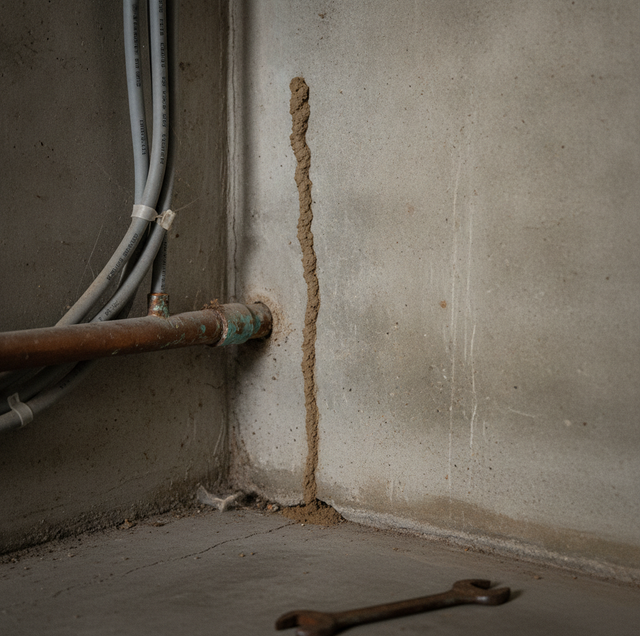
You are walking along the base of your house, or shining a light into a corner of the garage, and you notice a thin ridge of dried mud climbing the wall. It does not belong there. It is not a crack, not a water stain, not a smear of dirt. It runs in a mostly straight line, about as wide as a pencil, heading up toward the framing. That ridge has a name. It is a termite mud tube, and it is one of the clearest outdoor-to-indoor signs that subterranean termites are moving through your home.
Knowing what these tubes are, why they exist at all, and what they tell you buys you time and clarity before you call anyone. Here is how to read them.
Quick Answer: Termite mud tubes are pencil-width tunnels of soil, wood, and termite saliva that subterranean termites build to travel between their underground colony and the wood they feed on. They appear as thin, mud-brown lines running up foundations, piers, and walls. A mud tube means active subterranean termite activity and calls for a professional inspection, not a do-it-yourself spray.
What a Mud Tube Actually Is
Subterranean termites live in the soil, sometimes several feet down, where the ground stays cool and damp. The wood they want to eat sits above the ground, in your framing, subfloor, and trim. Between those two points lies open air, and open air is the enemy of a subterranean termite. Their bodies dry out fast, and exposed on a wall, they are easy prey for ants and other predators.
So they built a covered road. Workers carry up bits of soil and wood, mix them with saliva and waste, and press them into a hollow tunnel roughly the diameter of a pencil. Inside that tunnel, the humidity stays high, and the workers stay hidden. The whole structure is often called a shelter tube, which describes its job well: it shelters the colony's supply line as it crosses from damp earth to dry lumber.
Think of it the way a subway tunnel lets trains cross a city without ever surfacing into traffic. The termites are the trains, the wood is the destination, and the mud tube is the tunnel that keeps the whole route protected and out of sight. Break open a working tube, and you may see pale, soft-bodied workers inside, retreating fast from the light.
What They Look Like
Most mud tubes share a family resemblance once you know the pattern. They are thin, usually somewhere between pencil width and pea width, and mud-brown to grayish depending on the local soil. They tend to run in a fairly direct line, because the colony is aiming for wood, not wandering. The surface looks like packed, dried dirt, with a slightly bumpy or segmented texture where the workers added material in sections.
You will generally see them in one of a few forms:
- Working tubes are the thicker, well-traveled highways that connect soil to wood. These are the ones with live traffic inside.
- Exploratory tubes are thinner and flatter and often stop in mid-air or trail off against a wall. Termites send these out to prospect for new food and moisture, and many are abandoned.
- Drop tubes hang down from framing or a subfloor toward the ground, built from the wood side rather than up from the soil.
The color and the near-straight run are the giveaways. A mud tube reads as a deliberate line heading somewhere, not a random splatter.
Where They Show Up
Termites take the path of least resistance from soil to wood, so mud tubes cluster where those two meet or where a gap lets them slip past a barrier. Common spots include the exterior and interior of the foundation, garage walls, and the concrete stem wall around a slab. Inside, they can appear along baseboards, behind or beside trim, and up structural piers in a crawlspace.
Pay special attention to seams and penetrations. Expansion joints in a slab, the gap where a porch meets the house, and the openings where plumbing or utility lines pass through concrete all give termites a sheltered route inward. A tube emerging from a hairline crack or snaking up beside a pipe is textbook. Once you spot one, scan nearby: they often travel in company, and a single visible tube can have quieter siblings a few feet away.
Why They Matter
A mud tube is not just evidence that termites passed through the yard. It is evidence of an active path built specifically to reach the wood in your structure. Subterranean colonies are large, and they do not build supply lines toward food they are not using. The presence of a working tube means workers have a reason to keep the road open.
Subterranean termites are common in most of the country. Dry surface soil can hide how much moisture sits below, and established colonies are common wherever soil stays damp under the surface. That does not mean every home is infested, but it does mean a mud tube deserves to be taken seriously rather than scraped off and forgotten.
How to Tell If a Tube Is Working or Dead
You can gather one useful piece of information yourself without disturbing the colony much. Find a spot where the tube is clearly visible and gently break away a short section, no more than an inch. Then leave it alone and note the date.
If the colony is actively using that route, workers will seal the gap back up, often within a few days, because the break exposes them to the air they cannot tolerate. A tube that stays broken and dry over that window is likely abandoned, an old exploratory branch that never panned out. This tells you whether you are looking at current activity or an old scar, which is useful information to hand to a professional.
Keep the test small and local. The goal is a single quiet break, not a demolition of every tube you can find.
Telling Mud Tubes Apart From Look-Alikes
A few things get mistaken for mud tubes. Ordinary dirt and mud splash from rain or sprinklers can streak a foundation, but it lacks the tube's raised, tunnel-like ridge and its steady climb toward wood. Mud dauber wasp nests are also made of packed mud, but they form compact clumps rather than long, thin lines. And drywood termites, which are a different animal entirely, leave no soil tubes at all, so if you are seeing tubes you are dealing with the subterranean kind. The FAQs below break down each of these distinctions in more detail.
What Not to Do
The instinct to grab a can of spray and soak the tubes is understandable and almost always counterproductive. Surface pesticides rarely reach the colony, which lives in the soil, and disturbing the workers can push them to reroute through a part of the house you cannot see. You end up with a hidden problem instead of a visible one.
For the same reason, applying termite pesticides yourself is not a job to take on. Effective subterranean termite treatment relies on soil-applied products and baiting systems placed correctly around and under a structure, work that is regulated and best handled by a licensed professional. Knocking down a tube out of frustration also erases evidence that an inspector would want to see.
The productive move is the opposite of dramatic. Leave the tubes largely intact, note where they are, do your one small break test if you like, and get a professional inspection. That inspection is where the actual diagnosis and treatment plan come from.
Frequently Asked Questions
Feel and texture give it away fast. An abandoned tube dries out and crumbles to powder when you rub it between your fingers, while an active one stays damp and slightly pliable because workers keep the inside humid. Confirm with a small break test, but give the colony time before you judge: workers reseal faster in warm months and slower when it is cold, so allow an active colony several days to rebuild the gap before calling a tube dead. A tube that stays powdery, dry, and unrepaired across that window is the old kind.
Yes. Only subterranean termites build mud tubes because only they need to bridge from the soil to the wood while staying moist. Drywood termites live entirely inside the wood they eat and never contact the ground, so instead of tubes, they leave tiny six-sided fecal pellets that pile up like coarse sand below the infested wood. If you are finding mud tubes, the culprit is subterranean; if you are finding little hexagonal pellets and no tubes, that points to drywood instead.
A mud dauber nest is a lumpy, rounded clay pot or a cluster of stacked tubes packed onto a wall or under an eave, built by a solitary wasp to hold its young. A termite mud tube is a long, thin, low ridge that runs along a surface in a fairly straight line, always heading toward wood. Shape and direction tell them apart: the dauber nest is a compact blob that stays put, while the termite tube is a traveling line going somewhere.
Yes. A slab is not a sealed barrier. Subterranean termites get in through shrinkage cracks in the concrete, through expansion joints between slab sections, and through the gaps around plumbing and utility penetrations that pass through the slab. They also build tubes up the outside of the exterior stem wall to reach the framing above. A slab home changes where you look for tubes, not whether termites can arrive.
Because knocking down a tube does nothing to the colony, which lives in the soil and may number in the hundreds of thousands. The workers you disturbed simply reroute and rebuild, sometimes in a spot you cannot see as easily. Removing tubes treats the symptom while the source keeps producing. Only treatment aimed at the colony itself, through soil products or bait the workers carry home, actually stops the rebuilding for good.
Not necessarily, but active tubes mean feeding is underway somewhere along that route, so damage may be starting even if nothing looks wrong. Termites eat wood from the inside out and often leave a thin outer shell and the paint layer intact, which hides the hollowing behind a surface that still looks solid. That is why a real inspection probes and sounds the wood itself rather than judging by the tube alone, and why finding tubes early is better than finding a soft floor later.
Book a termite inspection today — catch active tubes before the damage spreads. Russell Pest Control serves the Phoenix Valley. Call (623) 469-7583.
