
What Kind of Bee Is This? Six Look-Alikes, Told Apart
The shape on the block wall has not moved in a minute. It is yellow and black, it is bigger than it ought to be, and from six feet back that is the whole of what anyone can honestly say about it. The distance between having a photo and having a name is where most of these questions start, and the name is what decides whether anything needs to happen at all.
"A bee" is a category running to some twenty thousand described species worldwide, several thousand of them in North America. Most of what people photograph and call a bee lives alone, digs in soil or nests in dead wood, builds nothing inside a wall, and finishes its season on its own schedule. One of them, the honey bee, forms a permanent colony with wax comb and stored honey, and it is the only one here whose arrival changes a building.
The Six Most Likely Candidates
Sizes below are typical adult ranges. Individual bees vary, and a worn forager reads smaller and darker than a fresh one.
| Bee | Size and colour | Where it nests | Social or solitary | What it means for a structure |
|---|---|---|---|---|
| Honey bee | About half an inch; amber-and-brown bands, fuzzy thorax | One small entrance into an enclosed cavity: wall void, soffit, chimney, meter box | Social; tens of thousands at peak | Wax comb and stored honey inside the cavity |
| Bumble bee | Round, three-eighths to over an inch; fur across the whole abdomen | Underground: rodent burrows, under deck boards, insulation | Small and annual; dozens to a few hundred | Nest in soil or under something, never comb in framing |
| Carpenter bee | Three-quarters to over an inch; shiny, near-hairless black abdomen | Round tunnels bored in bare unpainted wood, plus dry agave and yucca stalks | Solitary, sometimes several in one board | Holes and galleries in the exposed face of wood |
| Digger and mining bees | Quarter-inch to five-eighths; dark or dully metallic, often reddish hair | Separate tunnels in bare, well-drained soil | Solitary, one female per tunnel | Nothing structural; the work is in the ground |
| Leafcutter bee | Quarter-inch to three-quarters; dark with pale bands, pollen under the belly | Narrow cavities it did not make: beetle holes, hollow stems, gaps in trim | Solitary | Semicircular notches cut from leaves; no excavation |
| Sweat bee | Eighth of an inch to just under half; often metallic green | Small burrows in soil | Solitary to loosely communal | None; drawn to perspiration |
Honey Bees: Amber Banding and a Fixed Address
The honey bee is the reference point everything else gets compared against: about half an inch, a fuzzy thorax, a triangular head, and an abdomen banded amber and brown that darkens toward the tip.
The discriminator the table cannot carry is behavioral. Honey bees run two-way traffic through one small opening, in the same line, all day and week after week. Beekeepers commonly cite peak populations in the tens of thousands for a strong colony, with the count falling well below that outside the building season, but nobody sees that number from outside. What you see is the doorway, and that single fixed opening is the strongest field mark on this page. Worth knowing in passing, honey bees cannot be sorted by eye into calm and defensive types; that difference is behavioral rather than visual.
A steady two-way stream of bees at a fixed opening means an established colony with something to defend. Closing in for a sharper photo is the common way people get stung. Zoom from well back instead.
Bumble Bees: Round, Furred and Underground
Bumble bees are the ones people call huge: roughly three-eighths of an inch to over an inch, built round rather than tapered, with dense hair carrying across the abdomen to the very tip.
The tell the table cannot hold is the sound. Watch one grip a flower and vibrate hard enough to hear, shaking loose pollen the flower will not release any other way; no honey bee does that. A bumble bee nest under a shed floor is a different situation entirely from a honey bee colony in a wall, and it is not bee-removal work: the nest is annual, it sits in soil or under an object, and nothing gets built into the building.
Carpenter Bees: A Shiny Abdomen and a Round Hole
Carpenter bees get misidentified more than anything else here, because at a glance they have the size and shape of a bumble bee. One feature settles it.
In a photo, skip color entirely and read the top of the abdomen. Furred to the tip means bumble bee. A hard black shine with the light reflecting off it means carpenter bee, every time.
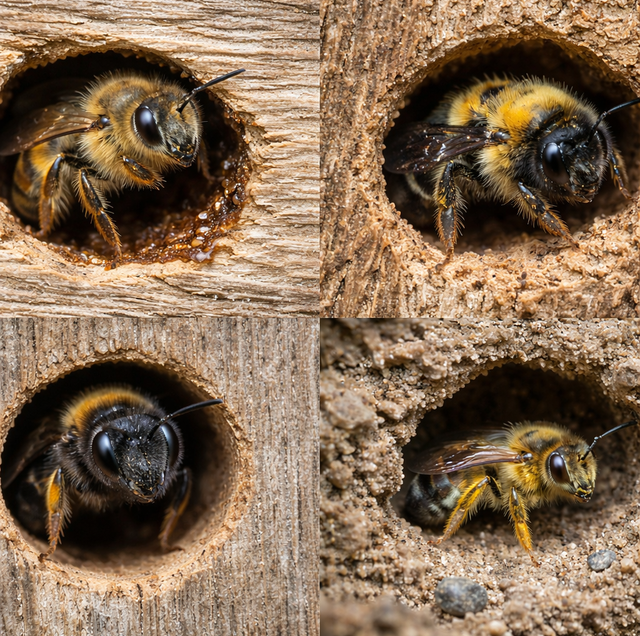
The second tell is the hole. A female chews a nearly circular entrance close to half an inch across, round enough that people assume it was drilled, then turns the tunnel to run along the grain. She wants bare, unpainted softwood, and old galleries get reused and extended in later years, so damage builds up faster than one season can explain.
Carpenter bees are not a bee-removal job at all. The damage sits in the exposed face of the wood rather than inside a void; there is no comb or colony to relocate, and the long-run answer is a woodwork question about sound, sealed, finished timber.
Digger Bees and Other Ground Nesters
This group covers mining bees, long-horned bees and their relatives, and it produces the most alarm per unit of actual risk. Long-horned males carry antennae nearly as long as their bodies.
The discriminator here is arithmetic. Honey bees come and go from one opening in a structure; ground nesters have many openings in soil, each with a single occupant. Count the entrances. Where the soil suits them, dozens or hundreds dig into the same patch of open decomposed granite or worn turf, so a hundred holes in a square yard can look like a colony while being nothing of the kind. The adults are above ground for a matter of weeks in any one patch. Ground nesting is not bee-removal work either, since there is no cavity, no comb, and nothing built into a structure to take out.
Leafcutter and Sweat Bees
Leafcutter bees announce themselves through leaf damage rather than sightings, and the signature is the cut: smooth semicircular notches taken from the margins of rose, bougainvillea, and similar soft leaves, clean enough to look scissored. The bee carries pollen under the abdomen rather than on its legs, so a returning female looks like she has a dusty yellow belly. Those leaf pieces line a nest tube inside a cavity she found rather than made. No wood is excavated.
Sweat bees are smaller again, and their tell is where they land. They come to skin for the salt in perspiration, so a bee that settles on your forearm on a hot afternoon and will not leave is almost always one of these, and its interest is in your skin rather than the house. The showy ones are a bright metallic green people rarely believe is a bee.
The Two Things in These Photos That Aren't Bees
A real share of these photos are not bees at all, and two categories account for nearly all of it.
Wasps are the first, and one feature separates them: a pinched waist between thorax and abdomen that no bee has. A wasp also works a patio table rather than a flower. They are a separate category of insect and a separate service line from bee removal, handled as ordinary pest work rather than relocated.
Hover flies are the subtler mistake. They give themselves away on two reliable points: one pair of wings instead of four, since a bee has four even though the pairs hook together in flight and can read as two, and short stubby antennae where a bee's are long and elbowed. The flight tells as well, because a hover fly holds a fixed point in mid-air and then darts sideways in a way no bee bothers with.
Frequently Asked Questions
Almost never, because you are almost certainly looking at a worker. Every foraging bee you see is female, and a honey bee queen stays inside the nest except during swarming; if she does appear, her abdomen extends well past the wingtips. Drones are the easier call: enormous eyes that meet across the top of the head, four wings, long elbowed antennae, and no sting. The eyes alone will not settle it, since male hover flies share that eye shape, which is what the wings and antennae are for.
Because he cannot hurt you. Male bees of every species are physically incapable of stinging, since the sting is a modified egg-laying organ that only females have, and the hovering is a territorial patrol aimed at other males rather than at you. The practical read: a bee that comes straight at your face and then holds position is almost certainly a male and almost certainly harmless, while a bee that approaches and then keeps circling behind you is a female near something she is defending.
Only honey bees store surplus in any quantity. Bumble bees keep a small wax nectar pot near the nest entrance holding a few days' reserve. Solitary bees store nothing: each female seals a single pollen-and-nectar loaf into each cell for one larva and never returns to it.
Both come to water, and that is where the two get confused most. Watch the legs in the air: a yellowjacket lets its hind legs hang and trail in flight, while a honey bee tucks hers tight against the body. Landed, the honey bee reads dusty and matte with visible hair over the thorax; the yellowjacket reads hard and glossy, with crisp black and yellow banding rather than amber and brown. A yellowjacket will also leave the water to investigate a plate of food or an open can, and a honey bee will not.
More than most people expect. Many ground-nesting solitary bees work a short window in the first hours after sunrise and go quiet by midday. Honey bee traffic at a nest entrance runs through the day and continues at dusk as late foragers return. Carpenter bee males hover through the warm middle of it.
Sometimes. A honey bee worker's sting is barbed, so it tears free and stays in the skin with the venom sac attached, and the bee dies. Bumble bees, female carpenter bees, and solitary bees have smooth stings, can sting more than once, and leave nothing behind. Get an embedded sting out fast, by whatever method is quickest. Any reaction beyond local pain and swelling at the site is a medical question rather than an identification one.
The Part an Identification Cannot Tell You
Naming the insect answers half the question; the address answers the other half. The same honey bee reads differently depending on where you found it: a cluster hanging in the open is one situation, and steady traffic through a fixed structural gap is another. So once you have a name, watch what the bee is using rather than what it looks like: the exact opening, when traffic peaks, how long it has run. Cavities that suit a colony tend to keep suiting one, because scouts check the same openings in later seasons.
Confirmed honey bees at a fixed opening — a live inspection settles whether it is an established colony and whether relocation or removal is the right call. Russell Pest Control serves the Phoenix Valley. Call (623) 469-7583.
