
Still Seeing Scorpions After Sealing? Four Real Reasons
Sealing gets scheduled, done, and marked closed, and then a scorpion turns up anyway: on a bathroom wall, on the kitchen tile before bed, wherever it happens to be that week. The question worth asking isn't whether the work failed. It's which of a short list of specific things is actually going on, because the four explanations behind a sighting like this point to four different responses, and most of them have nothing to do with the job being done wrong.
Quick Answer: Continued scorpion sightings after sealing usually trace to one of four things: a population that was already inside when the work happened, a route the survey missed, a material that has since failed, or a new opening that appeared afterward.
Sealing Stops New Entries, Not What Was Already In
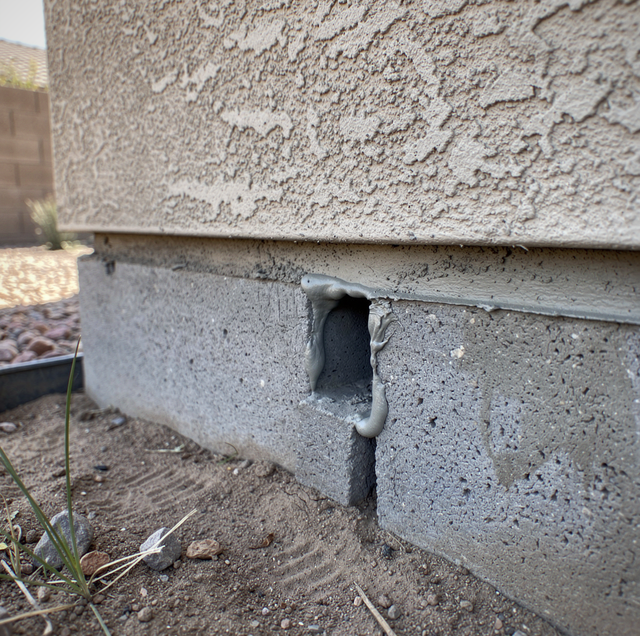
Sealing is built around the building envelope: the weep holes, threshold gaps, hose bib penetrations, and stucco cracks a scorpion could use to get from outside to inside. Closing those spots does exactly what it sounds like. It stops new traffic through them. It does nothing to address whatever was already sitting on the interior side of that envelope on the day the work was done.
A scorpion sheltering in a wall void, a block core, or an attic space before the sealing crew arrived was never using the route that got closed to get in. It was already in. Closing the envelope around it does not remove it, and the envelope was never the only boundary that matters. A wall void connects to the rooms of the house through its own set of gaps, at a baseboard, around a plumbing chase, behind a switch plate, none of which sit inside a sealing scope aimed at the exterior. A scorpion already living in that void has an unsealed path into the room even after the path it would have used to reach the yard is gone.
Timing plays into this too. A female bark scorpion carries roughly two to three dozen nymphs on her back until the first molt, usually one to three weeks. If she was already sheltering somewhere on the property before the work started, that timeline runs on its own schedule regardless of when the crew showed up. Seeing several small, pale scorpions appear over a short stretch a few weeks after sealing is often that clock finishing, not a new problem starting.
A bark scorpion sting can cause serious reactions in children, older adults, and anyone with a health condition. Treat any sting as a medical concern and contact the Arizona Poison and Drug Information Center or a doctor right away.
A Route the Survey Didn't Catch
The survey on which a sealing job is built is a record of one visit. Whoever walked the property found what was findable that day, under that day's conditions, and a handful of ordinary circumstances can keep a real opening off that list without anyone doing anything wrong.
A stack of stored patio furniture or firewood against one stretch of foundation blocks the checkpoint behind it from view. A thick planting bed, an overgrown hedge, or a run of ornamental grass can hide a hairline crack at the base of a wall the same way. Ambient light from a porch fixture or a string of outdoor accent lights can wash out an ultraviolet lamp in that one section of yard, which matters because that lamp is how an after-dark search finds scorpions in the first place, not how it finds the openings themselves; a technician relies on daylight to catch the cracks and gaps. A locked side gate, a dog kept in one part of the yard, or simply a section that got trimmed back or cleared out after the survey date can all put a real route out of view on the day it mattered and into view later, once whatever was blocking it moves.
None of that describes a poorly conducted survey. It describes a survey conducted on a single date of a property that is not stationary.
When the Sealing Material Itself Gives Out
A sealed opening is closed with a physical material at a physical spot, and every material at every spot has a way it can eventually give out: a sealant bond releasing at one edge, mesh working loose at a corner, a door sweep taking a permanent set.
None of these points to who did the work or how carefully. It indicates where a given material sits in its service life, which is exactly why a sealing warranty exists in the first place.
A New Opening That Wasn't There Before
The fourth category is the plainest of the four and the easiest to overlook, because it has nothing to do with the original work at all: something changed after the crew left.
A slab keeps settling for months or years after a house is built, and a settling crack can open in stucco or at a slab edge well after a sealing visit closed everything that existed on that date. A plumber, electrician, or cable technician working on an unrelated repair can cut a new penetration through a wall for a line or a vent, and that fresh opening was never part of any survey because it did not exist yet. A landscaping change can do the same thing from a different angle: a new mulch or gravel bed added against the house can raise the grade enough to bury or bridge a threshold or weep hole that was sealed correctly at its original height, turning finished work into an open route without any material failing at all. A shared property-line wall is another possible source of a new opening if a repair or change on either side disturbs it, though the mechanics of a shared wall are their own subject.
Walk the foundation line once a season and check clearance at every weep hole and threshold against a photo or note from right after sealing. Grade creeping up is gradual enough that it's easy to miss without something to compare it to.
What This Means for What You're Seeing
These four causes do not always announce themselves clearly from the count alone, and treating any one of them as the automatic explanation is a guess dressed up as a diagnosis. A follow-up visit can identify which of these applies to your situation, which is a more useful next step than trying to work it out from a porch light and a hunch.
Frequently Asked Questions
Roughly: sightings from a population already inside often cluster in the first two to six weeks, as nymphs finish their molt and settle into whatever routes they already had. A missed route tends to produce a repeat pattern at the same one or two spots from early on. Material failure usually takes longer, often months, since it depends on a full swing of temperature cycling working a joint loose. A new opening can appear at any point and lines up with whatever caused it: a repair date, a landscaping delivery, or a stretch of ground settling.
It happens more than people expect. Bark scorpions live for several years and show strong loyalty to a shelter that has already proven workable, so one that got sealed onto the interior side of a wall void can keep using that same route into the room for a long stretch of time. A sighting pattern clustered at nearly the same spot for months is more consistent with this than with a constant stream of new arrivals.
It can, in different ways for different causes. A sealant applied shortly before heavy rain may not reach the dry-curing window it needs, leaving a joint softer than intended without any defect in the product itself. Extended heat works more slowly, through the expansion-and-contraction cycling described above, and shows up as gradual material wear rather than an immediate failure.
Not necessarily. Where scorpions show up inside a house can shift for reasons unrelated to the sealing work itself. An interior renovation, a new stack of boxes creating fresh harborage, or even a drop in food supply elsewhere on the property- fewer crickets after a cricket treatment, for example- can push an existing population toward different rooms in search of shelter or prey.
Yes, and it is fairly common. A property can have a population already established inside a wall void and, separately, a new crack from settling on the opposite side of the house. The two are unrelated causes that happen to be producing sightings in the same season, which is part of why a single explanation rarely covers everything you are seeing.
Yes, and it speeds up the follow-up visit. Note the date and rough location of each sighting, whether it was on the floor or climbing, and anything that changed around the house in the weeks before: new mulch, a repair, a stretch of heavy rain. That short record does more to narrow down which of the four causes fits than a single fresh sighting can on its own, since a pattern across several sightings is what actually distinguishes them.
Sealing is exact work aimed at an exact set of openings, and exact work still sits inside a house that keeps changing after the crew leaves: block keeps expanding and contracting through the seasons, ground keeps settling, and whatever was already inside on the day of the work keeps living out whatever time it has left on its own schedule. None of that makes a scorpion showing up weeks later a sign that the work was wasted. It means a single visit closes what could be found and predicted on that one day, and a house keeps doing what houses do long after the crew's truck pulls out of the driveway.
Schedule a black-light scorpion search — get the specific cause behind continued sightings identified so the next step actually fits it. Russell Pest Control serves the Phoenix Valley. Call (623) 469-7583.
