
The Shared Block Wall Problem: When the Scorpions Are Coming From Next Door
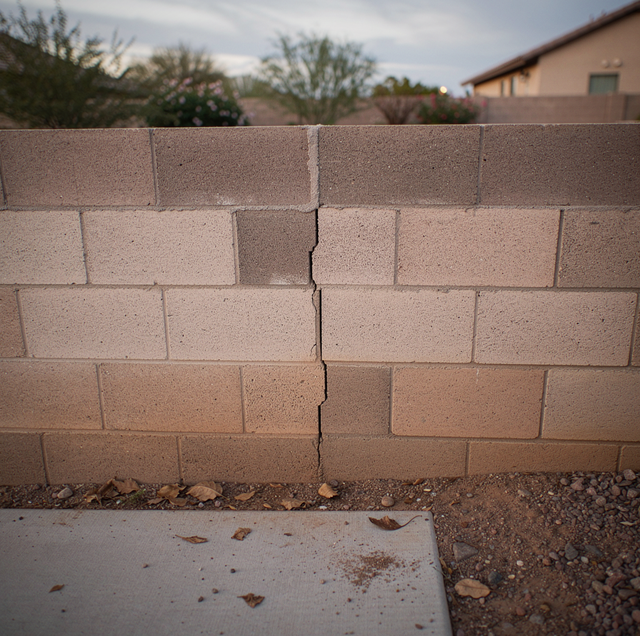
Quick Answer: A shared block wall is hollow inside, and its footing runs continuously beneath both yards. A population sheltering in the connected cells is reachable from either face, and reseeds whichever side gets treated alone.
You sealed the thresholds, pulled the rock bed back from the foundation, kept the treatment on schedule, and the count around the house dropped the way it was supposed to. Everywhere except one stretch. Along the block wall on the north side, the one that ends at your property line and begins again as somebody else's yard, you are still finding them: two on the wall face at ten at night, a nymph on the patio slab, another the following week in the same twenty-foot run.
When the pattern holds to one boundary like that, the question of whether the scorpions are coming from your neighbor's yard stops being paranoid. The wall between you is not the barrier it appears to be. It is a single hollow structure with two exposed faces, built once, sitting on one footing, and whatever is inside it is available to both yards. What follows is how that works, how to confirm the wall is the source rather than something unrelated, and how to raise it next door as a plain conversation.
What a Shared Wall Is Underneath the Paint
The standard masonry wall around a tract yard is built from concrete block, nominally eight by eight by sixteen inches, and each unit has two open cells running through it top to bottom. Laid in running bond, those cells stack course on course, so a six-foot wall carries a column of open space every eight inches along its length. Only some get filled: the ones holding vertical reinforcing steel, typically several feet apart, plus whatever the bond beam near the top required. The rest stay hollow from the cap down to the footing.
Horizontally, the wall is less sealed than it looks. Head joints, the vertical mortar joints between blocks in the same course, get buttered by hand and are routinely thin, incomplete, or skipped where a block sat tight against its neighbor. Over the long run, enough are imperfect that the interior behaves as a single connected space rather than a row of separate chimneys. Many walls also carry a cap that bridges the top cells without closing them, leaving a continuous void under the lid.
Underneath all of it is one footing. A shared wall is not two walls meeting at the line. It is a single run of block on a single trench-poured footing, put in once, usually before either yard was graded into its current shape. The concrete under your side and the concrete under theirs came out of the same pour.
Why the Inside of the Wall Doesn't Care Which Side You're On
That interior matters because it beats either yard as habitat. Inside a block core, the temperature swings less than open air, humidity holds longer than exposed ground, and every surface sits within touching distance on at least two sides. Bark scorpions seek exactly that contact, wedging into tight crevices through the day and hunting after dark, and a stack of open cells gives them a vertical crevice they can climb without ever being exposed. Their prey uses it too: crickets, roaches and silverfish shelter in the same voids, which means the wall feeds whatever lives in it.
Access to that interior exists on both faces and along the base: a cracked head joint, a chipped block, a drainage gap left unmortared at grade, an old anchor hole, the open cells where the run terminates. You can close the ones on your face. The ones on the far face stay open, and the interior connects them. Treating one face of a shared wall is like mopping one end of a hallway while the far door stays propped open.
The shared footing works the same way. The trench line under it stays cooler and holds soil moisture longer than an open yard a few feet away, and that band runs continuously beneath both properties, so a drip line along the base on their side waters the ground your side of the wall sits on.
Confirming the Wall Is Actually the Source
A boundary wall is a natural suspect and an easy one to be wrong about. Four checks separate a wall-driven pattern from the alternatives.
- Count by segment, not by night. Walk the property after dark with a UV flashlight; bark scorpions fluoresce blue-green under ultraviolet light. Divide the perimeter into runs of roughly twenty-five feet and write a number beside each. A wall-driven problem shows a gradient: high numbers along one shared run, lower numbers on the street-side wall and the house perimeter.
- Note how close to the base they sit. Scorpions crossing your yard from elsewhere spread out over open ground; a population living in the wall stays tight to it, and most of what you count lands within a couple of feet of the block.
- Look for nymphs. Small, pale, translucent juveniles turn up near harborage, seldom at the end of a long trip, so a nymph count along one run points to a brood inside that stretch instead of transient adults passing through.
- Check the timing. Pressure from a hollow wall builds slowly across a season. If yours jumped inside a week or two, the cause may sit off your street entirely, and "Why You're Suddenly Seeing Scorpions After Years of None" walks through what to look for.
Two nights of numbers beat a month of impressions. Repeat the walk within the same week and see whether the gradient holds.
When the Wall Itself Gets Opened Up
One scenario runs faster than the rest. When a section of shared wall comes down, for a new gate, storm damage, or a full replacement, the demolition opens every core along that stretch at once. Whatever was sheltering inside leaves the same day, into both yards, and the rubble staged on either side while the work runs offers the shaded, crevice-rich cover it was already using.
The rebuild carries its own window. Fresh block goes up with its cells open and its mortar still curing; the base sits in disturbed soil, and the new section often meets old block at a joint nobody closed. A run rebuilt in spring can read as a hot spot through the following summer for reasons unrelated to how either yard is kept. If your increase started within days of work on a shared wall, that timing is most of the answer, and the useful move is a check on both faces once the new section has cured.
What Sits Along the Other Face
None of what follows is a failure of care next door. It is ordinary yard design that happens to feed a shared void.
- Drip emitters or a soaker line along the base of the wall, keeping the footing band damp year-round.
- A rock bed banked against the block, shading the base and holding the crevice depth that scorpions and crickets both use.
- Stacked material against the wall: pavers, firewood, off-season patio furniture, pool equipment on a slab.
- Fruit drop from a citrus tree planted close to the line, feeding the insects that feed scorpions.
- A landscaping light left on nightly near the wall, pulling flying insects into the few feet directly above the harborage.
How to Bring It Up Next Door
There is no graceful version of this that involves an accusation, so skip the accusation. What you have is an observation and a number, and both travel well.
Go in person, in the evening, and keep it short. Lead with what you have seen and where. "I have been counting scorpions along the wall between us, six along that run last Tuesday night. Have you been finding any on your side?" That question does most of the work. If they have been seeing them too, you are two people with the same problem and one structure in the middle of it. If they have not, you have told them something worth knowing before they find out on a bare foot.
Make the wall the subject and leave the yards out of it. A hollow wall built as one piece explains the pattern without anyone's housekeeping entering the conversation. Say that the block is hollow, that whatever lives inside it is reachable from either face, and that this comes up often enough on a shared line to have a normal fix.
Then offer something easy to accept. Walking your side with a UV light and passing along the count asks nothing of them, and neither does offering to have your side looked at first and to tell them what the technician found.
If the answer is no, the work on your own face still earns its keep. Closing the openings you can reach, keeping the base of the wall clear, cutting the prey supply on your side, and holding treatment current along that run all lower what crosses. It will not reach zero while the interior stays occupied, and knowing that in advance keeps a real improvement from feeling like a failure.
If the neighbor agrees to compare notes, run both counts on the same night within the same hour, walking the wall from opposite faces at a matched pace. Numbers taken a week apart under different conditions will not line up.
Why Both Faces at Once Beats One Face Twice
If both sides do move ahead, timing matters more than it seems. A treatment applied to one face works on that face and the ground beside it. It does not reach the cores, and the population inside them repopulates the treated side from the untreated one as the residual weathers down. Run the two sides a month apart and much of what the second treatment does goes toward undoing the first side's recolonization, rather than making new progress of its own.
Run them inside the same week and the arithmetic changes. Both faces, both base bands, and the openings on both sides are handled while the interior population remains a single population, which shrinks the reservoir rather than relocating it. A UV walk on both faces before the work and again a month after gives two numbers that can fairly be compared.
Frequently Asked Questions
It changes the face and leaves the interior alone. A coat over block closes surface porosity and hairline crazing, worth a little on the climbing surface, while the cap void, the base gaps, and the open cells at the ends of the run stay as they were. A stucco skin can also hold moisture against the block longer.
Roughly, with enough counts. Numbers taken in twenty-five-foot segments across three or four nights tend to cluster around one section of the run, and that cluster usually sits where the base stays coolest and dampest longest: the stretch shaded by a tree, the low point where runoff collects, the length behind a rock bed. Chalk marks on the cap keep your segments in the same places night to night.
No, and the contrast is useful. A view fence has no interior void, so the mechanism described here has nothing to run through. What it does share is the footing beneath it and the habit of collecting a rock bed along both sides. Pressure through a view fence arrives across open ground and reads as a flatter count across your segments, without the spike along one run.
Expect weeks, not days. Nymphs already inside the cores keep emerging as they molt and move, and a bark scorpion's life cycle runs for years, so one quiet evening settles nothing. A repeat UV walk at three to four weeks, and again at eight, shows the trend better than the first night after service ever will.
Not as a wave, which is the usual worry. Treatment on one face reduces what survives there; it does not drive the interior population across the line in a burst. Expect at most a modest, short-lived rise along your face for a week or two as activity redistributes, then a return to roughly the previous level.
A property line is a line on a map. The wall drawn along it was poured as one footing, laid as one run, and hollowed the whole way through, and the population living inside it has no way to read a plat. Seeing the wall that way makes the conversation smaller than it looks from your kitchen window. You are not handing a neighbor a problem. You are telling them what you counted after dark along a structure you both live against, and most people would rather hear it from you than find out the way you did.
Schedule a scorpion control visit — get the shared wall line mapped and treated along with the rest of your perimeter. Russell Pest Control serves the Phoenix Valley. Call (623) 469-7583.
