
How Long Does Scorpion Sealing Last? What Actually Wears a Seal Down
Quick Answer: Scorpion sealing has no single expiration date. UV exposure, temperature swings, substrate movement, and adhesion loss wear at different rates, and the material at each joint ages on its own clock, so one bead can outlast another by years.
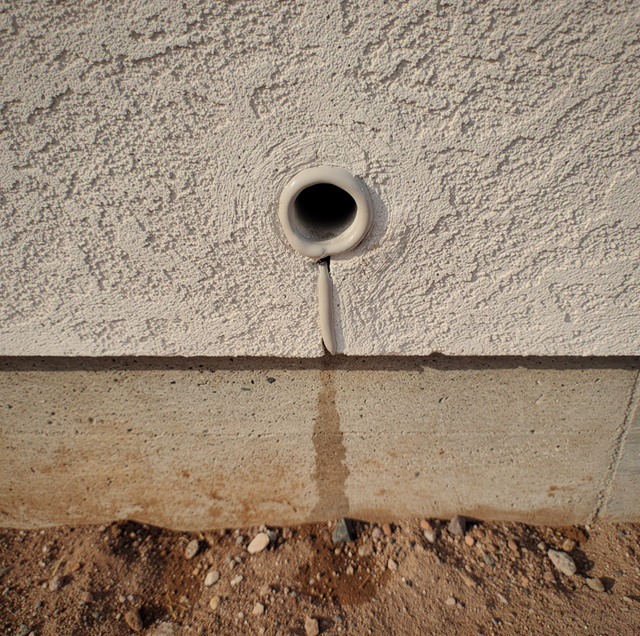
Press the sealant bead at a foundation weep hole two seasons after a sealing visit, and you learn one of two things. Either it still gives slightly under a fingertip, or it has gone hard and faintly chalky, with a hairline separation where it meets the stucco. Neither reading settles the question on its own, because a sealing visit never leaves one material behind. It leaves four or five, at different joints, on different walls, each aging on its own schedule.
What a Sealing Visit Closes
A scorpion doesn't need a doorway. A bark scorpion's body is flattened top to bottom, and the flexible membrane between its armor plates lets it compress further still, which is how one works through a gap roughly a sixteenth of an inch wide: the opening at a weep hole, the line under a threshold, the annular space where a utility line passes through stucco, the hairline crack where a garage slab meets the foundation wall. Sealing work targets those specific openings, not the wall as a whole, closing the ground-level and climbing routes a technician maps during an inspection.
Scorpion Sealing vs. Pest Control: Why Most Homes Need Both makes the case that physical exclusion, unlike a chemical barrier, needs no schedule and holds until something damages it — and for most of what goes into a sealing job, that holds up exactly as described: mesh, mortar, and hardware don't depend on staying fresh, and none of them fade the way a chemical residue does. Sealant is the one material in that mix that doesn't fit quite as cleanly, because it's a cured polymer bonded to the substrate rather than a rigid piece wedged or embedded into an opening, and a polymer bond ages on its own clock even while nothing around it has been damaged. That distinction, and how long the work holds because of it, is what the rest of this piece works through. A technician might pack copper or stainless mesh into a weep hole, run a bead of sealant along a threshold, screen a vent opening with hardware cloth, and replace a worn door sweep in a single afternoon: four materials, at four joints, aging on four timelines. Asking how long "the sealing" lasts is really four questions stacked into one.
The Materials Doing the Work
Sealant: Exterior scorpion sealing runs mostly on silicone or polyurethane, applied at cracks, expansion joints, and the annular gap where a pipe or wire passes through a wall. The difference between the two starts with backbone chemistry. Silicone is built on a chain of alternating silicon and oxygen atoms, with bonds strong enough that ordinary sunlight carries too little energy to break them, which is why silicone tends to hold its flexibility for a long stretch on a sun-facing wall. Polyurethane is built on an organic carbon backbone that ultraviolet light can break apart, so it weathers faster in direct sun. It earns its place at joints where bonding and finish matter, since it takes paint and can be matched to stucco.
Metal mesh: Weep holes, plumbing penetrations, and the hollow cores of block walls are often packed with copper or stainless steel mesh rather than sealed with a bead, precisely because those openings need to keep draining or venting. How to fit that mesh without blocking the drainage a weep hole depends on is its own detailed subject, covered in How to Scorpion-Proof a Weep Screed Without Trapping Moisture.
Hardware cloth and screening: Larger openings, including attic and foundation vents and gaps under eaves, are covered with rigid metal screening fastened around the edges, the same material used in rodent exclusion work. The screen itself is rarely what gives out first. The fasteners and the edge detail usually go on before the mesh.
Door sweeps and thresholds: The gap under an exterior door opens and closes every time somebody walks through it, so it takes a rubber or vinyl sweep rather than a static bead. That component wears through abrasion and takes a permanent set after years of being compressed in one position, which is a different failure path from anything that happens in a sealant joint.
The Four Things That Wear a Seal Down
None of these is a defect in the work. They are the ordinary physics of an exterior surface, and they explain why one bead on a property looks fine for years while another, closed the same afternoon, needs attention much sooner.
UV degradation: Ultraviolet light carries enough energy to break certain chemical bonds, and in an organic polymer it cleaves the long chains that give the material its stretch. The visible result is chalking, where the binder at the surface erodes, leaving mineral filler behind as a powder, followed by stiffening and then fine surface cracking. This is the mechanism that turns a rubber band left on a sunny windowsill brittle months before one kept in a drawer goes anywhere. It works on polyurethane and acrylic harder than on silicone, and it works on a bead facing south or west harder than on the same bead tucked under an eave or sitting on a shaded north elevation.
Thermal cycling: Stucco, block, metal flashing, and sealant all expand and contract at different rates as an exterior surface heats through the day and cools overnight. Every joint between two of those materials widens and narrows daily, and the bead spanning it has to stretch and compress by that amount every cycle. Manufacturers rate their products for movement capability, usually expressed as the percentage of the joint's width the material was tested to accommodate without losing its bond. A joint working near the top of its rated range every day fatigues the bond line steadily, long before a single hot afternoon does anything visible.
Substrate movement: Foundations settle, stucco develops hairline cracks as a house ages, and a slab can shift at a control joint enough to widen a gap past what the bead covering it was ever sized to bridge. This failure has almost nothing to do with age. The material can still be in good condition and be overrun anyway, because the gap outgrew the seal.
Adhesion loss at dissimilar-material joints: A bead meeting stucco on one side and a metal door frame or flashing on the other side carries more stress than one that sits entirely on a single material. Cementitious stucco is porous and strongly alkaline; metal is smooth, non-porous, and changes dimension at a different rate as it heats. A sealant can keep its grip on the stucco side and release from the metal side, and that one-sided release is among the more common ways a joint can reopen while the bead itself still looks intact. Surface prep and priming carry the most weight exactly here.
When you walk your own sealing work, start on the south and west elevations and at any joint where two different materials meet. Those two conditions account for most of the wear, so the weakest bead is usually already among them.
What Manufacturers Publish, and What It Leaves Out
Sealant makers publish performance data for their own products, including service-life expectations drawn from accelerated weathering and standardized movement testing. Those published figures vary widely from one product line to the next, and each one describes the material under laboratory conditions: controlled ultraviolet exposure, a managed temperature range, a test joint built to the geometry the product was designed for, and no substrate behaving unexpectedly. A rating like that is a manufacturer's claim about a material in isolation.
A lab specimen never had two remodels done around it. It was not pressure-washed twice a year, buried under fresh rock, or asked to bridge a joint that widened a quarter inch when a foundation settled. Service life at a specific joint on a specific house depends on sun exposure at that spot, how much the substrate moves, whether the surface was clean and dry when the bead went on, and what happens to it afterward, and a lab figure accounts for none of that. Read a published number as a ceiling under ideal conditions rather than a forecast for any joint on an actual property.
Where Sealant Sits Between Mesh and a Chemical Barrier
Scorpion Sealing vs. Pest Control: Why Most Homes Need Both covers the broader contrast between a chemical barrier's steady fade and physical exclusion's abrupt, localized failure. Sealant is the material that doesn't fall cleanly on either side of that line: it's a physical barrier like mesh, closing a specific gap rather than treating a band of ground, but it's also a cured polymer with its own aging curve, the same UV and thermal-cycling mechanisms covered above, so it weakens with age even though nothing has physically damaged it. That is why sealing work at one property rarely ages uniformly. The mesh in a weep hole, the bead at a threshold, and the screening over a vent each runs on its own clock, shaped by its own material and its own exposure, even when a technician installed all three on the same afternoon.
Ask which mesh grade went into wet locations. Stainless generally holds up better than copper in soil that stays damp near an irrigation emitter, since dissimilar metals in continuous wet contact can accelerate corrosion at whichever one is less resistant.
What Extends or Shortens the Life of a Specific Joint
A handful of factors move the needle more than the choice of material alone:
- Exposure and orientation: A joint that takes full afternoon sun runs hotter and absorbs more ultraviolet radiation than one on a shaded elevation, and both of those feed the mechanisms above.
- Surface prep before the bead went on: A joint cleaned, dried, and primed where the substrate calls for it bonds better and resists adhesion loss far longer than one sealed over dust, old caulk, or a damp surface.
- Joint geometry: Sealant needs workable width and depth to flex the way it was designed to. A bead smeared thin across a wide crack, or packed so deep it grips the back of the joint along with both sides, has less room to move and fatigues sooner.
- Conditions at the time of application: A joint sits at its widest when the wall is cold, and its narrowest when the wall is hot, and sealants carry an application temperature range their makers specify.
- What happens to the joint afterward: A pressure washer aimed at a sealed foundation band, fresh rock piled against a bead, or an irrigation line rerouted to soak a wall all load a seal in ways the original work never accounted for.
- Corrosion exposure for metal components: Mesh or screening sitting in consistently damp soil gives out sooner than the same material in a dry gap.
- Ongoing disturbance: Settling, remodeling, and nearby construction can all reopen a gap that was closed correctly the first time.
Sealing work usually carries a warranty of its own, separate from the warranty that covers the materials aging above.
Frequently Asked Questions
Not with any expectation that it holds. A sealant bonds to the substrate, and a new bead laid over an aged one is bonded to a layer already failing. Cured silicone is the harder case, because very little adheres well to it once it has skinned over, including fresh silicone from the same tube, and manufacturers who publish a recoat procedure generally require an abrasion or primer step first rather than a direct bead over the old one. Properly resealing a joint means cutting out the old material and cleaning back to the sound substrate before anything new goes in.
Usually, it's the joint itself that has changed since the original work, not the material or the crew. A gap that widens further each cycle from ongoing settling, or a joint that now sits between two materials moving at noticeably different rates because a repair changed one side, will overrun any bead sized for the original opening. At that point, the fix is addressing why the gap keeps growing, sometimes with a backing rod or a wider joint detail, rather than a third identical bead in the same spot.
Paint is not a protective layer for a joint that moves. A paint film is far less flexible than the sealant under it, so it cracks along the joint and can lift, and cracked paint holds water against the bead. Silicone will not accept most coatings, which is one reason polyurethane shows up where a stucco color match matters. Matching a finish is a cosmetic decision, and it buys no extra service life.
Often not. Acrylic-latex caulk is formulated for interior trim gaps that barely move, and manufacturers rate it for far less joint movement than exterior-grade silicone or polyurethane. Product literature normally states a movement capability and an exposure rating, and those two figures tell you more about whether the material was built for a joint that flexes in direct sun year-round than the label's marketing copy does.
They are two different failures with two different causes. A split through the middle of a bead still bonded on both sides means the material itself tore, because it was asked to move further than it could or has aged past its stretch. A bead that releases cleanly along one edge while remaining intact is a bond failure, which points to surface prep, contamination, or a joint between two materials that behave differently. The first is a material and joint-width question. The second is a preparation question.
No, and gap size is part of why a technician carries several materials to one job. A sealant bead needs real width and depth to flex as designed. Feathered thin across a wide opening, it tears early, and forced into a gap too narrow to hold a workable bead, it never develops much strength. Wide openings usually get a backing material behind the bead or a mechanical closure, and openings that have to keep draining or venting get mesh or screening.
Reading the Wall in Front of You
A seal does not run out on a date. It gives way at the one spot where sun, movement, and material chemistry line up against it hardest, and that spot can sit on a bead a year old or on one that has held for ten. So the useful question at any property is a present-tense one: which joints here are carrying the most load, and what do they look and feel like today, regardless of how long ago the work was done. A bead that still gives under a fingertip. An edge still tight against the wall. Mesh still packed where somebody set it. Those are readings you take with a flashlight and a few minutes, and they describe the house in front of you in a way no published rating can.
Schedule a scorpion sealing inspection — find out which joints on your property are holding and which ones have started to open. Russell Pest Control serves the Phoenix Valley. Call (623) 469-7583.
