
Bees Coming Through a Ceiling Light? What That Fixture Reveals
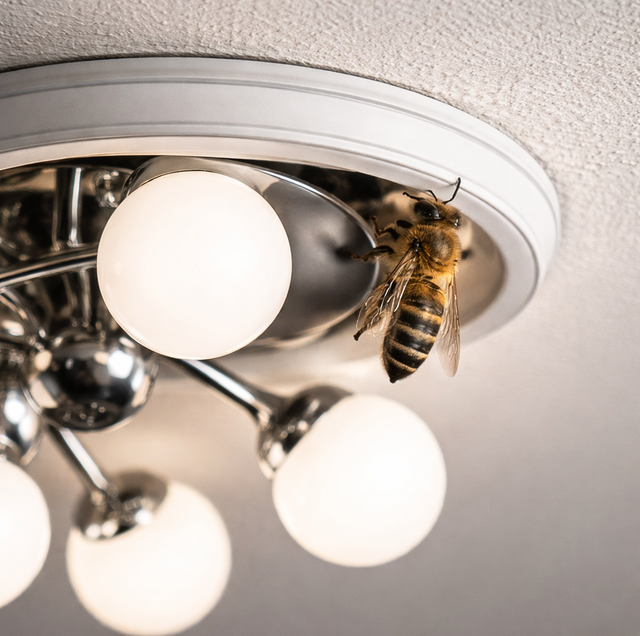
The screwdriver usually comes out within ten minutes of the first bee. Something moves at the edge of the hallway; can light. The trim ring has picked up a faint dark crescent along its lower edge, and the obvious next move is to pop the ring loose and look. It takes a few seconds and no skill at all, which is the problem. That ring is the difference between a slit a bee has to squeeze through and an open hole into the room.
Bees Emerging at the Fixture's Edge
A recessed can light, a bathroom fan housing, or a flush-mount ceiling fixture is not sealed the way the surrounding drywall is. Each one is built around a cut hole: a housing hung on adjustable bars spanning between the joists, wiring pulled in through a knockout in its side, a trim ring that springs or clips against the ceiling rather than bonding to it. None of that hardware closes tight. A colony working the space above the room uses whichever gap is loosest as its interior exit, and around that gap, a trim ring forms the reveal between the ring's flange and the ceiling plane, usually no deeper than the ridge of paint the ring was pressed into. A worker folds its wings and pushes through that, a few at a time rather than as an obvious stream, which is why the fixture and not the ceiling in general is the detail worth watching.
Staining That Spreads From the Trim Ring
Before a bee is ever visible, the fixture often tells on itself in paint. A ring of amber-brown discoloration creeps out from the edge of the trim, sometimes with a thin drip line running from the low point of the ring toward the nearest corner. That is honey and nectar working through the drywall from the back side. The pattern is more useful than the color: staining tied to a colony above a fixture stays tight to the housing and darkens most right where the ring meets the ceiling paint, because that is both the shortest path the moisture has to travel and the one line where the paint film is already interrupted by a cut edge. On a textured ceiling, the same seam catches it first, so the mark runs around the ring's circumference before it bleeds outward into the open field of the ceiling. A flush-mount fixture with a glass shade hides it better: the residue collects as a dull film inside the shade and gets taken for dust.
The Housing Itself Is an Opening Into the Space Above
A can light housing is not a sealed box. Many older ones especially carry a vented top or side slots that let bulb heat rise into the joist bay above, and even the enclosed, gasketed types leave gaps where the mounting bracket and the wiring knockout meet the can. A vent path that moves heat in one direction carries a bee just as easily moving the other. A colony already established above a room can reach the housing by the same route the heat leaves it, which is why a fixture can show activity with no visible gap from below at all: the opening in use isn't the trim ring, it's the vented cage sitting a few inches above it. That is also why a bead of caulk around the visible ring rarely settles anything: it closes the opening a homeowner can see and leaves the route in use untouched.
Why the Signal Lands at the Metal Can
Warmth and sound above a ceiling are not new information in themselves. What the fixture changes is where they land. Steel and aluminum move heat and vibration far more readily than gypsum board, so comb built close to the top of a housing registers as one concentrated point at the can instead of a broad zone across the ceiling. Honey bee brood is held close to 95°F inside active comb year round, whatever the weather outside is doing, so a colony sitting against a housing is a steady source rather than an intermittent one. A can that still reads warm an hour after the bulb went off is the version of that worth acting on, because the bulb has already been ruled out as the cause.
What Can Be Checked Without Touching the Fixture
Most of the useful observation happens from the far side of the room rather than from under the light. Sighting along the ceiling from a low angle, almost edge-on to the plane, shows a shallow dimple or bulge that is invisible when you look straight up at it. The other fixtures on that run deserve the same look, since a second trim ring carrying the same crescent narrows things further than one does alone, and a return vent or a smoke detector base counts as the same kind of penetration. None of it requires a ladder or a hand near the fixture, and all of it is accessible to a technician.
Why the Trim Ring and Housing Should Not Be Opened
Do not run the fixture while activity is showing at it. A lit bulb adds heat to the comb, and honey resting against the housing, and softened wax reaching a hot lamp is what turns a pest problem into a fire.
A recessed housing is also an electrical enclosure, with wire nuts and a socket connection sitting right where a colony's comb would be closest to the room. Popping the ring loose, or pulling the housing down to see how bad it is, does two things at once. It puts a face and hands at the one point defensive bees are most likely to be, and it turns a slit into a full opening, giving the colony an unobstructed path into the room instead of a hidden one into the joist bay. Comb or honey that lets go once the housing is disturbed drops straight through, along with anything riding on it. None of that improves with a flashlight and a screwdriver; it only removes the one barrier keeping the situation above the ceiling.
Frequently Asked Questions
No. What the bees are working on is the physical gap around the housing and the trim ring, and that gap stays open whether the bulb is lit or dark. Some housings also carry a foam or felt gasket that seals the fixture against drafts at installation; once it compresses or ages, it stops sealing and becomes another soft spot a colony can push through.
Often, if what caused it is still in the cavity: a patch closed over comb and honey will re-stain, and the primer-and-paint sequence is a repair question answered separately. What matters at the ceiling is how much has to come out. Sugars travel along the paper face of the board well past the edge of the visible mark, and a ceiling board sags slightly between joists, so honey collects at the low point of the bay rather than directly under the comb. The area that has to be opened is routinely wider than the ring anyone can see from the floor, and often sits a little to one side of it.
The housing type matters more than the bulb. Many LED retrofits are canless wafers: a thin disc over a cut hole with a small junction box pushed off to one side, and no metal can between the room and the cavity at all. That leaves an open hole with a trim flange over it rather than an enclosure, so activity there shows at the flange edge instead of through a vent, and it leaves less residual warmth at the fixture, which makes a housing that does read warm a cleaner signal than it used to be.
A bath fan housing usually has its own duct running to a roof cap or a wall vent, a second penetration entirely separate from the fixture opening itself. That duct, and the loose-fitting damper flap at its outside end, can become an entry point on its own, so activity at a fan housing doesn't always point at the same structural situation as activity at a can light.
Not always. Bees will travel a short distance along a joist bay before reaching the nearest opening, so the comb can sit a few feet to one side of the fixture rather than stacked directly above it. A joist bay is a long open channel in one direction and closed off in the other, so that offset almost always runs along the bay rather than across it. A technician will sound or scan several feet of ceiling either side of the light, in line with the framing, before deciding where to open anything.
Yes, if it can be done safely at the panel. Cutting power removes the heat the bulb adds and keeps a live connection out of the picture while the situation is assessed. What it does not do is make the fixture safe to open. The defensive bees at the gap and the comb sitting above the housing are both entirely unaffected by the breaker, so the trim ring stays on until someone in protective gear is standing under it.
Starting an Inspection Outside the Room
A fixture that has been showing signs for a while is usually the newest opening in the story rather than the first one. Bees seldom pick a ceiling light as their way in from outdoors. They find a gap along a roofline, an eave, or a vent, work inward through the framing, and only meet the housing from the cavity side once the colony has spread that far. That is worth saying out loud when the appointment is booked, because it changes what gets looked at first. The fixture is where an inspection tends to end up. The outside of the building is where it starts.
Get that fixture checked before it gets opened — a technician can find out what's above it without disturbing it. Russell Pest Control serves the Phoenix Valley. Call (623) 469-7583.
