
Bees Entering Weep Holes: The Gap You Can't Just Plug
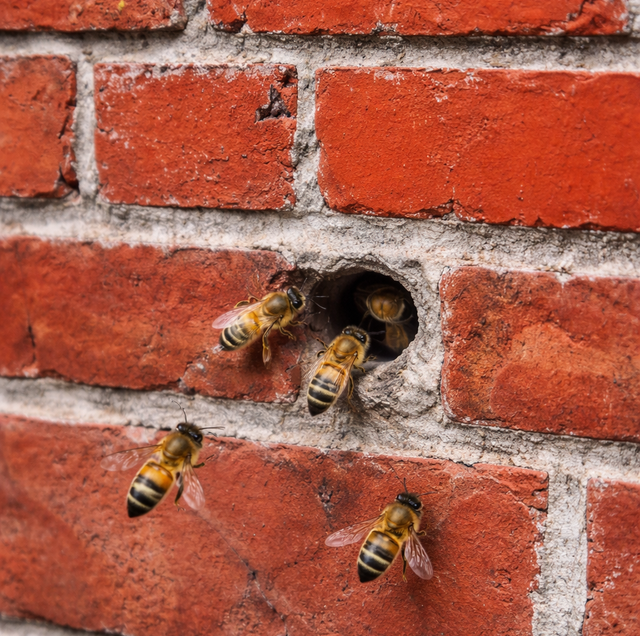
Watch the bottom course of a brick wall for a few minutes, and the traffic sorts itself out. Every bee is heading for the same spot: one vertical gap in the mortar, a slot the height of a single brick where the mortar was left out. They go in, and a minute or two later, they come back out. The instinct almost everyone has at that point is to reach for a tube of caulk. Hold off. That gap is not failed masonry. It is the one opening in the wall that the building actually needs, and closing it would cost more than it saves.
What That Slot Actually Is
A weep hole on a veneer wall comes in three forms, and they are easy to tell apart once you know what you are looking at.
The most common by a wide margin is an open head joint: the vertical mortar joint between two bricks, left unfilled, running the full height of one course. From a few feet away, it reads as a joint someone forgot. The second is a weep vent, a small plastic or aluminum insert pressed into that same head joint, usually louvered across its face. The third is a wick, a length of cotton or synthetic rope run through the joint into the cavity behind, pulling water out by capillary action rather than letting it run. Wicks age badly, and once the exposed end frays or gets tugged out, what remains is an open head joint with nothing in it.
All three sit at the bottom of the same assembly. A brick or block veneer carries its own weight and little else. It stands off the framing on metal ties with an air space behind it, and behind that space sit the sheathing and a weather-resistive barrier. Water that gets through the veneer, and some always does, runs down the back face of the masonry or down that barrier, lands on a through-wall flashing at the base of the cavity, and travels along it to the nearest weep. The flashing is the floor of the system. The weep is the door.
Weeps appear higher up the wall too. Wherever a flashing sits over an opening, it has to drain at that level, so they show up above window and door heads, at lintels and shelf angles, and sometimes at a sill pan. Stucco solves the same problem with a different part, a continuous weep screed along the base of the wall instead of a row of separate holes.
An open head joint left for drainage repeats at a regular spacing along the same course and has clean, tooled edges. A cracked or fallen joint is ragged, irregular, and does not repeat. Spacing is the tell.
Why a Bee Takes This Opening
Nothing about a weep hole has to be modified for a colony to use it. It sits shaded under the lip of the course above for most of the day, out of wind and glare, and it opens into a void that runs cooler than the sunlit face of the wall. A scout works through the same criteria it applies to any cavity, and this one satisfies them untouched.
Size settles the rest, and this is where the three forms diverge. An open head joint is narrow enough that bees pass in single file, which is the kind of doorway a small colony can post a guard on and hold. A round weep vent is barely more generous, and its louvers give an arriving bee something to land on. A wick still in place is the least usable, because the rope occupies most of the joint; a wick that has rotted back is the most usable, because it leaves a clean opening with a soft channel behind it.
From the bee's perspective, the appeal is that the opening already performs the filtering a colony would otherwise have to handle itself.
What Sits Behind the Opening
The cavity behind a veneer is continuous. It runs the full height and length of the wall, bounded by the back of the masonry on one side and the sheathing on the other, interrupted only by wall ties and mortar droppings that collect on the flashing during construction. A colony that gets in at a weep has that entire run available, and it builds where the void is steadiest and coolest with a firm surface overhead, which is seldom within sight of the slot it came in by.
Getting from that cavity into the framing is a separate step, and it takes a hole through the sheathing and the barrier over it. Those exist on most houses: a hose bibb, an electrical or plumbing sleeve, a dryer vent boot, an unsealed sheathing seam, or the open top of the cavity where the veneer runs up past the framing. Past any one of them, the interior gaps take over, and a colony can work bay to bay. The drainage cavity on its own does not put bees in a stud bay; a penetration through the sheathing does.
Open to Water, Closed to a Bee
Whatever goes into a weep hole has to keep letting water pass while also stopping insects, and those two jobs pull against each other.
Fill a weep with sealant, mortar, or foam and the drainage stops with it. Water that used to leave the wall at that point stands on the flashing instead, backs up against the sheathing and the back face of the masonry, and eventually shows on the outside as a damp band that lingers after the rest of the wall has dried, a chalky white bloom of salts, or mortar that crumbles when you pick at it. That is a slower problem than a colony and a harder one to reverse.
What goes in is a screen sized for the job, set into the opening so the drainage path behind it stays clear. Fitted is the operative word. A screen pushed in flush and compressed, or bedded in sealant that bridges the opening, or left sitting proud of the face where it catches the grit and webbing that wash down a wall, has failed at the water-half of its job, even while it still stops bees. A cover set into the joint with the flashing left clear behaves the way the bare opening did.
None of that happens while the colony is still inside. Closing an active entrance traps what is in there and puts returning foragers into a defensive cluster at head height, on the side of the house people walk past.
Never plug a weep hole with expanding foam. It swells into the drainage path behind the wall, where nobody can see it, and it has to be dug back out through the joint before the flashing will drain again.
The Order the Work Runs In
Removal comes first, and the cavity behind the veneer is cleared before anyone touches the weep, which on a masonry wall means opening the assembly from one side or the other to reach the void. By the time the opening comes up, the work at the weep is a fitting job rather than a patch. A cover sized to the slot has to sit in the joint without bearing on the flashing behind it, which is why it goes in as a fitted piece rather than being pressed into place while the mortar face is still being cleaned up. The other weeps along the same run get the same cover at the same visit.
Frequently Asked Questions
No. They belong to walls that drain behind their surface: brick, stone and block veneer, where an air cavity and a base flashing do the work. A solid masonry wall built as one mass, or stucco applied directly onto block, has no cavity to drain and no weeps. On lap or panel siding, water leaves at the bottom edge of the cladding rather than through a fixed opening. If bees are entering a wall with no weeps, they are using something else: a utility penetration, a vent, or a spot where trim has pulled away.
Traffic has to run both directions. A working entrance shows bees leaving the slot as steadily as others return, over several minutes, at a rhythm that holds through the day. Traffic running one way only is not confirmation on its own, because a line of bees crossing the wall on the way somewhere else looks identical from the ground for a minute or two. Watch one slot rather than the whole wall, in the warm middle of the day when flight is heaviest. Bees on nearby blossoms move flower to flower on a changing path and never funnel into a fixed point.
Yes, and the list runs longer than people expect. Wasps use them, so do crickets, spiders and other crawling insects, and so do mice. A house mouse gets through an opening around a quarter inch across, and an open head joint is wider than that for its full height, so an unmodified weep is a usable rodent entry exactly as it comes. That is why weep covers are sold and fitted as combined insect and rodent exclusion rather than as bee screens. A joint that has widened, cracked, or lost its wick only opens the field further.
No. A vent moves air continuously and usually arrives screened or louvered from the factory, so its opening is already sized against insects. A weep passes liquid water intermittently and, unless somebody has added an insert or a cover, sits there as a bare gap in the mortar. The difference matters most at the repair: a vent can be re-screened against its own frame, while a weep sits directly on the flashing, so anything fitted into it has to stay clear, or it dams the water it was meant to pass.
Not if it is fitted rather than stuffed. The failure people run into is a screen packed in flush and compressed, one bedded in sealant that bridges the opening, or one left proud of the face where it collects the dirt and webbing that wash down a wall. Any of those turns a drain into a dam. The sign shows on the face of the wall: a damp band along the base course that stays after the rest of the brick dries, or a white salt bloom just above the flashing line.
Yes, and the usual culprit is other work on the house. A mason repointing the base course can fill an open head joint without knowing what it was there for, and a heavy coat of paint or masonry sealer can close the louvers on a vent insert. Add string trimmers, pressure washing, and ordinary settlement working a cover loose at one edge, and the base course is worth a look from time to time.
Why This Job Ends With the Wall Still Open
Most of what gets sealed on a house is a gap nobody ever wanted: a torn vent screen, a split around a pipe, a door sweep that stopped touching the threshold. Those get closed, they stay closed, and the building is better for it. A weep hole belongs to a different category because the wall still needs it to work after the bees are gone. The finished job at the base of that course still has an opening in it, with something selective sitting in the way. Anyone who treats it as one more hole to fill will either solve the bees and create a moisture problem, or solve neither.
Schedule an inspection — a technician can confirm whether a wall opening is still active before any sealing work begins. Russell Pest Control serves the Phoenix Valley. Call (623) 469-7583.
