
Bees in a Water Heater Closet: One Door, No Way Out
Your hand is on the handle before anything registers. The water heater closet is where the shutoff valve lives, or where the pilot went out, so the door gets opened the way any door gets opened: quickly, one-handed, with a body already leaning into the gap. If there is a bee colony on the other side, that is the whole problem in one motion. There is no interval between finding out and standing inside it.
No Second Exit, and No Distance to Fall Back On
An eave or an open fence line gives everyone room to work with. A person can back away twenty feet while a defensive response spreads into open air and loses interest. A water heater closet takes both of those away. It is sized to hold the tank and little else: one door, no window, no second opening, and a narrow service aisle around the tank. The way out is the same door the person just came through, often pulled shut behind them out of habit. Whatever happens in that space happens at arm's length, with the escape route and the hazard sharing the same few feet of air. A modest colony that would be a scheduling question from across a yard behaves like something else at that range.
The Burner and the Gas Line Are in That Same Few Feet
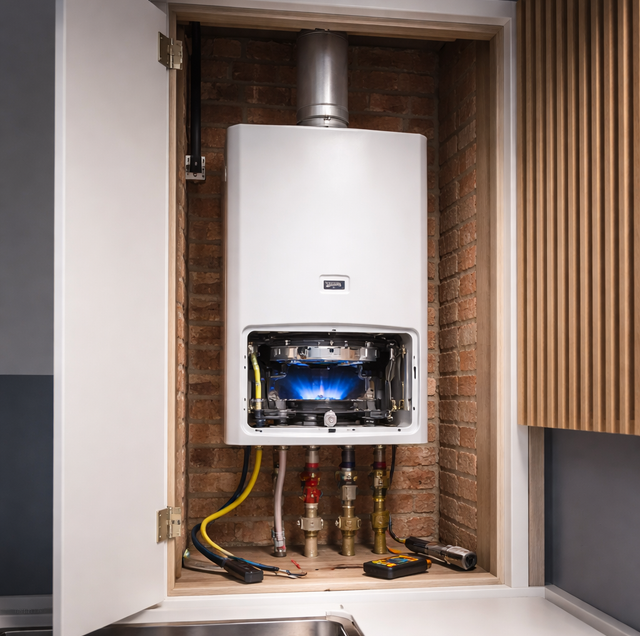
Most residential water heaters that run on gas keep a burner assembly at the base of the tank, fed by a gas line into the closet, with a flue above it. On an older unit, ignition is a standing pilot flame burning continuously a few inches off the floor. On a newer one, the igniter fires intermittently only on a call for heat, with no flame at all in between. Either design puts a live ignition point, a fuel line, and a hot flue connector within a step of the door, and a colony built against the tank jacket, behind an access panel, or in the gap along the wall is inside that same footprint.
The risk here is not that bees ignite anything. It is that the two hazards sit within a few feet of each other. Relighting a burner means kneeling at floor level with a face and hands inside the space a colony would be defending, holding a lit igniter, while an arm that jerks back at the first sting has a gas line, a flue connector, and the tank within reach of it. That is the mechanism: a person stung at arm's length in a room they cannot step backward out of, reacting suddenly, next to hardware that assumes nobody will fall into it. Comb and wax are combustible in their own right, and comb across the burner's air opening or the draft hood changes how the unit burns and vents. An aerosol can discharged toward a live burner is a separate flammability problem that belongs to the can, not the bees.
Aerosol insecticide propellant is flammable. A can discharged into this closet, toward a pilot or a burner that can light at any moment, is a fire hazard independent of the bees. Do not spray, and do not relight.
Why It Stays Unnoticed Until the Door Opens
An eave announces itself: a cluster overhead is something a person sees before walking under it. A door handle announces nothing, so the warning and the exposure arrive in the same second, which is backward from how a hazard should work. The people who reach for that handle are the ones with a reason to: whoever services the water heater, and whoever goes looking for the shutoff valve.
The closet helps hide the colony in the meantime, because the tank already ticks, hums, and runs warm on its own, so a colony's sound and warmth read as the appliance doing its usual thing. Time does the rest. In a lot of houses, this door gets opened a handful of times a year, long enough for a void a scout bee inspected to hold a working colony by the time anyone looks in.
Before Anyone Opens That Door Again
Put a note on the face of the door, where a hand lands before it reaches the handle, so nobody treats it as an ordinary closet and nobody relies on a verbal heads-up the next person through never hears. Tell the household and anyone with routine access: whoever handles maintenance, the water heater's next scheduled service, and a property manager if it is a rental. Then leave the space alone. Do not open the door. Do not light or relight the pilot. Do not spray anything into the gap around the frame or into the vent.
Do not tape or seal that gap either. Marking the door means a note on the door face, well away from the opening the bees are using. Closing their route pushes a colony to look for another route, and the next easiest way out of a closet like this usually leads farther into the house. If the water heater has to keep running in the meantime, leave the door shut and skip any reset that means reaching inside.
If someone has already been stung, the reaction decides what happens next. Several stings at once, a known reaction to stings, or any trouble breathing, swelling away from the sting site, dizziness, or nausea afterward is a call to emergency medical care first and to a pest company second.
Frequently Asked Questions
Watch from outside, at a distance, across a couple of daylight periods rather than in one glance; reading a flight line carefully is its own exercise. What it changes is what has to be opened. Traffic at the door seam points to a colony inside the closet itself, along the tank jacket or behind a panel. Traffic at a flue or supply-line penetration through the closet wall means the bees may be crossing into the framed cavity beyond it, with the closet as a corridor rather than the destination. Those are two different jobs.
An electric unit takes the gas line, the burner, and the flue out of the picture. The room stays exactly as it was. Electric tanks carry bolted access panels over the upper and lower thermostats and elements, and the wiring behind them is live at line voltage until the breaker is off, so servicing one means removing a cover at the same height a colony would occupy. The exposure point moves from the burner at the floor to a panel at chest and knee level.
No. The tank interior is sealed and holds water under line pressure, so there is no route in. The space that matters is around the appliance, created by its installation and rarely closed up afterward: the gap where the flue passes through the ceiling of the closet, the cavity behind an insulating blanket wrapped around an older tank, or the hole a supply line or a temperature-and-pressure discharge pipe was run through and never sealed.
Utility closets often do double duty, and each roommate changes something. A second gas appliance means a second burner and a second flue, so everything above about ignition points applies twice over in the same volume. If ductwork or an air handler shares the space, moving air can carry scent and debris further into the house than the closet alone, a reason to have it cleared before running heating or cooling on that airflow. A water softener adds the one thing a hot, dry closet otherwise lacks: standing water and a drain line, which makes the space more attractive to a colony rather than less.
It removes one hazard, leaves the other whole, and creates a third. With the gas off, there is still a defending colony in a room with one door. The shutoff also has to be undone later, and restoring gas means relighting every appliance on that line, which is the exact moment someone opens the closet with an igniter in hand. If the gas is going off, it is worth leaving it off until the closet has been cleared, and having whoever normally services the water heater bring it back.
It works the other way around. Comb hangs from the firmest overhead anchor a void offers and gets built out from there, and colonies favor the steadier, cooler part of a cavity over the part that swings hottest. A jacket shedding standby heat is a load a colony has to manage, so comb tends to end up along the wall side, behind a service panel, or near the ceiling of the space rather than pressed against the tank. It spreads in whatever direction the gap allows, which is why the volume of material that comes out keeps growing the longer it sits.
Getting the Closet Back Into Service
A closet is usually easier to clear than a wall holding the same colony, because everything is reachable from one side and nothing has to be cut open to get at it. The limiting factor is access to the room, so the practical question is when the closet can be handed over and for how long. The appliance side comes afterward. Once the space is clear, the water heater is inspected by whoever normally services it, and anything switched or shut off is restored by that person rather than by whoever reaches the hot tap first.
Get a same-day check on a water heater closet or utility chase — before anyone else opens that door. Russell Pest Control serves the Phoenix Valley. Call (623) 469-7583.
