
Bees in Your Wall? What Happens from Week One to Month Six
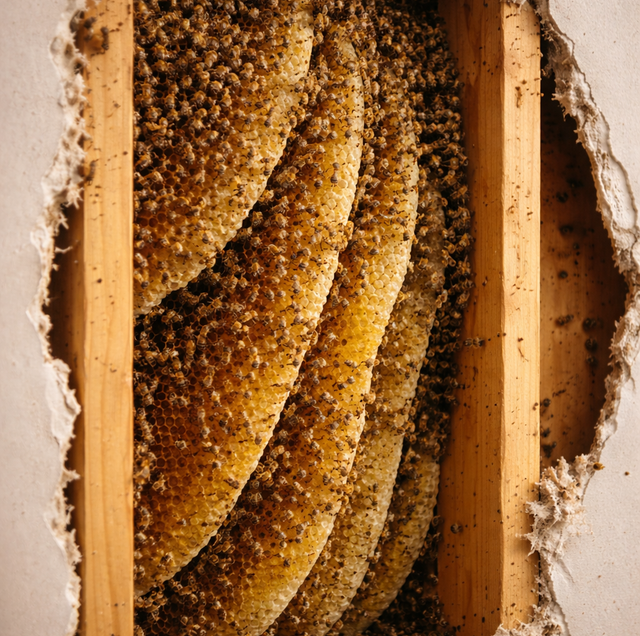
A wall cavity between two studs usually runs about fourteen and a half inches wide, three and a half inches deep, and several feet tall, closed at top and bottom by framing plates and sealed from weather by sheathing on one side and drywall on the other. It is dark, dry, insulated against temperature swings, and protected from birds, wasps, and rain by several inches of building material on every side. To a scout bee looking for a new home, that void is close to ideal, and even on a wall that bakes all afternoon, the cavity behind it stays fairly stable year-round.
The only sign of what is happening inside that stud bay is usually a gap about the width of a pencil, low on a wall or under an eave, where a crack in the siding or a utility penetration breaks the seal. What sits on the far side of that gap changes completely depending on when you notice it. Week one, week four, and month six are three different problems, and knowing which one you are looking at is most of what a technician needs before anyone opens a wall.
Week One: A Pencil-Width Gap and a Cavity Under Inspection
Before a colony commits to a cavity, scout bees inspect it, checking the volume, darkness, and how well it is sealed against drafts and light. A resting cluster with no comb built and nothing yet to defend often moves on within twenty-four to forty-eight hours if scouts do not find a suitable void nearby. If they do, entry openings as narrow as a pencil are enough for the colony to funnel through.
At this stage there is no comb, no brood, and only a small, inconsistent number of bees using the gap. From outside, that usually means occasional bees at one spot, no sound, no odor, and no staining. It is also the point at which a confirmed colony represents the smallest possible job: one stud bay, no comb, nothing stored yet.
Week Four: The First Comb and the Twenty-One-Day Hinge
Once bees commit to a cavity, comb-building starts almost at once. Wax scales are secreted from glands on the underside of the workers' abdomens within a day or so of moving in, and the first sheets of hexagonal cells hang from the top of the void well inside the first week. The queen starts laying eggs into finished cells as soon as they are drawn, and those cells double as nurseries and, soon after, storage for nectar and pollen.
For the first few weeks, growth is capped by how fast the queen can lay into comb that has actually been drawn, which in the early going is the real constraint rather than the queen herself. The turning point is the brood cycle: about three days as an egg, roughly six as a larva, and around twelve capped as a pupa, a little over twenty-one days from egg to an emerged adult worker. When that first batch of eggs finishes hatching, the colony gains its first wave of new foragers, wax-builders, and nurse bees, all capable of supporting the next round of brood. Growth stops being additive and starts multiplying on itself from that point forward.
Note the date you first saw steady traffic at that gap. Roughly three weeks later, the first home-grown workers emerge, and the population curve bends upward, which is why "a few weeks ago" and "about a month ago" are two different jobs.
Month Two Through Month Six: From One Comb to a Colony That Outgrows a Single Bay
Past the twenty-one-day hinge, comb sheets multiply, and population climbs into the thousands. Workers fill cells with brood in some sections and ripening honey capped in wax in others. Beekeepers generally cite established feral colonies as capable of building several dozen pounds of comb and honey inside a cavity within a few months, given stable darkness and temperature. As comb expands, a colony that started in one stud bay often runs out of room and exploits gaps around wiring holes, blocking, or the top plate to extend comb into the bay next door, and sometimes the one after that. This is the point a removal stops being a single opening and becomes several, and the point at which the gap where bees cross and the bay where the comb hangs stop being the same place.
A colony with brood and stored honey to protect also behaves differently than a handful of scouts did in week one, responding more readily to vibration or disturbance at the wall.
Do not drill or run an anchor into a wall section with a hum behind it. A bit of breaking through puts your hands inches from the colony, with nothing between you and it, and can drop a honey-filled comb loose inside.
Telling a Colony Apart From What It Gets Mistaken For
Most of the signs of a wall colony have an innocent twin, and the difference is usually in the timing rather than the sign itself.
| What You Notice | What Points to Bees | What It Is More Often |
|---|---|---|
| A sweet, waxy smell near an outlet or vent | Strengthens in warm weather and is strongest at one spot on one wall | A drain trap or a damp cabinet, which smells sour or musty rather than sweet |
| A slow brown stain on the wall or ceiling | Spreads steadily over days regardless of weather | A roof or plumbing leak, which advances after rain or after a fixture is used |
| Dead bees on an interior windowsill | Recurring every few days in the same room, with no open window nearby | A one-off from a bee that came in through an open door |
Frequently Asked Questions
Not reliably. Sound through drywall mostly reflects how close the comb is to the surface you're listening at, not colony size; a moderate colony close to the drywall can sound louder than a larger one built deeper, nearer the exterior sheathing. Traffic volume at the entry gap over several minutes is a better rough indicator than sound alone.
Most swarms never end up in a wall at all. Scouts evaluate far more candidate cavities than a swarm ever occupies, and they reject sites that are too small, too bright, too damp, or too drafty. A stud bay that stays dark and dry is a strong candidate; a vented soffit with daylight showing through it usually is not. That is why two houses on the same street, with the same swarm passing overhead, can end up with completely different outcomes.
Once comb, brood, and stored honey exist in a cavity, a colony has invested too much to abandon it voluntarily. The rare exceptions involve something catastrophic to the colony itself, like comb collapsing in extreme heat or a lost queen with no replacement raised in time, not simply time passing.
Comb hangs from whatever the colony can anchor to overhead and is built downward from there, so it usually forms against the back of the exterior sheathing and the framing rather than against the drywall face, where the anchor is firmer and the temperature steadier. That is why an interior wall can show nothing at all while a bay behind it fills up, and why a stain, when it finally appears, tends to show low in the cavity where honey has run down rather than at the height of the entrance.
It depends what kind. A bay with fiberglass batts still leaves usable air space around and behind the batt, and bees will work around and compress it, which is why insulated walls get colonized routinely. A bay packed edge to edge with dense-blown cellulose or closed-cell foam leaves no void to occupy at all, so scouts reject it, and colonies get pushed toward soffits, roof overhangs, and hollow block walls instead. It is one reason two neighboring houses built in different decades can have very different bee histories.
Sound without visible traffic usually means the entry is somewhere you are not watching, commonly under roof eaves, behind a vent, or into a soffit or attic void rather than a wall stud bay. Attic and roofline entries follow the same general timeline, but the space above a ceiling can hold noticeably more comb before anyone notices, since there is often no drywall behind it to carry sound or show a warm patch.
What to Note Before You Call
Two details matter more than any others when describing a wall colony: where you actually see bees crossing the gap, and where you hear, feel, or see signs of activity, since those are frequently not the same location. It also helps to notice which part of the day traffic is heaviest. A wall that gets hard afternoon sun tends to run hotter than the shaded side of the same house, and colonies generally favor the cooler, more stable part of a cavity to build comb, which can hint at which side of a stud bay the comb has actually formed on before anyone opens anything up.
Describe the traffic pattern, the sound, and any staining or warmth you've noticed — a technician can use those details to gauge how far along the colony is before anyone opens a wall. Russell Pest Control serves the Phoenix Valley. Call (623) 469-7583.
