
Buzzing in the Wall? How to Tell If It’s Bees
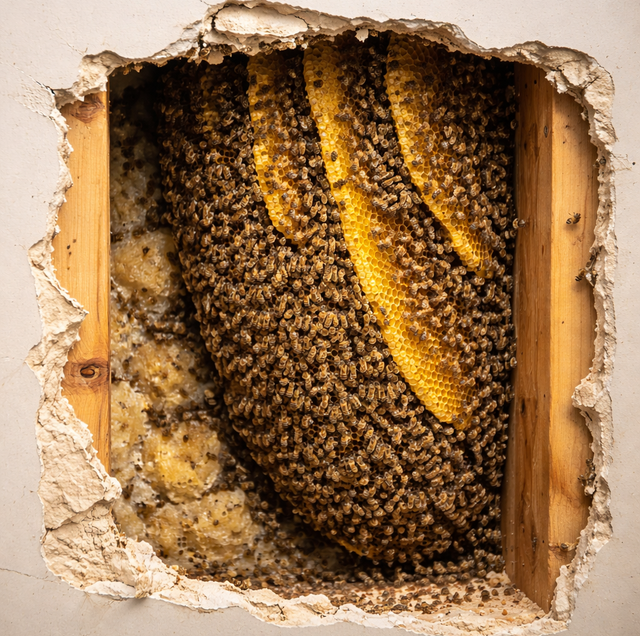
The first time you notice it, you are probably lying in bed with the lights off. It's a low, even hum coming from somewhere behind the drywall near the closet, not loud enough to place exactly, but steady enough that you stop and listen. Press an ear to the wall, and it has an almost mechanical texture, like a current running through a wire rather than an animal moving. Come back the next afternoon with the sun on that wall and the sound has changed: louder, busier, with a faint rise and fall instead of one flat tone. By early evening it settles again, quieter but never fully gone. Put your palm flat against the drywall where the sound is loudest, and you notice something else: it's warm, noticeably warmer than the wall a few feet away, on a day when nothing else there should be generating heat.
Mark the loudest point with a pencil and check that exact spot again two hours later. A colony's source stays put, a rodent's moves several feet, and a fan's stops dead the moment a switch or thermostat cuts out.
Honey Bees: A Steady Hum That Builds Through the Day
A mature honey bee colony inside a wall void is, in effect, tens of thousands of small engines running at once. The hum is the sum of that many wingbeats, and because it's an average of so many individual movements, it reads as one continuous tone rather than separate noises. That's the main thing that separates it from almost everything else on this list.
The sound also tracks the colony's workload, which tracks the temperature. Bees hold the brood area of a cavity within a narrow range even as the wall around it heats up, partly by lining up at the entrance and beating their wings to draw a current of outside air through the void. That work is a different job from flight, and it runs hardest when the wall is hottest. So the hum is often faint at dawn, builds through late morning as foragers move in and out, and peaks in the hottest stretch of the afternoon. It tapers after sunset, but a large colony rarely goes fully silent overnight.
That same heat load is why the wall can feel warm. Comb, brood, and thousands of bees packed into a cavity generate real, measurable warmth, and drywall is thin enough to conduct some of it to the surface, usually centered where the sound is loudest. Africanized and European honey bees sound and feel identical from outside a wall; the difference is behavioral, not audible, so neither pitch nor heat tells you which one has moved in.
Don't drill, hammer, or pry into a wall just to identify the sound's source. If it's an established colony behaving defensively, disturbing the wall can trigger a defensive response before anyone is ready.
Wasps: A Thinner Buzz That Comes and Goes
A paper wasp or yellowjacket nest in the same kind of void produces a related but smaller sound. Nest populations run from a few dozen in a young paper wasp nest to a few hundred at maturity, while a mature yellowjacket nest can carry into the low thousands. Even the largest of them is a fraction of a bee colony, so none produces the overlapping wingbeat volume for a steady drone. What you hear instead is thinner and broken up: short bursts as wasps cross the comb or move through the entry, with real gaps of quiet between.
Timing helps too. Wasp activity is heavily tied to daylight and often spikes hardest right at dusk, when the day's foragers return in a short window rather than trickling in all afternoon the way bees do. A burst concentrated in the last hour of daylight points toward wasps.
The warm-wall test reads differently too. An open paper comb has no honey stores and far less mass than a bee colony's structure, so it generates much less heat. If the wall over a wasp nest is warm at all, it's a mild difference, not the patch a bee colony can produce.
Rodents: Scratching and Scurrying, Not a Hum
Rodents in a wall or attic, whether roof rats along a top plate or mice near an eave, don't produce a hum at all. What you're hearing is discrete physical contact: claws on wood or drywall backing, teeth working at a stud or wire jacket, quick scrambling footsteps as the animal moves. Each is separate and irregular rather than an overlapping wall of noise; listen a minute, and you'll usually catch a pause, a scratch, then silence.
Timing runs close to the opposite of an insect colony's pattern. Rodents are largely nocturnal, so scratching that starts once the house quiets at night and stops by early morning is a strong signal on its own. A young litter can add soft, high-squeaking, audible mostly at night from a nest site.
There's no metabolic heat signature to match: a rodent nest doesn't generate meaningful warmth the way a large insect colony does, so a warm patch points away from rodents. One more tell: the sound source itself can move. A colony's noise comes from a fixed point, while a rodent traveling through a wall or ceiling produces sound that changes location over a few minutes.
Mechanical Causes: Water Hammer, Ductwork, and a Fan
Not every sound behind a wall is alive. A handful of ordinary mechanical causes get mistaken for an insect colony often enough to rule out first.
Water hammer: A sharp bang, thud, or shudder at the instant a valve closes, not a continuous tone. It shows up when a washer finishes filling, a dishwasher valve shuts, or a faucet is turned off quickly, tied to plumbing use rather than time of day.
Ductwork: Thin sheet metal expanding and contracting as it heats during the day and cools overnight, ticking, popping, or groaning as it moves. That daily heat tie makes it easy to confuse with a colony's afternoon buildup, but the sound is a distinct click or pop, and it usually traces to a duct run in a ceiling or floor rather than an exterior wall.
A failing fan: A bathroom exhaust fan, attic fan, or HVAC blower with a worn bearing is the closest mechanical impostor, producing a continuous drone that can sound remarkably close to a bee colony through drywall. The difference is in when it runs: a fan cycles on and off with a switch or thermostat call rather than existing around the clock, and it often carries a slight whine or click at the start and end of each cycle that a colony's hum never has.
Quick-Reference: What Each Sound Points To
| Source | What You Hear | When It Changes | Warm Wall? | What to Check Next |
|---|---|---|---|---|
| Honey bees | Steady, continuous hum, almost mechanical | Faint at dawn, builds through late morning, peaks in afternoon heat | Often, at the loudest spot | Mark the loudest point and confirm it hasn't moved two hours later |
| Wasps | Thinner buzz in short bursts with quiet gaps | Spikes hardest at dusk | Mild at most | Watch the exterior wall in the last hour of daylight for a return rush |
| Rodents | Irregular scratching, gnawing, scurrying, squeaks | Most active at night, quiet by day | None from the animal | Listen again after midnight and note whether the source travels |
| Water hammer | Sharp bang or shudder, not continuous | Triggered by fixture use, any time | No | Run a washer or a fast-closing faucet and see if it answers on cue |
| Ductwork | Ticking, popping, or groaning | Tied to daily heating and cooling of the metal | No | Trace it to a ceiling or floor run rather than an exterior wall |
| A failing fan | Continuous drone with a mechanical whine | Runs only when switched or thermostat-triggered | No | Kill the breaker or the switch and listen for the sound to stop dead |
Frequently Asked Questions
Loose insulation dampens higher-pitched sound more than a low hum, and a colony's tone travels through shared framing almost as much as through open air. A colony behind blown-in insulation is often still audible if the cavity touches a stud or joist that carries vibration to a spot you can hear.
More than people expect. Soft furnishings absorb the reflections that make a faint hum easy to locate, so the same colony reads as louder and easier to place from an empty closet with bare drywall and hard flooring than from a carpeted bedroom with a mattress against the same wall. The cheap trick is a drinking glass: hold the open mouth flat against the drywall and put an ear to the base, and move it a few inches at a time to find where the sound peaks.
Yes. A warm, sheltered cavity with an existing gap can host more than one pest, and a leftover wasp nest from an earlier season and an active rodent sometimes occupy different parts of the same cavity, producing a mixed set of sounds that doesn't cleanly match one profile.
Electrical boxes are one of the more common gaps in an otherwise sealed cavity, since the box itself isn't airtight against the surrounding drywall. Sound and warm air escape more easily around those edges than through solid drywall, which is why the loudest point often lines up with a switch or receptacle.
Warmth alone is the weakest signal in the set, and it's the one most often explained by something else: a wall that has taken direct sun for hours, a duct or flue run behind the drywall, or a recessed can light. Heat and sound both scale with the number of bees, so a colony warm enough to feel through drywall is almost always large enough to hear as well. Warmth with genuine silence points away from bees rather than toward them. Check the same spot again after dark, once the sun has been off that wall for a few hours.
Not usefully. A bee's wingbeat sits in a narrow frequency band regardless of how many bees are producing it, so a bigger colony reads as louder and more constant rather than lower. What does change with size is how wide an area the sound covers. A small colony is audible at one spot on one stud bay; an established one carries several feet along the wall and through the framing into the room next door, which is a rougher but far more reliable gauge than pitch.
Three Signs That Only Work Together
None of these signs work as well alone as they do together. A wall that's warm but silent, loud but cool, or scratching that doesn't match the hum from the night before is telling you it's a mixed picture rather than a clean match to one source. Those three details- where the sound is loudest, how it moves through the day, and whether the wall carries heat- are the same ones a technician works through on arrival. They decide what gets carried to the wall, and they are what keeps the first step from being a hole cut on a guess.
Describe what you're hearing and where on the wall it's loudest — a technician can often narrow the likely cause before anyone opens the drywall. Russell Pest Control serves the Phoenix Valley. Call (623) 469-7583.
