
Bee Swarm Season: What Triggers a Split and What Follows
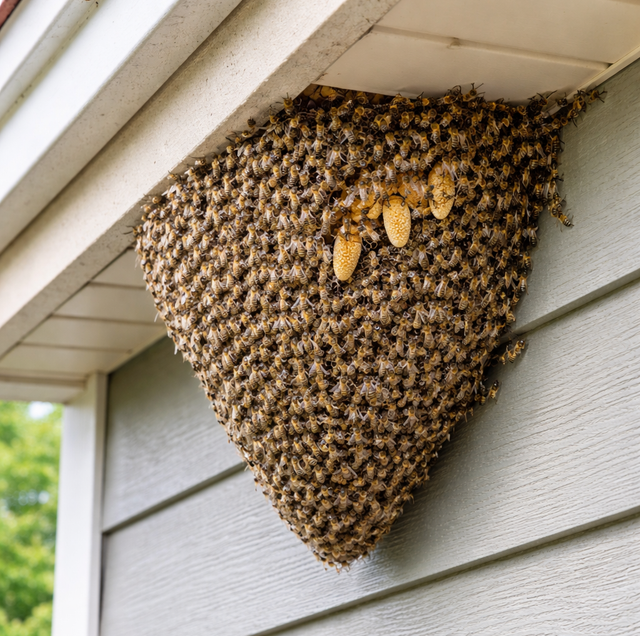
The cluster hanging under an eave and the colony living in the wall below it are frequently the same nest, a few hours apart. Roughly half the bees lift out of the cavity with the old queen, settle somewhere in sight of the building they came from, and wait while the search for a new address runs. The other half never leaves. What sets the timing of that departure is how full the cavity has become.
A colony divides when its own growth outpaces the space it occupies. Foragers carry in nectar and pollen; the queen lays in every cell that the workers can keep warm and provisioned; and the population climbs past the point where one queen and one set of combs can run the nest efficiently. That crowding, not a month on a calendar, is what starts the division.
A colony that never gets ahead of its own numbers does not swarm that cycle. One that catches a strong bloom reaches the threshold early. The same nest in the same soffit can divide early in a warm, wet year and late in a slow one.
What Builds Up Inside a Nest Before It Divides
Egg-laying rises and falls with what the foragers bring home. During a long flowering stretch, a colony can build into the tens of thousands, though the ceiling depends on how much room the cavity offers. A nest in an open attic volume has somewhere to put that growth. A nest in a wall works through the framing bay by bay, using wiring holes and gaps at the top plates, and a colony in a tight space like a chimney chase or a water-heater closet runs out of usable comb area sooner.
Crowding first appears as pressure on the queen's chemical signal. Her pheromone normally circulates through the nest, holding back the workers' urge to raise a replacement, and it thins out as the population climbs and the comb fills the void.
Once that signal weakens enough, workers start charging queen cups. The cups are the acorn-shaped starts of full queen cells, and empty ones sit in a strong nest more or less permanently, so their presence on the comb predicts nothing. What a beekeeper reads is the progression: an egg laid in a cup, a larva floating on royal jelly, then the cell drawn down into its full peanut shape and capped. A sealed cell is the marker that a split is coming, and it appears well before any bees leave the building.
The Moment a Colony Splits in Two
Once the first queen cells are sealed, the old queen leaves, usually within a day or so of that first capping, and takes roughly half the workforce with her. That departing group forms the cluster people find on a fence rail, a low branch, a porch column or the underside of a roofline, and it sits there while scouts work.
Watching a swarm leave does not empty the wall. Roughly half the bees stay behind with the comb, the honey and the brood, and that queenless remainder is the part still inside when someone opens the structure expecting nothing.
Scouts assess candidate cavities on volume and dryness among other things, and the decision runs as a vote. Each scout advertises the site she found and wins recruits away from weaker options until enough of them agree on one address, so the outcome is settled collectively, by whichever site wins the most recruits. Research on wild colony site selection points to a preference for cavities of around ten gallons, large enough to store a season's honey and small enough to defend and heat efficiently. It is a preference, and swarms take voids well under and well over it when the rest of the site suits them, which is how a soffit bay nobody would call roomy ends up occupied. Once the group commits, comb-building begins within a day or two of arrival.
Back at the original cavity, the split is not finished. The nest is queenless, sitting on stored honey and capped brood, waiting on the sealed cells the departing queen left behind.
The Second Departure, and Why It Arrives Later Than Expected
A virgin queen emerges roughly eight days after her cell is sealed, and the prime swarm left at about the time of that sealing. That arithmetic sets the interval: when a nest throws a second, smaller swarm, it typically follows the first by roughly 8 to 14 days. A couple of days is too short a window, because the first virgin is still sealed in her cell at that point. The follow-on swarm, called a cast, leaves with a virgin queen instead of the mated one and is usually a fraction of the size of the first.
Whether it happens at all depends on two conditions holding together: forage still coming in, and more than one viable queen cell surviving the rivalry between emerging sisters. Strong colonies rarely produce more than two or three departures in one cycle before settling back into ordinary growth. The interval is the part that costs homeowners, because a week of quiet after the first cluster reads as the end of the episode.
Write down the date a cluster leaves or is collected. The parent nest can release a second, smaller swarm from the same opening roughly eight to fourteen days later, which is well past the point most people stop watching.
What an Established Colony Does Between Divisions
Once a colony settles into a cavity and stabilizes relative to its size, the pressure that drove the split eases off. Brood-rearing continues at a maintenance pace, and most of the colony's energy goes into upkeep: foraging, comb repair, temperature regulation, and guarding what is stored.
Stand under a soffit that holds a settled nest on a still afternoon, and it sounds like machinery running at low load, steady and unhurried and unchanged for minutes at a time. That sound carries no information about how the colony will react to a ladder against the fascia, which is a separate question and one that moves with the forage.
When incoming nectar and pollen drop off, whether from a dry stretch, an off-year for flowering, or the tail end of a bloom, an established colony shifts from building to protecting what it already holds. Honey it cannot easily replace is worth more to the colony than honey it can, and the ground immediately outside the entrance gets worked harder on that math. The shift belongs to the nest and the few feet around it, and it can arrive in a mild winter as readily as in a long stretch of heat with no rain.
Supersedure Is a Different Event Entirely
Supersedure is queen replacement, and normally not a swarm at all. When a queen is failing or aging, workers raise a small number of replacement cells, typically one to three, on the face of the comb rather than hanging in numbers from its lower edges and sides, as swarm cells do. That placement, and the count, is what a beekeeper reads to tell the two situations apart on sight. The colony changes queens in place, often with the old queen still laying alongside her daughter for a period, and no group of bees departs.
It intersects with swarming only at the margins. A nest carrying several supersedure cells on top of a decent nectar flow can still let a surplus virgin go with a small cast. What decides that is whether forage is coming in and whether the colony has room left to use it.
Frequently Asked Questions
A cast is often a fraction of the size of the prime swarm, and it settles differently. The heavy, egg-laden mated queen that led the first departure flies poorly and drops the cluster low and close, sometimes at chest height. A virgin queen is slimmer and flies better, so the cast can end up much higher in a tree or on a second-story roofline. Most people log it as a separate, unrelated swarm when it is the same nest going again a week or two later.
It waits. Bees do not launch a swarm into rain or heavy wind, so a colony with sealed cells and a queen already slimmed down for flight by workers who stopped feeding her can sit on the launch for days. A stretch of bad weather stacks swarms up, and the first clear, calm afternoon afterward can produce several across a neighborhood in the same few hours.
The biology is identical, but managed colonies swarm less often in practice. A beekeeper who spots crowding early can add empty comb frames or another box, relieving the pressure before the colony commits to raising queen cells. A feral colony in a structure has nobody adding space for it, so its only relief is division.
The new queen has to mate before she can lay. She leaves on one or more mating flights, pairs with a substantial number of drones away from home, and stores that sperm for the rest of her life. Beekeeping references generally put her first eggs at roughly two to three weeks after she emerges. That gap in laying works through to a gap in emerging adults, so the entrance can look markedly quieter for a stretch. Quiet traffic at that point is not evidence the colony has left.
Yes, and cavity size is a large part of why. A colony that moves into a small void has less comb area to fill before crowding sets in, so it can reach the division threshold within a single strong forage run. The same swarm in a large open attic has room to keep expanding and may go a full cycle without dividing.
That is scout activity, not an arrival. Individual scouts revisit a promising cavity repeatedly while the group is still working toward agreement, so bees investigating a gap for days with no cluster appearing is ordinary. If scouts keep returning to the same opening in a soffit, a vent, or a gap at a roofline, treat it as a location worth closing once the activity clears.
How Much Time a Cluster Actually Gives You
The question worth asking about a swarm is how much time it leaves. A cluster on a fence rail or under an eave is a collection job: the bees are together in one place, they have built nothing, and the work is measured in hours. Once the scouts settle the vote on a soffit bay or a wall void, those same bees become a different piece of work, one that means opening the structure, taking out comb and honey, and sealing the entry afterward. Nothing about the calendar changes that arithmetic. Where the bees are standing when somebody picks up the phone does.
Schedule a bee inspection before a swarm settles in — relocation when a beekeeper can take the colony, full removal when the situation calls for it. Russell Pest Control serves the Phoenix Valley. Call (623) 469-7583.
