
Beekeeper or Exterminator for Bees: What Decides It
The description goes out twice, in almost the same words: bees moving in and out of a gap under the fascia, more of them every day. The answer comes back the same way both times. No comb anyone can see, no cluster to box, nothing to carry off, just an entrance nobody can reach and a wall nobody is going to open. Then a name, and the line goes quiet. That call was aimed at the wrong kind of help, and the mismatch is the thing this whole decision turns on.
The Hobbyist Beekeeper: What They Will and Won't Take
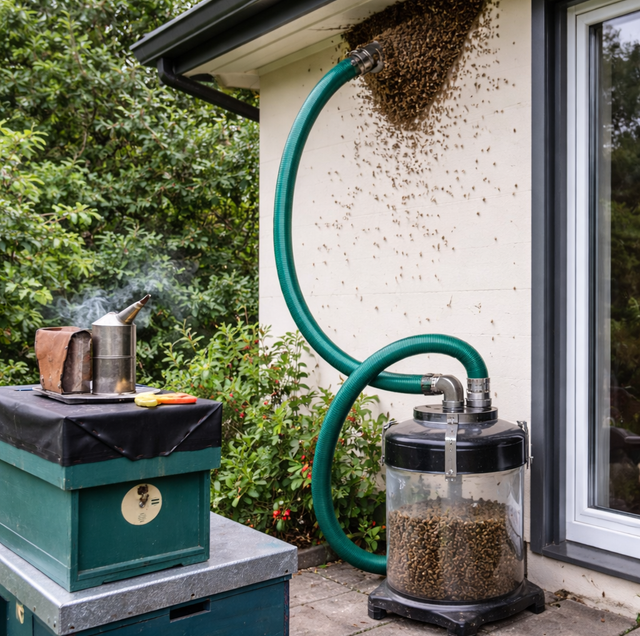
A hobbyist beekeeper collects bees the way anyone would collect a stray swarm off a fence post: bees clustered somewhere open, with nothing built yet and nothing to cut into. A bare cluster hanging from a branch, resting on a patio umbrella, or clinging to the side of a shed wall is the kind of call most hobbyists are willing to take, and a reachable cluster of bees is worth the drive to someone already keeping hives.
Their kit reflects that scope: a cardboard nuc box or a bee vacuum, a veil, a smoker, and gloves. None of it is built for cutting into stucco, drywall, or roof decking, and a hobbyist's setup stops at collecting bees rather than at opening and closing a building. The moment bees have built comb inside a void, behind a fascia board, inside a chimney chase, under roofing felt, most hobbyists step back. Getting a colony out of a cavity means removing building material and putting it back, which is a different trade with different tools behind it.
Note the exact entry point (a gap under the fascia, a weep hole, a chimney cap) and roughly how many bees pass through it each minute. That single detail often tells a technician which category the job falls into.
The same logic applies to the idea of handling a cluster yourself. A cluster that looks calm on a low branch is calm because it has nothing behind it yet, and that changes quickly once comb starts.
Do not knock a cluster into a box or a bucket yourself. A cluster in place a day or more may already hold comb and brood, and knocking it loose turns a calm mass of bees defensive at close range.
The Structural Removal Specialist: Opening, Clearing, and Sealing
Once bees are living inside a wall, roofline, or chimney, the job shifts to someone equipped to open the structure, work inside it safely, and close it back up. A structural bee removal technician arrives in a full suit sealed at the wrists and ankles, often with respiratory protection layered underneath, because opening a cavity that has held an active colony for weeks means working close to comb, honey, and bees that may already be agitated by the vibration of the work itself.
The job isn't finished once the bees are gone. Comb and honey come out with the colony, and the opening gets closed behind it, and that half of the work is the half a hobbyist has no reason to be equipped for: cutting into a finished surface, containers and disposal for what comes out of the cavity, and a closed opening at the finish rather than an open one.
Cutting into a roof or a wall, working an established colony out of the cavity, and closing the opening afterward so it cannot be reoccupied is a different scope of work than carrying a box of bees to a new hive stand. It is planned, staffed, and scheduled differently as a result, which is why the two jobs rarely sit with the same person.
Why a Routine Service Visit Isn't Hive Work
The third answer people run into comes from a company that handles pests generally, and it is worth reading correctly, because it is a statement about a visit rather than about a company.
A scheduled perimeter service stop is built around a defined route: ants along a foundation line, spiders in the eaves, scorpions working through a gap in the weatherstripping, a handful of stops in a morning. The truck for that visit carries backpack sprayers, bait stations, and dusters. Hive work is a different visit with a different load: a sealed suit and respiratory protection, a bee vacuum, tools for opening framing, containers for comb and honey, and a block of time long enough to open a cavity, clear it, and close it.
So a technician on a routine stop saying that a wall colony isn't something on the truck today is describing what that visit was scoped and loaded for, not passing judgment on the problem. Plenty of companies carry both, running a dedicated bee crew alongside the routine service route. The distinction that decides your outcome is whether a bee-equipped crew is being dispatched, not what the sign on the truck says, which is why it is worth asking for that directly rather than inferring it from a company name.
How the Cavity Decides Which One You Need
None of this comes down to who you'd rather call. A cluster resting somewhere open and reachable is a hobbyist's job regardless of how big it looks or how nervous it makes you; a colony that has disappeared into a wall, soffit, or chimney is structural work regardless of how simple the caller hopes it will be. The bees don't change what's needed. The cavity does.
That's also why the same question, asked to three different providers, can get three different-sounding answers that aren't actually in conflict. A beekeeper who can't reach it isn't declining to help; the job left that scope the moment the colony moved behind a building surface. A technician on a routine stop isn't dodging a bee problem; a perimeter treatment was never going to reach comb sealed inside a void. Both answers point the same direction: toward whoever opens structures for a living.
Where it gets confusing is a colony that has only just moved in, before there is comb anyone can see. At that stage the decision often still comes down to reach rather than size. If a technician of any kind can put a hand or a tool directly on the comb without removing building material, it may still sit within a hobbyist's scope. The instant it requires taking apart part of the structure, it has moved into removal-specialist territory.
Frequently Asked Questions
Usually, three things: whether the bees are sitting on an open surface or entering an opening, roughly how high off the ground the cluster hangs, and how long it has been there. A cluster more than two or three days old is more likely to have started drawing comb where it hangs, which turns a simple pickup into a job most hobbyists pass on. Height matters almost as much: a cluster above about 10 feet needs equipment a hobbyist is unlikely to carry.
No. Carpenter bees are solitary wood-boring bees that drill round tunnels into exposed lumber rather than build wax comb in a cavity, so they're a different insect from the honey bee colonies this decision is about. A hobbyist beekeeper has no interest in them, since there is no hive to collect, and the structural route above is built around a wax-comb colony in a void, which a carpenter bee never produces. Identifying which one you actually have is the useful first step.
Sometimes, and it's worth asking directly rather than assuming from the company name. Two things are worth confirming on the call: whether a bee-equipped crew is the one being sent, and whether one arrangement covers opening the cavity, clearing the comb, and sealing the opening, or whether those are separate visits by separate people. When a beekeeper is being lined up to take the colony, that coordination usually happens before the truck rolls, which can affect the day the work lands.
They're answering different questions. A beekeeper is judging whether the colony is worth taking and whether it can be lifted intact; a removal specialist is judging whether the cavity can be opened and closed safely. A colony can be a good one to keep, yet still be in a location where collecting it is the wrong approach, which is why the two answers can differ without either being wrong.
The seal itself- foam, wire mesh, or a mortar patch depending on the material- is built to keep bees and other pests from reentering, but matching paint or decorative trim afterward is generally left to the homeowner as a separate step, since it isn't a pest-control function.
Yes, though not in the way people expect. Waiting doesn't make the decision disappear, since an established colony doesn't relocate on its own. What changes is scale: comb and honey volume both grow the longer a colony stays undisturbed, and a cavity that filled one stud bay in spring can span several by late summer, which turns a moderate cleanout into a considerably larger one and widens the area that has to be opened to reach it.
Getting the Right Call on the First Try
The fastest way through this decision is describing what's actually visible before dialing anyone: where the bees are entering, whether that entry point leads into open air or into a wall, roofline, or chimney, and how long the activity has been building. Any of the three providers above can usually tell from that description alone whether the job is theirs, which means the first call doesn't have to be the right guess, only an honest description of what's there.
Describe what you're seeing — a technician can tell you over the phone whether it needs structural removal. Russell Pest Control serves the Phoenix Valley. Call (623) 469-7583 or request a free estimate.
