
Bee Swarm by the Front Door — When There’s No Way Around
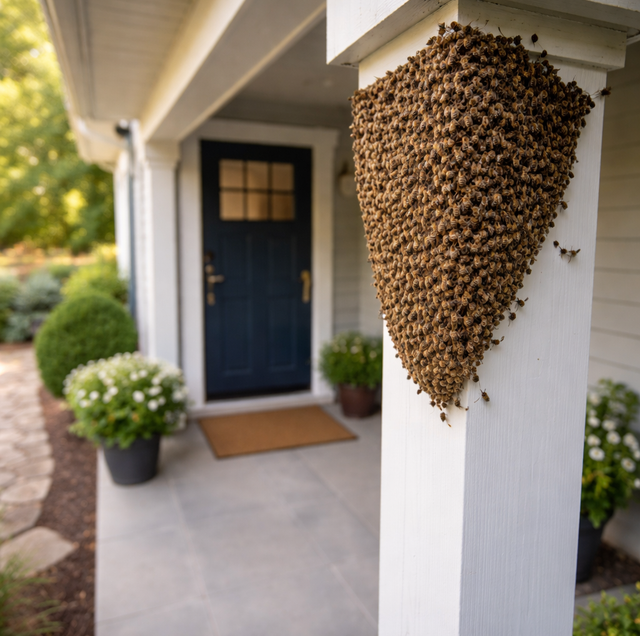
Most homes have exactly one door people actually use. Habit and the driveway decide which entrance becomes the real front door, and after that the mail carrier, the kids walking in from the bus stop, and everyone coming home from work all funnel through the same opening. A swarm hanging twelve feet from it does not reduce to the usual advice of giving it space, because there is no second route to give it. The building has already decided how close is close enough.
Why a Swarm Settles on a Porch Post
A swarm in the open is a mass of bees partway through a move, hanging in one place while scouts search for somewhere to live. Before leaving, the bees filled up on honey, which is a large part of why a resting cluster tolerates people close to it: full bees are slow to react, and there is nothing built behind them yet to defend.
The cluster itself is a structure. Bees grip each other's legs in a shell several deep around the queen, tightening when the air cools and opening looser when it warms, and a swarm can run to several thousand bees doing this at once. Whatever holds that weight has to give them an underside to hang from, a surface their feet can grip, and shade, since a mass in direct sun spends its energy cooling rather than searching.
That fits a porch post's shaded face, the underside of a garage header, and the dense interior of a shrub beside a walkway. A structure built to shade a doorway shades a swarm just as well. Scouts leave the cluster and come back to it through the day, and the mass stays put until enough of them settle on the same destination. The porch is simply the nearest thing shaped the way a cluster needs.
What a Single Entrance Takes Off the Table
The usual handling of a resting swarm rests on one assumption: that people can be pointed somewhere else while it runs its own course. That assumption is about the property rather than about the bees. A back fence has a corner to route around. One walkway to one working door has no corner behind it.
A resting swarm behaves the same on a porch post as on a back fence, calm unless it is handled roughly, and landing near daily foot traffic changes none of that. The difference lies entirely on the household's side: in how often someone has to pass within arm's reach of it and how little say they have in the matter. What makes an only entrance worth a phone call rather than a wait is the absence of an alternate route. The bees are doing what any resting swarm does.
The People Walking Past It
Everyone who lives in the house learns where the swarm is within an hour. Nobody else does. A courier who has never seen the property walks the shortest line from the curb to the door, which is the line the swarm is sitting on. Behind the courier is a roster of people who arrive on their own schedule and get no briefing at all: a grandparent doing an afternoon pickup, a contractor walking up to quote a job, a meter reader who goes where the meter is, a lawn crew that unloads before anyone comes outside, a house-sitter with a door code and no context, guests arriving after dark for something planned weeks ago. None of them angle wide around the post, because nothing tells them to.
Telling them works only if someone stands at the door to say it every time, which quickly becomes unrealistic after a couple of hours. A sign at the end of the walkway covers the people who read signs. It does nothing for the courier moving fast with a box held up in front of their face, and that is the visitor most likely to clip the post the swarm hangs on.
Kids walking to a bus stop on their own face the same problem in a sharper form. They are the least likely to spot a swarm before they are under it, and swatting is the reaction that changes a calm cluster's behavior.
Anyone in the household who has had a serious reaction to a sting before should not be the person walking past the cluster, and should keep prescribed emergency medication with them until the entrance is clear.
Pets and Deliveries That Cannot Be Briefed
A dog let out the front door for two minutes does not know to avoid a swarm on the porch rail. A cat that free-roams is harder: there is no calling it back from arm's length of the cluster, and it has a standing habit of investigating anything new near the door.
Deliveries bring the same problem from the other direction. A driver who drops a package beside the post and then knocks has jolted the surface the swarm is gripping, which is the stimulus a resting cluster reacts to. The bees do not have to be aggressive for this to go wrong. It is enough that nobody in the chain, human or animal, was told where not to stand.
When the Calendar Doesn't Move
Some swarms land on a day with nothing scheduled, and the household can use a side or back door until it clears. That is not this situation. A swarm that arrives the morning of a graduation open house, or on a delivery-heavy workday with a home office off that same entry, has a fixed date behind it. The guests are already invited, and the workday already assumes people can get in and out the way they always do.
Routing a household and its guests through a side door for the length of a party is possible and rarely realistic. The doorway turns this into a scheduling problem on top of a safety one, and the schedule is the part that will not bend.
What to Do Until Someone Arrives
Handling this well in the meantime is mostly subtraction: fewer trips past the swarm, fewer surprises for visitors, and nothing that disturbs the surface it landed on.
- Use whatever door is not the one in question, even if it means walking around, until the swarm is gone.
- Leave the porch light off after dark. A bulb burning a few feet from a cluster pulls individual bees off it, and a bee that leaves the mass in the dark rarely finds its way back onto it.
- Keep pets and small children inside rather than relying on a shouted warning at the door.
- Tell expected visitors and delivery drivers which entrance to use before they set out.
- Do not shake, knock, or lean on whatever the swarm is resting against: a post, a railing, a car mirror.
- Do not spray it. A resting swarm with nothing to defend tolerates people walking nearby, and a spray that misses leaves scent and residue at an entrance everyone still has to use.
Frequently Asked Questions
Bee work is booked for the same calendar day when the schedule allows, and it is daylight work, so a call placed after dark is scheduled for the next morning's light rather than that night. What "same-day" does and does not mean is covered elsewhere. The detail worth having ready is height: a cluster at chest height and one 12 feet up under a garage header are the same job with different equipment underneath.
It changes the ground more than the method. The walkway and the few feet either side of the cluster stay clear while the swarm is worked, so the entrance is out of use for that stretch rather than for the day. The tail end takes the longest: once the queen is in the container, the remaining bees walk and fly to her, and the box cannot close until most of them have done so. That wait is why the walkway returns a little after the visible mass is gone, rather than the instant it leaves the post.
Treat it as an entrance with no alternative, because a ramp carries a constraint a walkway does not: the usable width is fixed by the handrails, and a wheelchair cannot step off the path to swing wide around a post. A cluster on a ramp rail, or under the lip of a ramp's overhang, sits inside that fixed width rather than beside it. Say so when you call, so the person taking it knows there is no alternate route in or out.
Weather moves a cluster around a surface rather than off it. A mass caught in direct sun crawls to the shaded face of the post or deeper under the overhang, which is why a swarm can look like it shifted overnight without going anywhere. Rain runs off the outer layer of bees, and wind makes the cluster pull in tighter. What ends the stay is the scouts arriving at a decision, and that runs on its own clock rather than on the forecast.
Redirecting them is simpler than most people expect. A hold-for-pickup request at the post office covers letter mail for several days without anyone needing to be home. For parcels, the delivery-instructions field on the tracking page changes the drop location for that one package, and a carrier pickup locker or a neighbor's address handles anything too big for a side door.
Not necessarily. A resting swarm is still in transit, and scouts keep inspecting cavities elsewhere before the group commits to one. A post or an overhang near an entrance is often a convenient perch partway through that process, not a sign the group has picked that exact spot to stay. What would change the read is the swarm still being there after several days, because a cluster that stops searching starts putting its wax somewhere.
After the Swarm Comes Off the Post
The surface it was gripping is worth a minute once the walkway is yours again. A cluster that sat there a day or more can leave small flecks of pale wax behind, and wax on a painted post means it had stopped searching and started building where it hung. Scrape it off and wash the spot down, since leftover wax scent reads as an invitation to the next swarm through. Then look up: the shaded underside that suited a cluster usually sits within a few feet of a soffit gap or an open header seam, and those are worth closing while someone is already up there with a ladder.
Get a swarm blocking your entrance cleared the same day — trained techs work the cluster off the post or overhang and hand the walkway back. Russell Pest Control serves the Phoenix Valley. Call (623) 469-7583.
