
How to Read a Scorpion Re-Treat Guarantee: What It Covers and What It Never Will
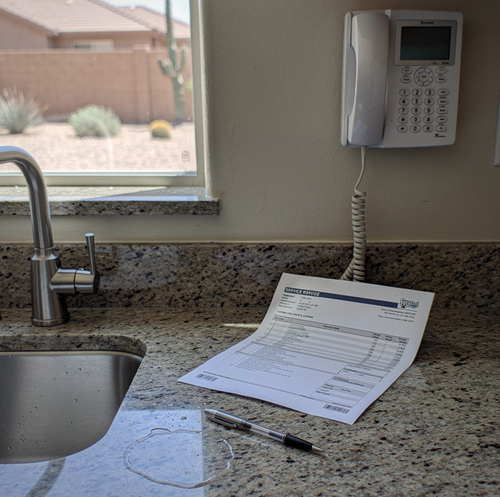
Ten days after a scorpion treatment, one crosses the hallway tile at eleven at night. The word in the service summary was "guaranteed," and now that word has to do real work: does this sighting bring somebody back out, and on what terms?
Nothing about that scorpion means the treatment failed. Bark scorpions live in the ground, in the hollow cores of block walls, under stacked yard rock and pavers, and in irrigation valve boxes, and they move toward a house after dark the way they have every night for years. A treatment changes what happens when they arrive. It does not change the fact that they arrive. The space between what a service can control and what it cannot is exactly what a re-treat promise exists to cover, which is why the wording of one is worth reading on a quiet afternoon instead of at eleven at night with a flashlight in your hand.
What a Re-Treat Promise Actually Covers
A re-treat promise is about what happens after the visit, not about how many scorpions show up afterward. It describes a return trip: what brings a technician back out, and under what conditions.
A bark scorpion can flatten itself through a gap around a sixteenth of an inch, climb stucco and block, hang upside down on a ceiling, and go weeks between meals. The surrounding open ground, the shared yard wall, and the neighbor's rock bed all keep producing them, and none of that is inside anyone's service map. Chemistry applied at a foundation changes the odds and the traffic on your property. It works alongside sealing, not in place of it, for closing physical gaps.
A spare tire is not a promise you will never get a flat. It is a promise about what is in the trunk when you do. A re-treat guarantee works the same way, and reading it well means reading it as a plan for a bad night instead of as a forecast that the bad night will not come.
The Five Questions a Re-Treat Promise Answers
Everything worth knowing about one of these promises fits into five questions. Ask them before the first visit, when the answers take nothing more than a phone call, rather than after a sighting, when you are working out what the promise already said.
| The question | What a complete answer names |
|---|---|
| What triggers a return visit | Whether one live sighting is enough, indoors or out, and whose report counts |
| How long the window runs | The date it starts, the date it ends, and what reopens it |
| Which ground is covered | Interior rooms, the exterior band, garage, walls, detached structures |
| Where the promise stops | Physical gaps, sealing work, and changes made on the property afterward |
| What happens if activity continues | Whether the next step is another application or a different kind of work |
What Actually Triggers a Return Visit
A trigger you can describe in one sentence is a trigger you can use. One live scorpion inside the house. One anywhere on the property, including the patio and the pool equipment pad. Two sightings in a week. Any of those is workable; what matters is that a number and a place are attached to it.
This is a practical question, because of how scorpion sightings actually happen. They are nocturnal, they are sparse, and the one you saw at midnight is gone by morning. You will rarely have a specimen to hand anyone. That means the return visit gets scheduled off your description, so the promise needs to say whose description counts and how it gets reported: a phone call, a note to the technician at the next stop, a message through the office.
Ask, too, whether an exterior sighting counts the same as an indoor one. Scorpion work is mostly exterior, so it's worth confirming that the patio, the pool pad, and the block wall line up alongside a sighting in the hallway.
The Window Has a Start Date, an End Date, and a Reason for Both
Every re-treat promise has a clock. The reason a clock exists at all is worth understanding before you judge the length of one.
Material applied outdoors has a residual life that ultraviolet light and hot masonry steadily cut down, faster on the south and west exposures that take the afternoon sun. A scorpion program also works partly at a remove: thinning out the crickets, roaches, and soft-bodied insects scorpions hunt changes where scorpions bother to travel, and that shift takes longer to show up in your hallway than a knockdown on an ant trail does. The first stretch of days after a visit is when you find out whether the treatment took hold on your particular lot. A window is simply a name put on that period.
A short rise in sightings in the first several days after treatment is common and isn't, by itself, a sign that it failed. Disturbed harborage sends scorpions moving before settling. Ask whether that early window counts toward a trigger.
Consider a specific case: a re-treat warranty running fifteen days from the service visit, attached to recurring general pest service. Both ends are visible: it starts the day the technician leaves, and it ends on a date you can circle. What makes that useful is not the window's length. It is that you can hold a calendar up against it and know precisely where you stand.
So ask two things: what date does the clock start, and does the next scheduled visit reopen it?
Which Ground the Promise Reaches
A treatment has a map, and the re-treat inherits it. Worth confirming what was on the map the first time: interior baseboards and plumbing chases, the exterior foundation band, the garage and its door track, the block wall line, the gate posts, the valve boxes, the pool equipment pad, a detached casita or shed.
Scorpion harborage sits overwhelmingly in that exterior list. The hollow cores of a block wall are climate-controlled by accident, staying cool and damp when the yard is neither, and a stacked-rock border does the same on a smaller scale. If those areas were treated on the first visit, the return trip should reach them again; if they were not, that is a scope conversation to have now, rather than a gap to discover in the middle of one.
Detached structures sit past where a front-of-house walkthrough naturally ends. Name the shed, the casita, and the block wall along the wash out loud while somebody is writing, so none of them get left off the map by default.
What a Re-Treat Was Never Built to Fix
The half of the promise that gets read least is the half that makes the rest of it legible.
A re-treat repeats a treatment. It does not add a physical barrier, and that boundary is real. No product closes the sixteenth-inch daylight gap at the corner of a garage door where the seal has taken a set. None of it screens an open weep hole, tightens a torn door sweep, closes the annular gap where a hose bib passes through stucco, or fills the joint where a patio slab has pulled away from the foundation. Those are physical openings, and physical openings get closed with material, not with chemistry. That work exists as its own service with its own separate promise attached, and the two are separate promises that should never be read as one.
Changes made on the property after the visit sit outside the promise for the same reason. Fresh rock or bark spread over the treated band buries it. A pressure washer run along the foundation strips it. A new irrigation line trenched along the wall, a stack of pavers left leaning against the house, a firewood pile against the garage, a wall taken down on the lot behind you: each one changes the conditions the treatment was built for. None of it puts a return visit out of reach. It means that mentioning the change when you call gets you a visit focused on the right thing.
A promise that names its own edges is doing its job, so the edges are the part worth reading closely: they tell you which situations the promise was built to answer.
What Changes If the Sightings Keep Coming
Ask this one last, and ask it before you need it: after two return visits, if scorpions are still showing up, what changes?
The useful answer describes a different kind of work rather than a third round of the same. Sightings that survive repeated applications usually tell you the question has moved from what is on the surfaces to where they are living and how they are getting in. That is diagnostic work: an after-dark search with ultraviolet light, which makes bark scorpions fluoresce a distinct blue-green and turns a guessing exercise into a map of the actual harborage, followed by closing the ground-level and climbing routes that map turns up.
Sealing work covers physical materials in physical places, and it carries its own separate warranty from the promise attached to a chemical service, worth asking about on its own terms when you're weighing the two. Knowing in advance that the escalation exists and that it has its own scope is what keeps a fifth sighting from feeling like the end of the road.
Frequently Asked Questions
It should not be a copy. A return trip is aimed at what you reported. A scorpion in the garage points at the door bottom, the track, and the shared wall behind it. One in an upstairs bathroom points at plumbing chases and the roofline, because bark scorpions climb vertical surfaces and travel through wall voids. Ask whether a return visit includes interior work if the first visit was exterior only.
Date, time, room, and the surface it was on: floor, wall, or ceiling. That last detail carries more information than people expect. A scorpion on a wall or ceiling climbed to get there, which points at a route up an exterior surface or through a wall void; one crossing a floor near a door more often came under a threshold. Note whether it was near standing water or a damp spot, too, since moisture concentrates their movement.
It means something different. On recurring service, there is already another visit behind the window, so the promise functions as a bridge. After a single visit, nothing is scheduled afterward, so the window is the entire promise. What matters is what happens on day sixteen: ask that plainly before booking a one-time treatment for a scorpion problem.
Yes, and it's worth expecting rather than reading as failure. Treating harborage disturbs it, and some of the movement out of block walls, rock beds, and valve boxes travels toward the house before it settles. Ask whether sightings in the first few days after an application count as a trigger under the promise, since this is the only stretch when a rise can indicate the treatment is working.
Several ordinary things do. Washing the foundation line, laying new rock or bark over the treated strip, running irrigation longer to keep the soil along the wall damp, and stacking firewood or pavers against the house all affect the treated surface or the harborage next to it. Each one is context a technician needs, so say it when you call, not after the truck arrives.
A night search under ultraviolet light is diagnostic rather than a treatment, so it is often scoped and scheduled separately from the application a re-treat promise covers. It earns its place when sightings and treatments disagree, because it shows where scorpions are actually sheltering on the property instead of where the treatment assumed they were. Ask whether a return visit under the promise can include a night check or whether that is a separate appointment.
What the Promise Is Really Telling You
A guarantee is not a prediction, and reading one as a forecast is what makes it disappointing later. Read it instead as a description of a specific future afternoon: a scorpion on the tile, ten days in, and a phone in your hand. If the wording already tells you who to call, what counts as a trigger, how many days you have, which ground it reaches, and where it stops, then it has finished its work before anything happens. That is the whole test, and it is one you can run in five minutes, long before you need the answer.
Ask about our scorpion re-treat guarantee — what triggers a return trip, how long the window runs, and where it stops. Russell Pest Control serves the Phoenix Valley. Call (623) 469-7583.
