
When to Seal Your House Against Scorpions (Not When You’d Guess)
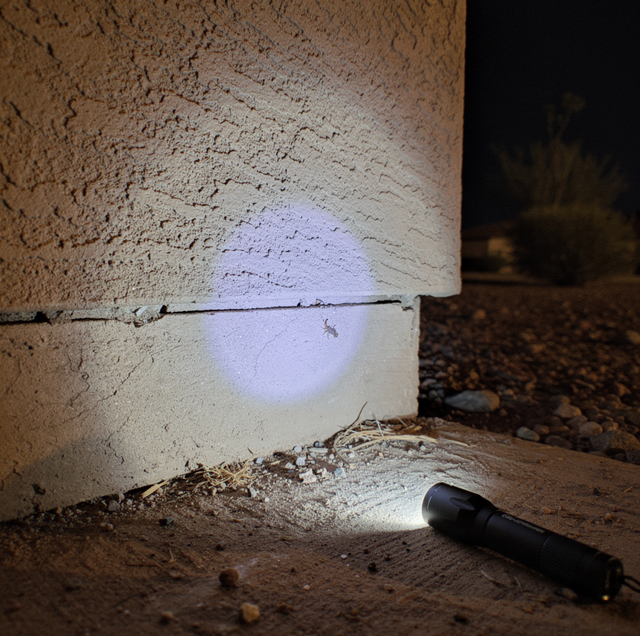
Two houses on the same street get sealed in the same week. Same crew, same sealant, the same list of thresholds, weep screeds, expansion joints and pipe penetrations. Six months on, one of them has not had a scorpion inside since. The other is back to a sighting every few weeks. Nothing about the date on those two work orders separates them.
What separates them is that one house was sealed against routes somebody had actually found, with whatever was already living inside handled first, and the other was sealed against a list of gaps that usually matter on a house like it. That is the timing question worth answering, and most of it lies elsewhere, not on the calendar.
Quick Answer: Seal when two things are true: someone has mapped the routes scorpions are actually using on your property, and the population already inside has been knocked down. Those two decide whether a seal holds. The month does not.
What a Seal Is Actually Up Against
The Arizona bark scorpion is the most venomous scorpion in the United States; it climbs stucco and block rather than staying on the ground; it hunts after dark; and it can flatten itself through an opening of roughly a sixteenth of an inch. Two consequences follow from that last number, and both concern information rather than weather.
The first is that a gap that size is not something you find by looking. A typical house has dozens of openings in that range: the terminated end of a weep screed, the shrinkage crack running off a stucco control joint, the oversized hole a plumber drilled and never packed, the corner where a door threshold's end cap stops short. Most of them are never used by anything. Closing every one of them is not realistic work. Closing the used ones is, and that is a different job, dependent entirely on knowing which is which.
The second is that a seal closes a boundary in both directions. Anything already inside when the last gap goes shut stays inside, in a structure that has just become harder to leave and easier to keep to itself. A perimeter closed around a resident population is not a finished job. It is a slower one.
Every other consideration about timing hangs off those two facts.
Condition One: A Mapped Route, Not a List of Usual Suspects
A bark scorpion's cuticle fluoresces a distinct blue-green under ultraviolet light, which is the only practical reason a technician can find one in the dark at all. That is what turns a guess into a map: walk the property after dark with a UV light, and the animals themselves show you where they travel, where they shelter, and which side of the house they favor.
One walk is a snapshot. What actually produces a route map is repetition, because a single pass records where scorpions were on one night, under one set of conditions. Two or three walks that keep turning up activity along the same block wall, the same stretch of foundation, the same planter bed against the garage describe a route. A one-time sighting in the middle of the yard is describing an animal that was passing through.
A map matters because of the arithmetic. Suppose a house has forty openings a scorpion could theoretically use and four it does. Sealing on evidence closes those four. Sealing on a checklist closes whichever twelve are easiest to reach and stands a decent chance of missing at least one of the four, and one open route is enough to keep the sightings coming. That is why a seal built after a survey outlasts one built from a standard list, and it is a difference in method, not in season.
Scorpions forage hardest in the first two to three hours after full dark. A survey walked in that window shows which routes are in use tonight, rather than which gaps happen to exist on the building.
Conditions on the night still matter, in ways that are worth scheduling around rather than waiting out. A bright full moon washes out a UV beam enough to hide a scorpion that a darker night would have made obvious. Porch and path lighting does the same thing at close range. Those are reasons to pick the night, not the season.
Condition Two: Whatever Is Already Inside
The second condition is the one homeowners tend to skip, because it is invisible in a way a gap is not.
Bark scorpions carry their young. A female produces a brood of dozens and carries them on her back until they can survive on their own, at which point they disperse into whatever cracks and voids are nearest. Those nymphs are smaller than the adults, which means they pass through gaps an adult could not, and they can be established in a wall void or under a baseboard well before anyone in the house has seen an adult on a wall.
So the question is never only how they are getting in. It is also what is in there now. A structure with an interior population gets sealed and then keeps producing sightings; the natural reading is that the seal failed. Often the seal is fine, and the sightings are residents.
Sealing a house that already has scorpions in its wall voids does not remove them. It shortens their range and can push activity toward living space rather than the exterior wall line. Knockdown belongs on the same plan as the seal.
In practice, that makes the two conditions one sequence rather than two options: find the routes, deal with what is already inside, close the routes. Reversing the order or dropping the middle step is what produces the version of this job that people describe as not having worked.
The Two Transitions Worth Working Toward
There are two points in the year when pressure on the building changes, and a seal that is already finished when one arrives does more for you than one that starts after.
Spring warm-up: as nights lift out of the cold, prey insects come back first, and scorpions follow them, dispersing outward and feeding again after a slow winter. Activity around the structure climbs before anyone indoors notices a thing.
Autumn cool-down: the reverse pressure. As nights cool, a heated structure is the warmest, most stable shelter on the lot, and movement runs inward. This is the stretch that produces the surprising winter sighting of a scorpion in a house where nobody saw a scorpion outdoors all year.
Neither one is a deadline, and the useful part is that one of them is always within a few months of whatever day you are reading this. A seal finished ahead of the next transition meets that transition with the routes already closed. A seal started in the middle of one is doing the same physical work while the pressure is already on. Both close the same gaps. Only the sequencing differs.
Where Working Conditions Come Into It
Sealants care about the surface they go onto. Most exterior-grade products, whether polyurethane, a hybrid polymer, or a straight silicone, require a clean, dry substrate and a temperature within the range printed on the data sheet to cure and bond for the long haul. Stucco still damp from a storm, or a surface temperature past what the product allows, works against a clean bond. Wide swings between a cold morning and a scorching afternoon also move stucco, wood trim, and door thresholds enough that a joint sealed at one extreme sits slightly differently at the other, which is an argument for a flexible sealant and a later perimeter re-check rather than an argument about months.
None of that is a reason to postpone. It is a reason the technician checks substrate moisture before opening anything and holds off on a wall that has not dried out. That judgment belongs to the person doing the work, on the day, and it is the last of the three variables here rather than the first.
Reading Your Own House
The honest version of "when should I seal" is "what does the property look like right now." This is what the answers point to.
| What the property looks like now | What that means for a seal | The move that fits |
|---|---|---|
| Scorpions seen indoors within the last month | A population is likely established inside; a seal alone confines it | Interior knockdown and a survey on the same plan as the sealing work |
| Sightings outdoors only, nothing inside yet | The routes are the whole problem, and they are unmapped | After-dark survey first, then seal what the survey actually found |
| Sealed several years ago, sightings returning | Settlement and material movement have reopened joints | Re-survey the perimeter and reseal the joints that moved, not the whole list again |
| Never sealed, no sightings, buying or remodeling | No population pressure yet, and the structure is unusually accessible | Seal ahead of the next seasonal transition, while walls and penetrations are open |
| A storm, a re-roof or a trench opened the envelope | New gaps that predate no map | Targeted re-check of what changed, rather than a full repeat |
| Sightings in the garage only, never past the inner door | The house boundary is holding; the garage boundary is not | Work the roll-up door's seals and the garage-to-house door before anything else |
Frequently Asked Questions
Not every opening in a wall is in use, and the evidence at the opening usually says which is which. Fine dust or grit disturbed at the edge, fragments of shed exoskeleton (scorpions molt several times as they grow), or a slightly polished look to the edge from repeated traffic all mark a working route. A gap with that kind of sign gets priority over one that is merely the right size, which is how a survey turns forty candidate openings into a short list.
New construction is sealed for air and water, which is a different standard. The routes that survive a modern build are the ones the air barrier was never aimed at: the terminated end of a weep screed at the slab line, the void behind a stucco expansion joint, a utility penetration foamed generously enough that the foam skinned over without filling the annulus behind it, the corner where a garage door's side seal meets its bottom seal. A new house often has fewer routes than an older one. It rarely has none.
Usually, and settlement is why. Years of soil movement reopen hairline cracks along the foundation line and at stucco control joints that were properly closed the first time, and older sealant loses elasticity and lets go at the edges of a joint rather than in the middle. New-construction seals tend to last longer simply because the structure has undergone fewer cycles. A perimeter closed five or more years ago is worth re-walking rather than assumed intact.
Not typically. A general pest visit is a comparatively quick interior and exterior treatment on a recurring schedule. Sealing is a longer, separate appointment because it needs full-perimeter access: every door, every penetration, every weep hole and expansion joint on the structure, plus the surface prep the sealant requires. Plenty of households schedule the two as a coordinated pair, but the sealing portion holds its own slot.
Yes, and this is the underrated part. Once the routes are closed, new arrivals stop muddying the picture, so an indoor sighting afterward carries information it did not carry before. Logging what turns up by room and by date starts to separate the two possibilities: finds clustered in one room over weeks read as residents, while finds tracking along one exterior wall read as a route that was missed. That is a far better diagnostic than a count of how many were seen.
It changes the job rather than replacing it. Before a seal, the exterior treatment is intercepting animals that have a way in. After, the routes are shut and the treatment's useful work shifts toward suppressing the prey base, mainly crickets and roaches, that draws scorpions to the wall in the first place. The two services do different things, and the seal is what makes the recurring work smaller instead of endless.
The question a month can answer is a small one. The questions that decide whether you see another scorpion on the kitchen floor are which routes somebody found before anyone opened a tube of sealant, and whether anything was still living in the walls when the last gap closed. Get those two right and the date on the work order stops mattering much. Get them wrong, and no month on the calendar will rescue the job.
Book an after-dark scorpion survey and seal — the routes get mapped before anything is closed, so the seal goes in against what the survey actually found. Russell Pest Control serves the Phoenix Valley. Call (623) 469-7583.
