
Honey Smell After Bee Removal? What’s Normal and What Isn’t
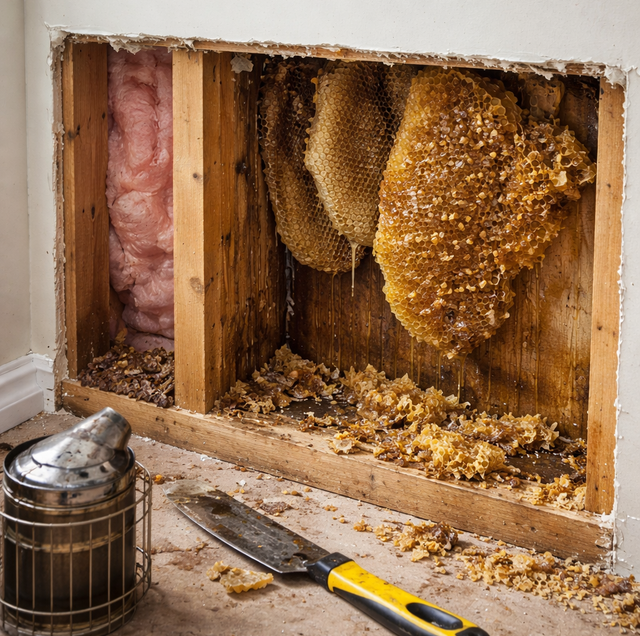
The sweetness is what catches people off guard. Days after the crew has gone, a warm, waxy smell hangs a foot or two off the wall where the cluster used to sit and disappears if you step back, closer to overripe fruit crossed with warm sugar than to anything you would call a bad smell. It sits low on the wall, strongest around whatever opening the bees had been using, and is barely there up near the ceiling. It is also a smell that keeps changing its mind about how strong it is, which unsettles people more than the smell itself.
A faint honey smell in the days and weeks after a bee removal is normal. Residual wax and honey worked into porous material continue to give off scent for a while, and that scent thins out on its own. The version worth acting on is a smell that grows stronger as the weeks pass, or one that arrives alongside fresh staining, and it usually means material is still sitting in the cavity.
What That Smell Actually Is
Beeswax carries a faint scent of its own, mostly from the propolis, pollen, and honey worked into it while the comb was being built, and honey is mostly sugar that holds onto moisture long after the bees are gone. Both cling to whatever porous material surrounds them: raw framing lumber, the paper facing on drywall, batt insulation, subfloor decking. A removal crew pulls out what comb and honey it can physically reach, but a settled colony has usually pressed some of that material into gaps, seams, and porous surfaces that careful work cannot fully extract. What you are smelling once the colony is gone is that leftover residue. The amount varies widely from one removal to the next. A young colony that had only just started drawing comb leaves behind far less than one that had been provisioning a cavity for a full season, which is why two houses can come out of what looks like the same removal on very different timelines.
The First Few Days Should Smell Worse
Right after a removal, the smell is typically most noticeable because the residue is freshest and nothing has crusted over yet. A comb that has been cut into and honey exposed to open air both release noticeably more scent in the first days after they are opened than they will a week later. This is expected. A homeowner who calls, worried that the smell is worse than they braced for on day two, is almost always describing ordinary fresh residue. What actually deserves attention isn't day two; it's whether day twenty still smells like day two.
Residue Gives Up Its Scent at Different Speeds in the Same Wall
As the residue sits, the volatile compounds that carry the scent evaporate, and the exposed surface of the honey crusts over, slowing the rest of it. Wax stiffens the same way and stops shedding much scent at all. Honey deeper in the cavity does not dry out so much as seal itself in behind that crust, and what remains is progressively absorbed into whatever porous material it soaked into or cleaned up by the ants and other scavengers that find it. That process is uneven across a wall. A smear on open insulation gives up its scent faster than the same amount pressed into solid framing, and a deposit near an air path (a gap, a vent, a stud bay with some airflow through it) clears faster than one sealed into a tight pocket with nowhere for the vapor to go.
Most people notice the smell thinning within a few weeks and find it largely gone by a month or two, with a heavier colony or a deeper cavity pushing that longer.
Set a box fan in an open window near the wall the colony was in, aimed outward so room air is pulled outside. Give it the first week or two, while the residue is freshest and giving off the most.
Why a Warm Wall Releases More Than a Cool One
Temperature drives evaporation, and that is the whole story behind the daily swing. Warm air carries and moves more scent than cool air does, and a wall that has absorbed heat throughout the afternoon keeps releasing some of it back into the cavity behind it well after the room itself has started to cool. The same spot that reads as almost nothing in the morning can be clearly, unmistakably present by late afternoon. Nothing about the material has changed over the course of that day; what changes is how readily it gives up its volatiles. Beeswax also softens well below its melting point. Cooler, more humid conditions slow the same process down without stopping it, which is why the smell can briefly resurface on any unusually warm day, in any month of the year.
When the Smell Means Something Was Left Behind
A smell that is fading, even slowly, is the expected pattern and nothing to act on. A smell that is getting stronger three or four weeks out is a different story: it usually means there is still enough comb or honey in the cavity to keep feeding fresh scent into the room, so the source is replenishing about as fast as it runs down. The same goes for a smell that shows up alongside a new stain on the drywall or ceiling. A stain paired with an odor that has stopped settling down is worth having the area rechecked.
A recheck is a much smaller job than the removal was. A technician is looking for the specific thing that would explain a rising smell: A comb left in a bay that was never opened, honey that has run down inside a stud cavity and pooled below the original site, or a second pocket the colony had expanded into through a wiring hole at the top plate. Which of those it turns out to be decides whether anything needs to be opened up at all, and where. Often it is one small inspection hole in one bay and nothing further, and often the answer is that the cavity is clear, which is worth knowing before you patch and paint over it. Leftover residue also reads as an occupied cavity to a future scout, which is the other reason a sealed entry matters as much as a clean one.
Frequently Asked Questions
Yes, usually. Opening drywall or drilling a small inspection hole exposes sealed-off residue, and the rush of fresh air across it typically makes the smell noticeably stronger for a day or two. That short spike is expected. The exposed spot also tends to settle down faster afterward than it would have left closed up.
Rarely, and it behaves differently when it does. What reaches the room is vapor coming from a cavity, so soft furnishings pick it up, the way they pick up cooking smells, and let it go again once the source quiets down. Stored fabric inside a closet that shares the same wall is the exception worth checking, because the air in a closed closet never turns over.
Not usually. Standard cleaners only reach the exposed surface, while the source is often inside the cavity behind insulation, where nothing wiped on from outside can touch it. Where residue is directly reachable, like an exposed garage rafter, hot water and dish detergent do more than anything sold as an odor eliminator, because honey is water-soluble and simply dissolves. Wax is the stubborn half: it has to be scraped off first, since nothing sprayed on will lift a hardened film.
Because the cavity vents through the nearest available gap: an outlet box, a baseboard seam, a soffit vent. Vapor takes the easy path out and seeps only slowly through solid drywall. That path does not have to line up with where the entrance or the comb actually sat, so the strongest-smelling spot in a room is an unreliable guide to where the colony had been.
It usually helps, though not for the reason people expect. Cooling the room slows evaporation at the wall surface, so less scent is released to begin with. The catch is the return side: a system pulling return air from a hallway or a ceiling plenum near the old cavity can move the smell into rooms that were never anywhere near the colony, which is how a house can start smelling faintly sweet two rooms away from the actual site.
Watch the opening, not the smell. Residue outlasts the colony by months, so an odor on its own proves nothing about live activity. Bees going in and out of the same gap is the sign that matters, and that one is worth a call rather than something to sort out from the yard.
Your Nose Adjusts to the Smell Faster Than the Room Does
One thing trips almost everyone up: after a few days living with it, your own sense of smell adapts and starts registering the odor as fainter than it actually is, an ordinary kind of sensory fatigue that has nothing to do with the residue itself fading. A visitor walking in fresh, or you coming back inside after a day away, will often catch a stronger version of the same smell you had stopped noticing, even though nothing in the wall changed while you were gone. Track the timeline by how it strikes someone coming in cold, and the difference between normal fading and something still stuck in the wall becomes much easier to read.
Still as strong two months on, or getting stronger week by week — have a technician check the cavity for material left behind. Russell Pest Control serves the Phoenix Valley. Call (623) 469-7583.
