
Targeted Scorpion Sealing vs. Whole-Home: What Decides It
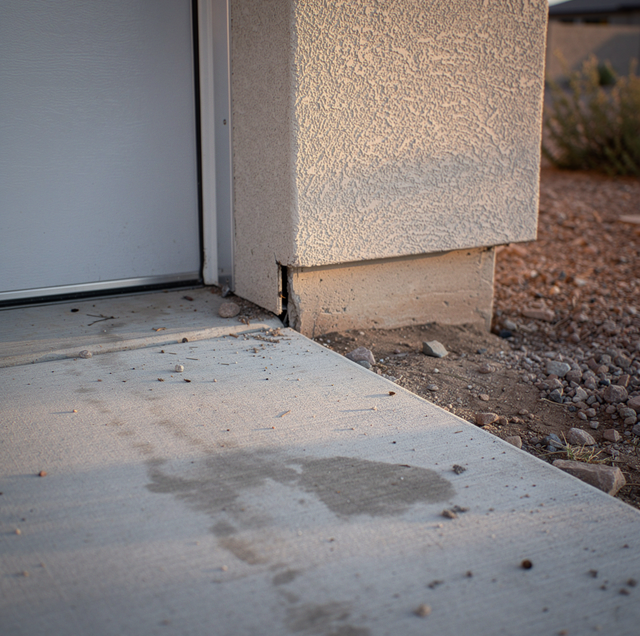
You are standing on your own porch while the technician clicks off the regular flashlight and switches to the UV lamp, and the concrete stops looking plain. Two faint blue-green dots show up at the garage door threshold, one more where the patio slab meets the house, and nothing else for thirty feet in either direction. A neighbor down the street gets a different result from the same lamp: gaps at the weep holes, a gap under the block wall, a gap where old stucco has pulled away from the trim, a glow that doesn't stop after three or four spots and keeps going around the corner. Same tool, same kind of night, two different answers to the same question: does your property need a few gaps closed, or does it need the whole exterior addressed at once?
What a Black-Light Survey Shows You
Bark scorpions carry a compound in their cuticle that fluoresces blue-green under ultraviolet light, which is why a black-light scorpion search happens after dark. The published guide to sealing entry points around your house covers the mechanics of why the lamp works and what it catches that a daytime walk misses. What matters here is what the survey gives you once it's done: not just a scorpion count, but a map of where the activity clusters, whether that's one threshold and one expansion joint, or a spread across the garage, the patio, and the block wall line in the same evening.
That mapped record is also why sealing work can carry its own warranty coverage: the checkpoints are marked on a diagram rather than remembered, so a callback can trace back to a specific spot rather than to a general impression that "scorpions came back." It's also why a hairline gap counts as a real finding: a bark scorpion can flatten its exoskeleton to pass through an opening about as thin as a credit card held edge-on, roughly a sixteenth of an inch, so a crack that looks cosmetic to the eye can still be an active route on the survey.
When the Findings Point to Targeted Sealing
A survey that comes back short and specific, two to four checkpoints, clustered around one or two entry types, with a full pass of the rest of the exterior turning up nothing, describes a property where the routes are still contained. A widened weep hole under one window, a gap at the garage threshold, a hairline crack at a single expansion joint: each of those closes on its own without touching the rest of the house.
Ask for the checkpoint count and location in writing, not a verbal summary like "found some activity." A diagram or a written list tells you whether the routes are truly confined to a few spots.
When the Findings Point to Whole-Home Sealing
Two different signals push the answer the other way, and only one of them is about how many scorpions showed up that night.
The first is simple to read: activity is spread across most or all elevations rather than clustered in one corner. That pattern says the entry points aren't a short list; they're distributed around the structure.
The second signal matters even when the checkpoint count appears moderate, because it indicates how many new gaps are likely to open after the visible ones are closed. Old stucco with hairline cracking and a weep screed pulling away from trim across many linear feet keeps producing new gaps near wherever the last one was patched. Mature landscaping, whether branches bridging to the roofline or dense planting against the foundation, creates shaded, concealed routes the survey can't fully map until the growth is pulled back. A shared block wall carries hollow cores that often run continuously along the property line, so a gap on your side can connect to a void on the neighbor's side. And a preserve-edge or undeveloped-lot boundary puts the property against a continuous source population instead of a fixed number of scorpions, so pressure at that perimeter doesn't stop once tonight's visible gaps are closed.
Why Partial Sealing Doesn't Hold on a High-Risk Property
Picture a window screen with a handful of small tears scattered across it. Patching two or three of them makes sense when those really are the only tears in the mesh. But if the mesh itself is worn thin across its entire surface, patching a few holes buys only a brief window before new tears open elsewhere on the same screen. At that point, the fix that actually holds is to replace or cover the whole screen, rather than another round of patches.
Old stucco, established landscaping against the walls, and a shared block wall work the same way on a structure. The checkpoint count on any given night can look manageable: two, three, maybe four visible gaps, while the underlying material keeps producing new ones faster than a patch-by-patch approach can keep up. Closing today's gaps without addressing that source just moves the next glow a few feet down the same wall.
Matching the Survey Pattern to the Approach
| Survey pattern | What it usually means | Approach that fits |
|---|---|---|
| A handful of checkpoints (2–4), clustered around one or two entry types, rest of the exterior reads clean | Isolated routes, contained | Targeted sealing at those checkpoints |
| Activity spread across most or all elevations | Distributed entry, not a few outliers | Whole-home sealing |
| Few checkpoints tonight, but stucco shows ongoing hairline cracking | New routes forming faster than one-at-a-time patching | Whole-home sealing |
| Few checkpoints tonight, but landscaping bridges to the roofline or touches walls on multiple sides | Concealed entry the survey can't fully map until growth is addressed | Whole-home sealing, or targeted sealing paired with a landscaping adjustment |
| Few checkpoints tonight, property shares a block wall with a neighbor | Ongoing pressure from a source outside your own sealing perimeter | Whole-home sealing along that wall line |
| Property backs to a preserve edge or undeveloped lot | A continuous reservoir population, not a one-time event | Whole-home sealing |
So What Does the Survey Actually Need to Show?
Two tests decide it, and they don't always point the same direction.
The first is count and clustering: does tonight's map show a short list, all grouped near one or two entry types, with the rest of the property clean on a full pass? If yes, targeted sealing fits what's actually in front of you.
The second is a risk-factor screen, run independently of tonight's count: old stucco, mature landscaping against the structure, a shared block wall, or a preserve-edge lot. Even one of those present pulls the answer toward whole-home, because those factors describe how many new gaps open after the visible ones close, not how many exist tonight. A clean-looking count on a high-risk property is a snapshot, not a forecast.
A Property With Both a Few Hot Spots and a Risk Factor
The property that trips people up isn't the obvious case in either direction. It's the one with a short checkpoint list and a risk factor sitting right next to it: three glowing spots tonight, on a house with thirty-year-old stucco that's already showing hairline cracks nowhere near those three spots. Count-and-clustering alone would call that targeted. The risk-factor screen overrides it because the stucco is why next month's survey is likely to find a fourth and fifth spot that the current patch never touched. When the two tests disagree, the risk-factor screen is the one that holds up over time.
Frequently Asked Questions
Most residential surveys run 30 to 60 minutes, depending on the size of the lot and how much of the exterior needs a close pass; a larger property with a block-wall perimeter or a lot of landscaping to check tends to run toward the longer end. It happens after dark once bark scorpions have started foraging, since the same lamp used during the day turns up almost nothing.
The material is matched to the gap, not applied uniformly. Stainless or copper mesh works at weep holes and vents, since the mesh is fine and rigid enough that a scorpion can't flatten or push through it. Hydraulic cement or mortar handles hairline stucco cracks and expansion joints. Thresholds get a door sweep or brush seal. Exposed foam is generally avoided on its own, since sun and heat break it down over time and a scorpion can work through degraded foam that a mesh or cement seal wouldn't yield to.
Yes. If a later inspection or a new sighting turns up activity at a checkpoint that wasn't part of the original survey, that gap gets added to the sealing plan then. It usually means something on the property changed since the first survey, like new landscaping installed near a wall or a fresh settling crack in the stucco, and that change opened a route that didn't exist before, not that the original targeted approach missed something.
Yes, and that's expected, not a shortfall. Sealing closes routes in; it doesn't remove scorpions already living in wall voids or nearby landscaping at the time of the work, and it doesn't stop a preserve-edge lot from having scorpions probing the perimeter continuously. That's why sealing is usually paired with ongoing scorpion control to treat the population, rather than standing alone as a one-time fix.
Because the hollow cores that run through a block wall aren't sealed at the property line. A gap discovered on your side can connect to a void that continues onto the neighbor's side, which means scorpions can keep moving through the wall itself even after every gap visible from your yard gets closed. Sealing that wall line usually needs to be treated as its own zone instead of folded into a short list of unrelated checkpoints.
Ask to see the risk-factor reasoning, not just the checkpoint count. A recommendation that jumps straight to whole-home off three spots with no stucco condition, no landscaping note, and no shared-wall or preserve-edge mention is worth questioning directly. One that names a specific risk factor and explains how it changes what happens after the visible gaps close is describing a real pattern, not padding the job.
What Decides the Size of the Job
The size of the job is a reading of the evidence sitting on the survey diagram, not a judgment about the house. A short, clustered list says the routes are still contained today. A spread pattern, or a property carrying old stucco, established landscaping against the walls, a shared block wall, or a preserve-edge boundary, says the routes run further than tonight's glow shows on its own. Ask to see the findings in a form you can actually look at, and let that pattern make the call.
Request your black-light survey findings in writing — a checkpoint count and map tell you whether targeted or whole-home sealing fits your property. Russell Pest Control serves the Phoenix Valley. Call (623) 469-7583.
