
Honey Bees or Wasps: How to Tell What’s Nesting
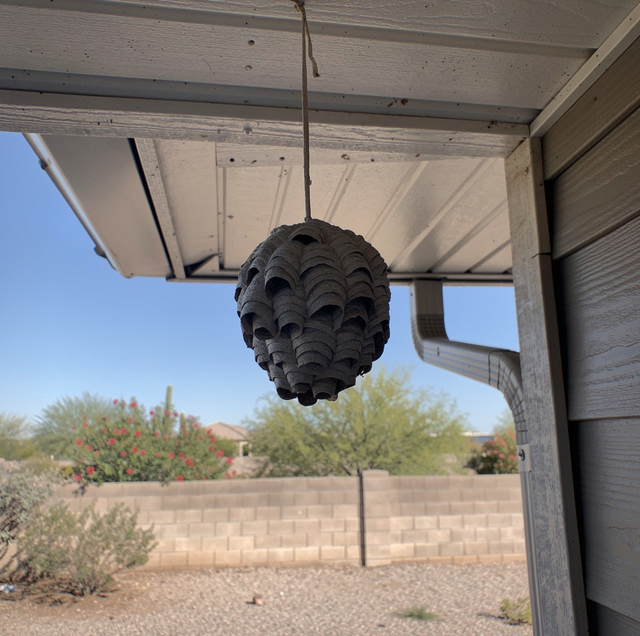
Quick Answer: Honey bees build hidden wax-comb nests inside cavities, such as wall voids, attic spaces, or hollow trees, and rarely nest fully out in the open. Wasps, including paper wasps and yellowjackets, build gray or tan paper nests from chewed wood fiber, either as an open umbrella shape under eaves or as a fully enclosed ball, and yellowjackets often nest in ground burrows or wall gaps. Behavior differs too: honey bees defend a hive but tend to leave people alone when they are away from the entrance, while wasps guard a wider area and react faster to nearby vibrations or movement.
A gray, football-sized nest shows up under the porch roof, or a low hum starts coming from a gap in the siding, and the first assumption is usually the same: bees. That assumption gets people stung, sprayed with the wrong product, or worried about a colony that was never going to bother anyone. Honey bees and wasps build differently, act differently, and call for a different response, and the nest itself gives away which one you are dealing with before you ever need to get close.
What Honey Bee Nesting Actually Looks Like
Honey bees almost never build where you can see them. A wild colony needs a protected cavity, roughly the size of a large duffel bag, with a small entrance that it can defend and use to guard against weather. That usually means a hollow tree, an irrigation box, a chimney, or a gap in a wall or roofline where the bees slip through a crack no wider than a pencil and build inside the void where you cannot see it.
Inside that cavity, the colony builds vertical sheets of beeswax comb, each cell a perfect hexagon sized to hold either honey, pollen, or a developing bee. A mature colony can hold tens of thousands of workers, and the comb structure is the reason honey bee removal is a different job from wasp treatment: the comb, brood, and stored honey have to come out of the wall or cavity, or the colony rebuilds and the abandoned honey draws ants, roaches, and rodents later.
The giveaway signs are behavioral before they are visual. A steady stream of bees following a repeated flight path in and out of one small gap, a low, continuous hum audible through the drywall, and a faint wax-and-honey smell near the entry point all point to honey bees working a hidden hive rather than a wasp colony out in the open.
What a Wasp Nest Actually Looks Like
Wasps build with paper, not wax. A foraging wasp scrapes fibers from weathered wood or fence boards, mixes them with saliva, and lays down thin gray or tan strips that dry into a papery material. That material appears in two distinct shapes depending on the species.
Paper wasps build an open, umbrella-shaped comb that hangs from a single stalk, cells facing downward and visible from below, usually tucked under an eave, a porch ceiling, or a patio structure. Yellowjackets build a fully enclosed paper nest, layered like an onion around a central comb, and they often choose a hidden cavity of their own: an old rodent burrow in the ground, a gap behind a block wall, or a void inside a meter box. A ground-level nest with wasps flying a low, direct path in and out of a small hole in the soil is a strong yellowjacket signal, since honey bees rarely nest below grade.
Both wasp types build faster than honey bees and abandon nests more often, so an empty gray paper nest from a prior season is common and no longer a threat on its own, though the location that attracted one colony often attracts another the next year.
Behavior Tells You More Than Shape
Nest material and shape are the clearest clues, but behavior narrows it down even without a clear view of the structure. Honey bees are generally calm away from the entrance to the hive; a bee working flowers in a nearby shrub is not a threat, and the colony's defensive reaction usually stays close to the entry point itself. Wasps, particularly yellowjackets, patrol and defend a wider radius around the nest and respond faster to vibration, movement, or a swatted hand, which is why a wasp problem near a doorway or a grill area escalates faster than a bee colony tucked into a wall thirty feet away.
Sound differs too. A honey bee colony produces a steady, low hum, the collective vibration of thousands of wings moving air through the cavity, audible if you put an ear near the wall. A wasp nest is quieter until disturbed, then produces a sharp buzz as the colony reacts.
One more factor changes the stakes: many hot, dry regions carry an established population of Africanized bees alongside the standard honey bee, and Africanized colonies defend far more aggressively and in greater numbers than a typical hive. Because the two look identical to an untrained eye, any colony that reacts fast, in large numbers, or from a distance beyond the entrance should be treated as a professional call rather than a do-it-yourself removal, regardless of which species it turns out to be.
Why the Right Identification Changes the Plan
Honey bees and wasps are not treated the same way, and that difference is not cosmetic. Honey bees are pollinators, and a healthy colony found in a wall or attic is typically relocated alive rather than exterminated, since the wax comb, brood, and bees can often be removed intact and re-homed in a managed hive. Wasp colonies, by contrast, are treated at the nest, since paper wasps and yellowjackets do not produce anything worth preserving and a delayed response only lets the colony grow through the season.
Misidentifying one for the other leads to two common mistakes. Spraying a suspected wasp nest that turns out to be a honey bee entry point kills part of a colony without reaching the comb inside the wall, leaving a mess of dead bees, leftover honey, and a wax structure that draws secondary pests for months. Ignoring a nest because it "looks like just bees" when it is actually an aggressive yellowjacket colony near a doorway invites a sting incident, especially for kids or pets who do not recognize the warning signs of a patrolling wasp.
Comparison at a Glance
| Feature | Honey Bees | Paper Wasps | Yellowjackets |
|---|---|---|---|
| Nest material | Wax comb | Paper (chewed wood fiber) | Paper (chewed wood fiber) |
| Nest shape | Hidden inside a cavity, not visible | Open umbrella, cells facing down | Fully enclosed, layered ball |
| Typical location | Wall voids, attics, hollow trees | Under eaves, porch ceilings | Ground burrows, wall or meter box voids |
| Colony size | Tens of thousands | Dozens to a few hundred | Hundreds to a few thousand |
| Defensive range | Mostly near the entrance | Moderate, near the nest | Wide, reacts fast to vibration |
| Typical response | Live relocation when possible | Nest treatment | Nest treatment |
When to Stop Looking and Call Instead
A few situations call for a professional rather than continued observation from a ladder. Any nest inside a wall, attic, or chimney where the entry point is the only visible clue, since reaching the actual colony safely requires opening a cavity without collapsing comb into the space behind drywall. Any nest near a doorway, walkway, or play area, regardless of species, since proximity to foot traffic raises the odds of an accidental encounter. And any colony that reacts to distant movement or produces stings from multiple insects at once, since that behavior pattern is worth treating as a heightened risk rather than confirming with a closer look.
A nest that is small, stationary, and far from daily foot traffic can sometimes be left alone for observation, particularly late in the season when wasp colonies naturally decline. But a colony inside a structure, especially one confirmed to be honey bees, benefits from an early call, since removal becomes more involved as the comb grows larger and fills more of the cavity.
Seasonal Timing Shifts the Odds
Nest activity is not evenly distributed throughout the year. Honey bee colonies swarm when a hive gets crowded, sending a queen and a portion of the workers out to found a new colony, and that swarming behavior peaks when forage is abundant, which in hot, dry climates tracks closely with spring blooms and the flush of vegetation that follows the season's first heavy rains. A sudden new bee presence around vents, sheds, or gaps in block walls around windows is often a swarm looking for a cavity to occupy, not an existing hidden colony finally becoming noticeable.
Ground-nesting yellowjackets respond to the same wet season in a different way. A heavy seasonal storm can flood a below-grade nest, and a displaced colony sometimes relocates to higher, drier ground near a foundation, a potted plant, or a gap under a slab. That is one reason pest calls for both stinging insects and general nuisance pests such as ants and roaches climb together once the summer storm pattern sets in: the same weather swing that drives roaches and ants indoors also reshuffles where bees and wasps choose to build.
Frequently Asked Questions
Not reliably. Honey bees are typically fuzzy and amber-brown with darker banding, while wasps have a smoother, shinier body and a more defined narrow waist, but lighting, distance, and individual variation make color alone a weak indicator. Nest material and behavior are far more reliable than body color, especially from more than a few feet away.
Yes, if the colony survives the season and the cavity stays intact. A successful hive can occupy the same wall void or tree hollow for years, growing the comb structure larger each season, which is part of why an old, established colony requires more removal work than a new one in its first few weeks.
Wasp colonies peak in population late in the season as the queen's egg production winds down and workers spend more time foraging for sugar rather than raising brood, which makes them more visible around trash cans, drinks, and food left outdoors. This is a normal colony life cycle, not a sign of a bigger infestation than earlier in the year.
There is a real mechanism behind this: an alarm pheromone released when a wasp is crushed or injured near the nest can trigger a faster defensive response from nearby colony members. That is one reason why swatting at a nest or a single aggressive wasp near a nest entrance often escalates the situation rather than ending it.
Very much so, and this is one of the more common sting scenarios. A ground nest entrance can look like a plain hole in the soil or lawn, and mowing over it, stepping near it, or running an irrigation line close to it can trigger a defensive swarm response from dozens of wasps within seconds.
Yes, this happens fairly often since the two rarely compete for the same nest sites. A honey bee colony in an attic void and a paper wasp nest under a patio eave can coexist for a season with no interaction, which is part of why a single property inspection sometimes turns up more than one type of nest.
Take the extra minute to look before anyone reaches for a spray can or a broom. The nest material tells you what's actually there: wax means a hive worth saving, paper means a colony that needs to come down, and mixing up the two is how a five-minute call turns into an afternoon of cleanup.
Get a nest identified before anyone gets close to it — safe removal or live relocation, matched to what's actually nesting. Russell Pest Control serves the Phoenix Valley. Call (623) 469-7583.
