
Termites vs. Carpenter Ants: The Damage That Gives Each One Away
You spot a soft spot in a doorframe, a hollow-sounding stud, or a small pile of what looks like sawdust on the windowsill, and the first question is the one that matters most: which insect is doing this? Termites and carpenter ants both wreck wood, and to a homeowner, the aftermath can look similar. The insects themselves, though, are almost nothing alike, and the two problems get solved in completely different ways. Reading the evidence correctly is the difference between fixing the right thing and treating for a pest you don't even have.
The reason the distinction matters comes down to what each insect is actually doing to the wood, and why.
Why One Eats the Wood and the Other Only Digs Through It
The single biggest difference isn't visible at a glance, but it explains everything else you'll find. Termites eat wood. Wood is their food source, specifically the cellulose in it, and their bodies are built to break that cellulose down into energy. That means every gallery a termite carves is also a meal, and the colony keeps feeding as long as there's wood to consume.
Carpenter ants don't eat wood at all. They chew through it only to hollow out space for a nest, the way you'd dig a basement without eating the dirt. Their food comes from elsewhere, mostly other insects and sugary substances. So, when a carpenter ant tunnels, it's construction, not consumption, and it carries the debris out of the way rather than digesting it.
Hold onto that one idea, because it drives every telltale sign below. An insect that eats the wood behaves differently, and leaves different clues, than an insect that only quarries it.
What Termites Leave Behind
Subterranean termites, the kind that account for most termite trouble, live in the soil and travel up into a structure to feed. Because they need constant moisture and hate open air, they build protective highways to get from the ground to the wood.
Those highways are mud tubes: pencil-width tunnels of soil, saliva, and waste running up foundation walls, across concrete, or along framing. Finding mud tubes is one of the strongest signs you're dealing with termites and not ants.
The damage itself hides inside the wood. Termites eat along the grain from the inside out, often leaving a thin, intact-looking shell on the surface while the interior turns to a honeycomb packed with mud and soil. That's why a beam can look fine and sound hollow when you tap it. When you break into termite-damaged wood, it's dirty, layered with soil and a mud-like material rather than clean.
Termites also swarm to start new colonies, and swarms leave discarded wings behind, often in small piles near windowsills or light fixtures where the winged reproductives were drawn before shedding their wings.
What Carpenter Ants Leave Behind
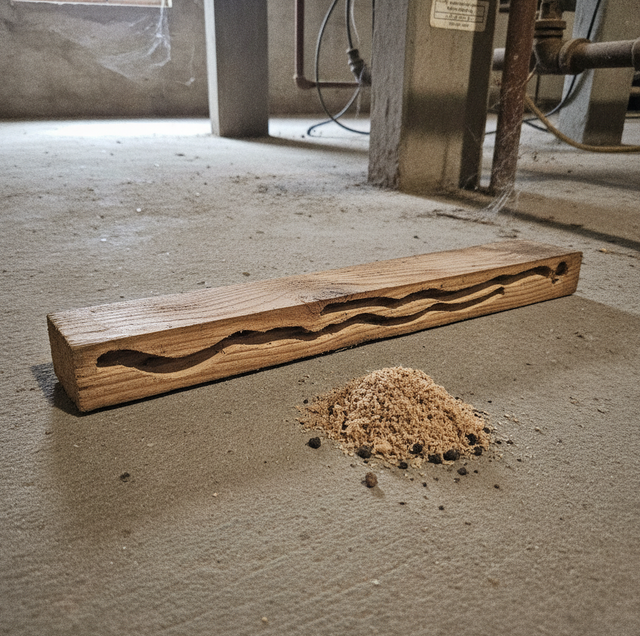
Carpenter ants tip their hand in the opposite way. Since they don't eat the wood, they have to get rid of it, so they push their excavated shavings out through small openings in the surface. The result is frass: a pile of sawdust-like material, often mixed with bits of dead insects and other debris the colony has cleared out of the nest.
A frass pile under a windowsill, along a baseboard, or below a beam is the carpenter ant's signature. And because these ants prefer wood that's already soft, the trouble usually starts where there's a moisture problem: around a slow roof leak, a leaky window, a damp crawlspace, or wood in contact with poor drainage.
Open up a carpenter ant gallery, and the contrast with termite damage is obvious. The tunnels are smooth and clean, almost sanded-looking, with no soil packed inside. They follow the softer grain of the wood in sweeping, gallery-like chambers. Clean and empty means ants; dirty and mud-packed means termites.
Telling the Insects Themselves Apart
Sometimes you get lucky and actually catch the culprit, especially during a swarm when winged reproductives appear. Up close, a termite and an ant are easy to separate once you know the three features to check.
Look at the waist first. A termite has a broad, straight-sided body with no real waist, like a grain of rice with legs. An ant has a sharply pinched, narrow waist between its midsection and rear.
Then the antennae. A termite's antennae are straight and look like a tiny string of beads. An ant's antennae are bent, with a distinct elbow partway along.
Finally, the wings, if the specimen has them. A termite's four wings are all the same length and extend well past the body. An ant's front wings are noticeably longer than its back pair. Equal wings point to termites; mismatched wings point to ants.
A Side-by-Side Comparison
| Sign | Termites (subterranean) | Carpenter ants |
|---|---|---|
| Eats the wood? | Yes, for cellulose | No, only tunnels to nest |
| Damage appearance | Intact shell outside, hollow inside, sounds hollow | Smooth, clean galleries in soft/damp wood |
| Debris left behind | Mud tubes; wood packed with mud and soil | Sawdust-like frass, often with insect parts; no mud |
| Body, antennae, wings | Straight body, straight antennae, equal-length wings | Pinched waist, bent antennae, unequal wings |
| What the fix targets | Soil and whole structure with barriers or baits | Finding the nest plus correcting the moisture source |
Why the Right Answer Changes the Whole Repair
Getting the identification right isn't trivia, because the two pests are handled by different methods aimed at different biology.
Subterranean termites are treated in the soil and structure. Because the colony lives in the ground and feeds throughout the wood, control usually means establishing a treated zone in the soil around the structure or using bait stations that the workers carry back to the colony. It's a whole-structure approach, not a spot fix on the visible damage.
Carpenter ants are handled by locating and eliminating the nest, then correcting the conditions that invited them. Since they settle in wood that's already damp, the lasting fix pairs nest treatment with drying things out: repairing the leak, improving drainage, and replacing wood that's too far gone. Treat the ants without fixing the water, and a new colony tends to move into the same soft spot.
This is also why guessing is risky. A soil-and-structure termite treatment does little against an ant colony nesting in a wet roofline, and chasing ants does nothing about termites quietly feeding inside a wall. That's the case for a professional inspection rather than a hardware-store spray: correct identification comes first, and broad do-it-yourself pesticide use tends to scatter the problem rather than solve it. A trained inspector reads the mud, the frass, and the insect, then matches the treatment to what's actually there.
Frequently Asked Questions
Study the debris up close. Carpenter ant frass is fibrous and often mixed with insect body parts, so it looks like coarse sawdust, whereas drywood termite droppings are tiny, uniform pellets, almost like ground pepper. A large ant colony can also make a faint rustling sound inside the walls at night as the workers move. Coarse fibrous shavings point to ants; uniform hard pellets point to termites.
The timing of the flight is a clue on its own. Subterranean termites usually swarm in warm daylight after rain, while carpenter ants tend to swarm later, in spring and early summer, and ant swarmers are generally darker and larger-bodied. If you have the insect in hand, an ant shows a sharply pinched waist, bent elbowed antennae, and front wings longer than the back pair, while a termite has a straight body, bead-like antennae, and four equal wings. Darker and larger with a pinched waist means an ant.
No. Carpenter ants only tunnel through wood to carve out a nest, and they feed on other things, such as insects and sweets. Termites, by contrast, consume the wood itself for its cellulose. That difference in diet is why termite damage tends to spread more extensively over time, since the colony is feeding continuously rather than just excavating living space.
They favor wood that is already damp or damaged, typically softened by a leak, condensation, or poor drainage. A carpenter ant problem is very often a moisture problem underneath, which means finding and fixing the water source is part of the solution in a way it usually isn't with termites. Dry out the wood, and you remove the conditions the colony was looking for.
Yes. A home with a moisture issue and soil close to the structure can attract carpenter ants and subterranean termites at the same time, since each is drawn by conditions the other tolerates too. Finding one pest doesn't rule out the other, which is one reason a thorough inspection checks for both rather than stopping at the first culprit it identifies.
Because the colonies are built differently. Carpenter ants often keep a parent nest outdoors, in a stump or a damp tree, with satellite nests inside the house, so lasting control requires finding and killing that parent colony rather than the ants you happen to see. That is why spraying the workers indoors rarely solves it: the satellites keep restocking from outside. Termites, by contrast, nest underground and get treated in the soil and structure with barriers or baits, which does nothing to an ant colony living in a wet stump.
Schedule a professional inspection — get the pest identified correctly before any treatment starts. Russell Pest Control serves the Phoenix Valley. Call (623) 469-7583.
