
Termites or Carpenter Ants? How to Tell the Difference in a Phoenix Home
Two of the most damaging wood-destroying pests Phoenix homeowners deal with are termites and carpenter ants. Both can cause serious structural damage, both tend to stay hidden until the problem is well established, and both are commonly mistaken for one another — especially during swarming season when winged reproductives from both species can appear at the same time.
Knowing which one you're dealing with matters. The treatment for termites is completely different from the treatment for carpenter ants, and misidentifying the pest — or assuming they're the same problem — can lead to wasted time, wasted money, and damage that keeps getting worse.
Here's how to tell them apart, what each one actually does to your home, and what to do if you find either one.
Why People Confuse Them
The confusion is understandable. Both insects are small, both are associated with wood damage, and both produce winged reproductives that swarm — often in spring and early summer in Phoenix, which is exactly when termite swarms are most common in the Valley.
At a glance, a winged termite swarmer and a winged carpenter ant look remarkably similar. But once you know what to look for, they're actually quite easy to distinguish.
How to Tell Termites and Carpenter Ants Apart
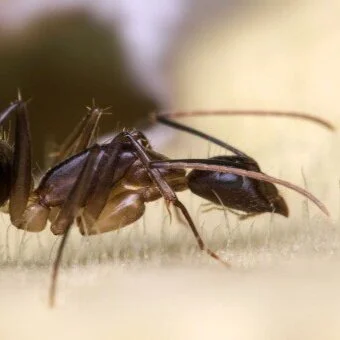
Body shape is the clearest differentiator. Carpenter ants have the classic ant silhouette — three distinct body segments with a narrow, pinched waist between the thorax and abdomen. Termites have a much more uniform, straight-sided body with no visible waist. If the insect you're looking at has an hourglass shape, it's an ant. If the body looks like a straight tube from head to tail, it's a termite.
Wings are the second key difference, particularly with swarmers. Termite wings are equal in length — both the front and rear wings are the same size, and they extend well beyond the body, sometimes up to twice the body length. Carpenter ant wings are unequal — the front wings are noticeably larger than the rear wings, and they don't extend as dramatically beyond the body. If you find discarded wings (both species shed them after swarming), termite wings will all be the same size while ant wings will be mismatched pairs.
Color can also help. Termite swarmers are typically dark brown to black with translucent wings. Carpenter ants are usually black or black and red, and larger than termites — carpenter ants are among the biggest ant species in Arizona, sometimes reaching half an inch in length.
Antennae are another tell. Termites have straight, beaded antennae. Carpenter ants have elbowed antennae with a distinct bend in them, like most ant species.
What Each Pest Is Actually Doing to Your Home
Understanding the difference in behavior helps explain why both are serious problems — just in different ways.
Termites eat wood. They consume cellulose — the organic compound found in wood, paper, and plant material — as their primary food source. They work from the inside out, hollowing out structural wood while leaving a thin outer shell intact. Termite damage has a layered appearance, with galleries that often contain soil or mud. Because they're eating the wood itself, termite damage accumulates constantly and can compromise structural integrity over time.
Carpenter ants don't eat wood — they excavate it. They can't digest cellulose, so they're not consuming your home's framing for nutrition. Instead, they chew through wood to create galleries for nesting. The damage looks different — smooth, almost sanded walls inside the galleries, with no soil or frass packed in. Carpenter ants typically start in wood that's already been softened by moisture or rot before expanding into sound wood, wall voids, and insulation.
Both cause real structural damage, but termite damage tends to be more widespread and more directly threatening to structural integrity over time.
What the Damage Looks Like
Termite damage often isn't visible from the outside at all. Tap on baseboards, door frames, or structural wood — a hollow sound indicates termites have been working inside. You may also see mud tubes along the foundation, bubbling or pinholed paint, or frass (tiny sawdust-like pellets) near small exit holes. Termite galleries follow the softer spring wood grain and have a layered, stratified appearance.
Carpenter ant damage looks cleaner. The galleries are smooth-walled and often have a sanded texture. You won't find soil packed inside the way you do with termites. You may find coarse sawdust-like debris — called frass — pushed out of small openings near the nest, but it will be larger and coarser than termite frass, often mixed with insect body parts.
What Both Pests Have in Common — and How to Use It Against Them
Despite their differences, termites and carpenter ants share one critical vulnerability: they both need moisture to survive.
Subterranean termites require moist soil to maintain their colonies. Carpenter ants almost always establish initial nests in wood that's been softened by water damage. Eliminating moisture problems around your home makes it significantly less hospitable to both pests at once.
Practical steps that help with both:
Fix leaky pipes, faucets, and irrigation lines promptly
Ensure gutters and downspouts direct water away from the foundation
Replace any wood that's been damaged by rot or water exposure
Improve drainage around the foundation — standing water after monsoon rains is a risk factor for both
Seal gaps around plumbing penetrations and utility entry points
Keep wood — firewood, lumber, debris — stored away from the structure and elevated off the ground
Which One Do You Have?
If you've found winged insects, damage to wood, or suspicious activity in your home and you're not sure which pest you're dealing with, don't guess. The treatment approaches are completely different, and using the wrong one wastes time while the actual problem continues.
A licensed pest control technician can identify the species quickly and accurately, assess the extent of the damage, and recommend the appropriate treatment. In Phoenix, where both termites and carpenter ants are active throughout much of the year, getting a professional assessment is always the right call.
Russell Pest Control Knows the Difference
Russell Pest Control has been identifying and treating wood-destroying pests in Phoenix Valley homes since 1996. Our licensed technicians are experienced with the termite species and carpenter ant populations common throughout Maricopa County, and we approach every inspection with the local knowledge that comes from over 30 years of working in the Sonoran Desert.
If you've spotted signs of either pest — or you're just not sure what you're looking at — call us at (623) 469-7583 or request a free estimate online. We'll tell you exactly what you're dealing with and what it takes to stop it.
