
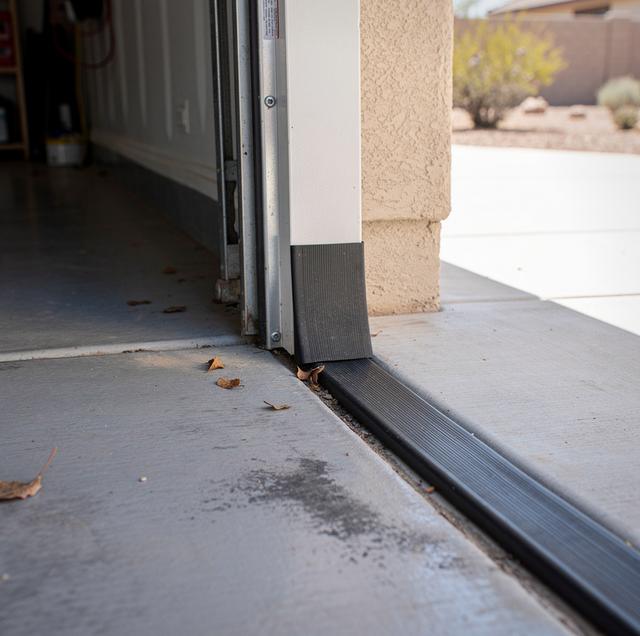
You had every visible gap around the garage sealed last spring: mesh set into the weep holes, a new door sweep, mortar packed into the hairline crack where the slab meets the stucco. Then in July a bark scorpion turns up on the kitchen counter at midnight, and the sealing work suddenly looks like it failed. It probably did exactly what it was built to do. Sealing closes routes in. It says nothing about what a chemical barrier is built to do outside those routes, and nothing about a scorpion that was already living somewhere on the property before the mortar ever went in.
That gap between the two services isn't a flaw in either one. It's the reason most properties end up with both a treated perimeter and a list of physically closed gaps, rather than one or the other. Understanding why starts with what each service actually does, mechanically, not with which one sounds more thorough when someone describes it.
Two Different Kinds of Barrier, One Job Each
A chemical barrier and a physical seal both get called "scorpion protection," and that shared label hides how differently they work. One is a treated band of residue laid down along a structure's foundation, garage threshold, and other ground-level travel paths; scorpions that cross it pick up the material through contact. The other is a set of physical materials- mesh, cement, door sweeps- installed into the actual openings scorpions use to move from outside to inside, or from the ground onto a climbing surface.
Contact versus closure is the whole distinction. A treated surface changes what happens to a scorpion crossing it. A sealed gap changes whether a scorpion can cross at all, at that specific spot. Neither is a stronger or weaker version of the other; they interrupt the problem at two different points, and a property's actual exposure usually runs through both.
What a Chemical Barrier Actually Does
Scorpion control lays down residue along the paths scorpions most often travel: the foundation line, the base of exterior walls, garage thresholds, and gate posts. A bark scorpion moving toward the structure from a rock bed, a block wall's hollow interior, or a neighboring yard picks up the material when it crosses that band, regardless of which specific route it eventually would have used to get inside.
That reach is also the barrier's limit. It affects only a scorpion that crosses the treated line. One already living inside a wall void, under a slab, or in an interior space before the treatment goes down never touches the barrier at all, because it doesn't need to cross exterior ground to move from room to room. And the barrier itself doesn't hold still. Sun and surface heat break the residue down over weeks, rain and watering wash sections of it away, and a fresh layer of rock or bark spread along the foundation can bury the treated band entirely without anyone touching it directly. A recurring service scheduled monthly, bi-monthly, or quarterly exists specifically to keep that band from lapsing between visits, since the material doesn't hold its strength indefinitely on its own.
What Physical Sealing Actually Does
Scorpion sealing works on the openings themselves, matching a physical material to whatever kind of gap it is, and none of those materials depend on staying fresh the way an exterior residue does. A rigid material doesn't lose its shape in the sun, a cured patch doesn't wash off in a storm, and hardware keeps its seal until something physically wears or damages it. Once a gap is closed, it generally stays closed for as long as the material and installation hold, which is a fundamentally different kind of durability from anything that relies on a chemical residue staying active.
That permanence comes with its own limit. Sealing only closes what gets identified and sealed. It does nothing about a scorpion already living inside the structure when the work happens, and it does nothing about the ground beyond the sealed perimeter- a rock bed, a shared block wall, an open lot next door- where scorpions keep living and moving no matter how tight the building envelope becomes. A sealed house is a house with fewer ways in. It isn't a house with fewer scorpions already present.
Comparing the Two Mechanisms Side by Side
| Chemical barrier (scorpion control) | Physical seal (scorpion sealing) | |
|---|---|---|
| How it works | Residue on ground-level surfaces; affects scorpions on contact | Material closes an actual opening; blocks entry at that spot |
| What wears it down | Sun, heat, rain, watering, fresh rock or bark over the treated band | Physical disruption: a new settling crack, torn mesh, a worn sweep |
| What it doesn't reach | Scorpions already indoors or in wall voids before treatment | Ground beyond the sealed perimeter; harborage on neighboring property |
| Upkeep it needs | Scheduled reapplication as the residue breaks down | None on a schedule; only after physical damage occurs |
Where Both Methods Share the Same Blind Spot
A scorpion that's already indoors when either service starts sits outside the range of both. The barrier can't affect it, since it never has to cross treated ground to move between rooms. The seal can't affect it either, since sealing targets routes in rather than space already occupied. An existing interior population is a separate problem from either service and needs its own diagnosis, starting with a technician actually confirming whether one is present rather than assuming either service will catch it as a byproduct.
Ask directly whether an inspection turned up any sign of an existing indoor population before assuming either service covers it. Neither a chemical barrier nor a physical seal is built to find or address scorpions already inside.
Outside that shared blind spot, the two methods fail in opposite directions. Sealing alone leaves every acre of ground beyond the property line, or every hollow core in a shared wall, free to keep producing scorpions that press against the structure indefinitely; nothing stops them at the yard's edge, only at the specific gaps that happened to get closed. A barrier alone leaves every gap in the building envelope open, so a missed reapplication or a section of residue stripped by a hard rain hands the property right back to whatever's approaching it, because nothing physically blocks the crossing once the chemistry stops working.
Why Most Properties Carry Both
Closing the routes that can be closed does real work for a barrier: fewer paths in means fewer chances for a lapse between applications to actually matter. And a barrier does real work for a sealed house: it keeps working on everything sealing structurally cannot reach, existing harborage nearby, a shared wall's hollow interior, and any gap that opens later and hasn't been found yet.
A physical seal behaves like a deadbolt: install it once, and barring damage, it holds without further attention. A chemical barrier needs to be renewed at set intervals because what it lays down keeps fading, regardless of how well it worked the first time. A property covered by only one of those is covered by exactly half of what scorpion pressure actually looks like on the ground.
A black-light search, run after dark since the compound in a bark scorpion's cuticle fluoresces blue-green under ultraviolet light, maps where a property's existing population and its entry routes are located, so both services are aimed at real evidence rather than a guess. That mapped record is often what a technician uses to decide where sealing goes and where the treated band needs to run.
Which of the two happens first, and how they get scheduled around each other, is a separate question worth asking a technician directly rather than assuming a default order.
Frequently Asked Questions
Not directly. The residue breaks down through sun, heat, and water exposure, not through how many scorpions attempt to cross it, so a sealed property's barrier fades on roughly the same schedule as an unsealed one's. What sealing changes is the consequence of a lapse: fewer open routes means a gap in reapplication timing is less likely to end in an actual indoor sighting.
Because a sealed house still sits next to whatever ground surrounds it, and a bark scorpion can go for weeks between meals, so outdoor pressure doesn't run out just because it can't get inside anymore. A heavily sealed property with no ongoing treatment often shows fewer indoor sightings but the same or higher outdoor population, since sealing changes where scorpions end up, not how many of them are on the property.
It varies more with exposure than with a fixed calendar date: on a shaded, painted, or otherwise favorable surface, a treatment commonly holds close to its full labeled window, while the same material on a wall that takes direct afternoon sun can lose most of its effect in a matter of days. That's why recurring plans reapply at a set interval instead of waiting for a visible gap in coverage.
It can. A technician sealing a property already under a treatment plan sometimes prioritizes differently, since a gap that's already backed by a treated perimeter is a lower-consequence miss than the same gap on an untreated property. That's a scoping conversation worth having directly rather than assuming the two services are planned independently of each other.
Yes, because a barrier and a seal fail in different ways, and having only one leaves the other's failure mode uncovered. A pressure-washer pass along the foundation, for instance, can strip a treated section down to bare concrete in a single afternoon, leaving a gap in coverage that looks identical to bare ground someone forgot to treat in the first place.
Neither the exterior barrier nor gap sealing extends into a wall cavity from the outside, so an existing interior population is its own separate problem, worth raising directly with a technician rather than assuming routine service has it covered. A follow-up sighting, or the absence of one over the next few weeks, is usually what confirms whether it's actually been addressed.
What Coverage Actually Looks Like
Most of what a scorpion problem actually consists of splits cleanly between the two mechanisms: what crosses open ground meets a barrier, and what would have come through a specific gap never gets the chance once that gap is closed. Neither service replaces the coverage the other provides, and picking only one leaves exactly the half it wasn't built for wide open. Ask a technician to walk the exterior with you, name what a barrier will reach on your property and what a sealed gap will close, and use that specific picture instead of a general sense of which service sounds more complete.
Ask which combination of scorpion sealing and scorpion control fits your property — a technician can walk the exterior and explain what each service will and won't reach. Russell Pest Control serves the Phoenix Valley. Call (623) 469-7583.
