
How to Scorpion-Proof a Weep Screed Without Trapping Moisture
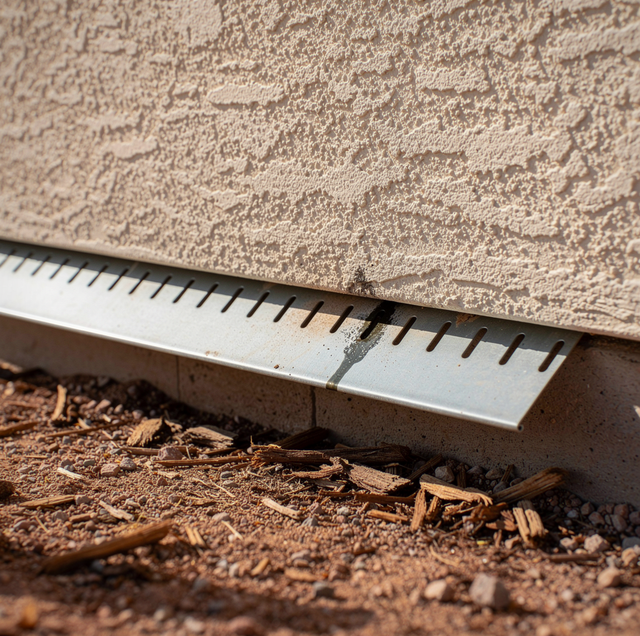
Quick Answer: A weep screed's slots drain water trapped behind the stucco, and they must stay open. Block scorpions with stainless mesh whose openings run finer than a sixteenth of an inch, fitted into the slots themselves. Never caulk, foam, or mortar.
Run your eye along the bottom edge of any stucco wall on your house, and you'll find a strip of metal or plastic where the stucco stops and the foundation begins. Cut into that strip, every few inches, is a row of small slots. Homeowners who keep finding scorpions low on the wall almost always notice that row once they start looking, because the slots sit at about the size a scorpion is built to use. The reflex that follows is to load a caulk gun and run a bead down the whole line, and that reflex has to be stopped before it starts. Those slots are not sloppy workmanship and not a gap somebody forgot to close. They are the drain the wall behind them depends on, and a wall that cannot drain does not stay sound.
What the Strip at the Bottom of Your Stucco Actually Is
The strip is a weep screed and a flashing, which means its entire purpose is to move water.
Stucco is not a waterproof shell. A traditional three-coat system goes on wet, in scratch, brown, and color coats, over metal lath, and behind that lath sits a weather-resistive barrier fastened to the sheathing. The barrier, and not the stucco, is the surface the assembly relies on to shed water. Stucco absorbs water during a storm, holds it, and develops hairline cracks as it cures and as the wall moves. Everything that gets past the outer coat lands on the barrier and runs downhill.
The weep screed catches it at the bottom. Its nailing flange fastens to the wall, and the weather-resistive barrier laps down over the top of that flange, so water tracking down the barrier is delivered onto the screed rather than behind it. A vertical section, called the ground, establishes the stucco thickness and gives the wet coats something to stop against. Below that, the screed turns outward into a sloped nose that throws water clear of the foundation, and the slots are cut through that nose. They are the exit.
Four ordinary sources keep that exit busy: condensation collecting on cooler surfaces inside the assembly as temperatures swing between afternoon and pre-dawn, wind-driven rain working through the color coat's hairline cracks during a storm, a sprinkler head that has rotated a few degrees over a season and now sprays the wall base directly, and drip emitters set close enough to the foundation to keep the lower stucco damp for hours after every cycle. The assembly is built on the assumption that water enters and exits at the bottom. Take the exit away, and nothing changes about how much water arrives. The only thing that changes is its ability to leave.
Why Scorpions Work That Same Row of Slots
A bark scorpion flattens itself through an opening of roughly a sixteenth of an inch, and a weep screed's slots run wider than that, sized for drainage rather than exclusion. That extra margin is exactly why the row lets a scorpion through with room to spare, not despite the sizing but because of it. The slots sit inches off the ground, on the wall's shaded lower edge for most of the day, and they open into a cavity that stays cooler and darker than anything outside it and runs unbroken along the wall. So a scorpion working the foundation line never has to find a flaw in your house. It finds a repeating, predictable row of openings at its own working dimension, at the exact height it already travels.
The One Rule That Never Bends: Those Slots Stay Open
Caulk, expanding foam, mortar, and stucco patch all arrive at the same result. A row of deliberate openings becomes a solid strip with no openings at all, and nothing looks wrong from the sidewalk afterward.
Behind the stucco, water keeps arriving on the barrier and running down to a base that no longer releases it. It collects at the bottom of the drainage plane and stands against the sheathing, the bottom plate, and the framing above. Wood held wet long enough decays, and the decay starts in the one part of the wall nobody can see, and nobody opens. Mold follows the same moisture into the same cavity. Outside, the first visible signs appear years later: a white mineral bloom near the base of the stucco, a soft or crumbling lower edge, and staining on the interior drywall along the floor line.
A blocked weep screed behaves like a floor drain once someone patches concrete over it. The room floods exactly as often as it did before. It simply never dries out between floods. And none of the damage indicates a scorpion problem coming back. It shows up as a wall problem, usually when a contractor opens the stucco for something unrelated and finds sheathing that has been wet for years.
Never caulk, foam, or mortar a weep screed closed. Those slots are the only exit for water trapped behind the stucco, and blocking them saturates the sheathing, framing, and bottom plate until the wall rots from the inside out.
Mesh Is the Fix, and the Sizing Logic Behind It
A weep screed can be closed to scorpions while staying fully open to water, because water and an arthropod do not pass through an opening on anything like the same terms. Liquid water moves freely through openings far finer than any insect screen, so mesh seated correctly in the slot, with openings well under a sixteenth of an inch, drains at close to the rate of a bare slot; the placement matters as much as the mesh grade, which is why where it sits gets its own section below. What that mesh stops is a body with legs, a carapace, and a fixed minimum cross-section. The margin between those two thresholds is wide, and the entire fix lives inside it.
Stainless steel mesh is the default choice. It holds whatever shape you form it into, sheds nothing onto the wall, and survives sitting in a spot that gets wet on an irrigation schedule.
Copper mesh excludes just as well and is easier to work into a tight or irregular slot by hand, but it carries two caveats. Its patina can bleed a faint green stain down light stucco wherever the copper stays wet longest. More significantly, copper sits far from steel and zinc on the galvanic scale, so copper held in continuous damp contact with a galvanized steel screed accelerates corrosion of the screed itself. Against a plastic screed, that concern disappears. On galvanized metal, stainless is the safer pairing.
Plain or galvanized steel hardware cloth has no place there: it corrodes in that position and streaks rust runoff down the wall at every slot within a season or two. Neither does any woven fabric, filter cloth, or foam filter media, all of which hold water against the assembly by design, which is the exact opposite of the job.
Where the Mesh Sits, and Where It Must Never Go
Fitting mesh at a weep screed is exclusion work rather than stucco repair, and the difference shows up almost entirely in placement. The mesh runs as a continuous strip along the nose of the screed rather than as individual patches cut for each slot, seated so the screed's own lip grips it along the whole run. That continuous fit is what makes treating a full elevation a realistic job instead of hundreds of separate insertions.
Two placements fail, in opposite directions. Laid flat across the outside face of the nose, mesh covers the drip edge and gives water a surface to cling to and track back toward the foundation, the one path the sloped nose exists to prevent. Packed deep, up past the slot and into the drainage cavity, mesh can bridge the gap between the back of the stucco and the weather-resistive barrier, where a tight weave holds a standing film of water by surface tension and presses it against the barrier around the clock. Seated in the slot and held by the slot is the whole placement rule.
Where a piece needs retention, small dabs of sealant at its ends are enough; they belong only at the ends. A continuous bead run along the mesh's lower or outer edge stops drainage as completely as filling the slot would, because at that point the sealant becomes the dam and the mesh is decoration sitting on the wrong side of it.
The Ends, Laps, and Corners the Slots Distract You From
Weep screed comes in lengths and gets installed run by run, so the slots are only part of what is open along that line. Where two lengths meet, they lap, and a lap that was never drawn tight or has since been pushed apart leaves an opening larger than any slot on the run. At corners, and where the screed dies into a door jamb, a garage opening, or a porch slab, the run terminates, and terminations are where original installs get rushed and where later trades do their damage. There is also the seam along the top, where the flange meets the wall: a section knocked loose by a shovel opens a continuous slot along its own upper edge that has nothing to do with the weep holes below it.
Fitting mesh into every slot on an elevation while leaving those conditions alone produces a wall that looks fully treated and still admits scorpions at the same rate. A pass worth doing walks the terminations first, then the slots.
Grade, Mulch, and the Clearance Underneath
A weep screed is detailed to sit clear of whatever lies below it, with roughly four inches of air between its bottom edge and bare soil, and about two inches above a paved surface. That clearance is not cosmetic. It keeps splash, standing irrigation water, and ground moisture away from the screed, and it gives the slots somewhere to discharge.
Clearance closes up slowly, and nobody ever decides to close it. Beds get topped with fresh mulch, decorative rock gets refreshed and spread a little wider, a paver path goes in on a sand bed sitting an inch above the old walkway. After enough of that, soil or rock is touching the screed or covering it outright, and the stucco above the line stays damp by pulling moisture straight out of the ground no matter how carefully the slots were treated. The correction is not more mesh. It is digging that material back down and keeping it down.
Irrigation deserves the same look while you are down there. Water that repeatedly wets and dries at the wall base leaves mineral deposits on anything it passes through, mesh included, and across several years that scale can narrow the effective opening enough to slow drainage.
Before fitting anything, check the clearance below the screed's bottom edge. If soil, mulch, or rock has crept up to within a few inches of it, pull that material back down first. Mesh cannot fix a buried screed.
How to Tell a Weep Screed Has Already Been Blocked
A continuous bead of caulk running the length of the line where slots should be visible is the clearest tell, especially when its color or texture differs from the caulk around nearby windows and doors. Slots packed solid with mortar or stucco patch are the second pattern, usually dating to a re-stucco or color-coat repair where a crew skimmed across the screed without masking it off first. A screed can also arrive blocked from the original build, since mortar droppings during the scratch coat fall to the bottom of the cavity and can plug slots from behind before the house is finished.
Then there are the signs the wall gives on its own: a damp band just above the screed line that never fully dries through a stretch of dry weather, a chalky white bloom across that same band, a lower edge of stucco that crumbles under a fingernail or sounds hollow when tapped. Each says water is arriving and is not getting out where it should.
A screed that is bent, torn, separated from the wall, or already filled from an earlier repair is a different job again from fitting mesh into intact slots. Mesh worked into a deformed section rarely seats against anything on either side, and the gap left alongside it does the same work for a scorpion as if there were no mesh at all. That is the kind of condition a scorpion sealing evaluation is designed to find, screed section by screed section, along with the terminations and laps, rather than treating the whole perimeter as a single uniform strip that gets an identical fix everywhere.
Frequently Asked Questions
Possibly not, and it changes what you are looking at. A weep screed belongs to a framed wall assembly: sheathing, weather-resistive barrier, lath, stucco, with a drainage gap that the screed terminates. Stucco applied directly to concrete block has no lath cavity and no barrier behind it in the same sense, so the base detail is often something else, or nothing at all. Identify the piece that is actually there and work out what it drains first, because the correct treatment for a screed is not automatically correct for a different termination.
Liquid drainage is barely affected, but air exchange is a separate question, and it is the reason to use a single layer of the openest mesh that still excludes. Water passes openings orders of magnitude finer than a scorpion needs. Moving air does not, and some assemblies do part of their drying through those same openings. Stacking layers, or backing mesh with fabric to make it finer, cuts airflow without buying meaningful additional exclusion. One correctly sized layer per slot is the specification.
Treat the full elevation at minimum, and preferably the full perimeter. Scorpions work the base of a wall as a continuous route and test whatever they meet along it, so a screed treated in patches simply moves the entry a few feet down the same line. There is a diagnostic reason too: a partially treated run makes it impossible to tell whether the mesh is working or whether activity has just shifted to the untreated section.
No, and the higher ones get missed most. Anywhere a stucco system steps, changes plane, or terminates over another surface, at a floor line on a two-story elevation, or where an addition's roof meets an existing wall, a screed or similar termination flashing performs the same drainage function at that height. Those pieces carry the same slots and the same absolute rule about staying open, and they sit on routes a ground-level sealing pass never reaches.
Regularly, and it undoes correctly fitted mesh faster than weather does. Sprayed or rolled coating at the base of a wall bridges open slots outright, and where mesh is already in place, paint films across a fine weave and dries solid over it. Elastomeric coatings, thick by design, manage it in a single pass. Masking the screed line before any exterior coating work takes a few minutes and is worth specifying to a painter before the job starts.
More than popping out the plugs you can see. Material cured inside the channel behind a slot keeps blocking the opening even after the face looks clear, so the run has to be cleared through its full depth, slot by slot, across every affected section, not just the handful that look worst. It also deserves an assessment first, because a screed filled for years may have been damaged during the filling, and the wall behind it may have been holding water the entire time.
A weep screed asks for two things at once that only sound contradictory: closed enough that a scorpion cannot walk through, open enough that the wall behind it keeps draining, and holding both for decades with nobody checking on it. Mesh delivers both. Sealant delivers one and destroys the other. Handle the screed properly, and it goes back to being a piece of the house nobody has to think about, which is where a working one belongs.
Schedule a scorpion sealing evaluation — have the weep line assessed and fitted with mesh that keeps the wall draining. Russell Pest Control serves the Phoenix Valley. Call (623) 469-7583.
