
Bee Swarm in a Tree: The 48 Hours That Decide What Happens
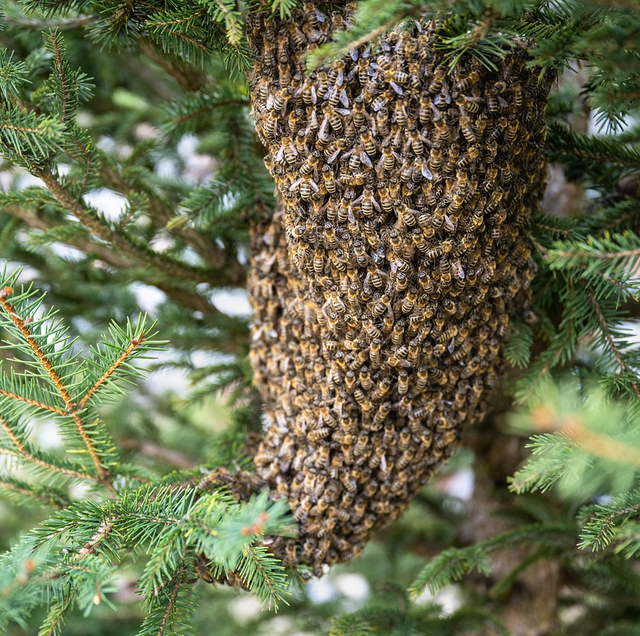
The branch was bare yesterday. This morning it carries a dark oval about the size of a rolled bath towel, dense enough that individual bees blur into one shifting surface, and the limb hangs a few inches lower than it did the day before, because several thousand bees together weigh a few pounds. Nothing is darting at the glass. Nothing is chasing the dog across the yard. A low hum carries across the yard anyway, and by dusk that shape will have pulled in tighter and rounder than it looks at noon.
What That Cluster On the Branch Actually Is
That's almost certainly a swarm, and a swarm is a different animal from a hive that has moved into your house. When a colony gets crowded, roughly half its workers leave with the old queen, each one gorged on honey to fuel the trip. What they do not bring is infrastructure: no wax, no comb, no brood, and nothing stored anywhere but their own crops. They cluster tightly around the queen on whatever surface is nearby, mostly to keep her warm and protected, while scouts fan out to look for a permanent home. There is no colony to defend yet, which is the single fact that changes how urgent this is.
Temperament is also not something anyone can read off a cluster by looking at it, which is why an established feral colony gets worked in full suits and respiratory gear, whatever it looks like from the yard. A resting swarm still tends to be markedly calmer than an established hive, precisely because it has nothing built yet to protect.
It Does Not Only Land in Trees
A tree branch is the postcard image, but a cluster will settle on anything a few thousand bees can grip together: a chain-link fence rail, the top of a closed gate, a mailbox post or its flag, a patio umbrella pole, even the hitch on a parked trailer. The bees aren't choosing the spot for any reason connected to your house. It's just wherever the group happened to stop when the queen landed.
What changes with a fence, gate, or mailbox isn't the biology; it's your routine. A cluster on a high branch is easy to leave alone. A cluster wrapped around the gate latch you use twice a day, or sitting on the mailbox the carrier needs to open, interrupts something you do on autopilot. That's a reasonable trigger to arrange around it, skip the gate or redirect mail for a day or two, rather than treating it as a bigger safety problem than a cluster in a tree. The wait-and-see math underneath is the same either way.
What the Bees Are Doing While It Sits There
During the day, scout bees leave the cluster in ones and twos and physically inspect candidate cavities across a wide radius, often well beyond the property line and sometimes more than a mile out: attic vents, wall voids, meter boxes, block-wall weep holes, even a gap in a woodpile. They walk the inside of an opening to judge its size and darkness, and the opening only has to be wide enough for a bee to walk through, not to fly through. Scouts that find a promising site come back and communicate it to the group, and over repeated rounds the swarm narrows toward a consensus candidate.
Most of that scouting happens in daylight, which is part of why the cluster can look deceptively idle at midday, thin at the edges as workers come and go. It tends to look busiest and most tightly packed right around dusk, when the day's scouts return and the group re-settles for the night. That evening surge is normal swarm behavior, not a sign anything has changed for the worse.
Photograph the cluster from about twenty-five feet away, roughly a car length plus a few strides, then zoom in with your phone instead of walking closer. That distance and a clear photo are what a phone call needs.
What the Next Day or Two Decides
Because there's no comb and nothing stored yet, most swarms move on within a day or two once scouts settle on a site elsewhere. The full search can stretch closer to three days if the immediate surroundings don't offer anything obviously good, but the pattern holds either way: a swarm is a temporary stop, not a destination, until it actively decides otherwise. Checking once a day from a distance is enough. There's no benefit to closer monitoring, and a real downside to closer contact.
That downside shows up most often as the classic mistake: hosing the cluster with water, spraying insecticide at it, or blowing smoke toward it to move it along. None of that addresses anything, because there's no colony inside a cluster to disrupt. What it does do is agitate several thousand bees with nowhere to retreat, which can turn a calm cluster defensive in seconds, and it leaves a chemical residue that does nothing to the swarm itself.
A resting cluster stings less readily than an established hive, but a direct hit of water, spray or vibration can turn it defensive in seconds. Anyone with a known bee-sting allergy should stay well back and let someone else take the photo.
The Moment Waiting Stops Being Free
The line to watch for is simple, even if easy to miss on a once-a-day glance: bees moving steadily into and out of one specific gap, rather than resting as a single stationary mass. A soffit vent, a weep hole, a meter box, an irrigation valve lid, a gap under roof tile. That traffic pattern means scouts didn't just find a candidate; the swarm committed and started moving in.
Once that happens, comb-building starts within a day or two, and everything changes. There's suddenly something to defend, the population only grows from there, and removal later means dealing with comb and stored honey in a void, not just a cluster on a branch. That's the point where a day of waiting stops being free and starts being a day the colony spent building. It's also the point where photographing it yourself is no longer enough; that call is worth making the same day you see bees committing to a gap, not after another look tomorrow.
Frequently Asked Questions
Normal yard activity at a working distance does not register as a threat. Mowing, walking a dog, or watering a bed on your side of the yard is not what provokes a cluster; vibration transmitted through the branch or post it is gripping is. Avoid pruning, leaning a ladder against the same tree, or running a string trimmer along the trunk, all of which reach the bees through the structure rather than through the air.
The case worth knowing is the one that fools people. On a hot evening, an established colony will hang a curtain of its own workers outside its entrance to shed heat, and from across the yard that looks like a swarm. The tell is what the mass is anchored to. A heat curtain sits directly around a gap in siding, a vent, or a box lid, spreads flat against the surface rather than hanging free, and is usually gone by mid-morning. A true swarm hangs off a branch or rail with no opening underneath it and holds its shape around the clock.
No. A resting swarm has nothing to chew, bore, or build with, and it leaves no mark on bark, wood, or metal once it lifts off. The exception is worth watching for: if scouts fail to turn up any suitable cavity at all, a swarm will occasionally stop searching and start drawing comb in the open, right where it is hanging. The first sign is small white flecks of fresh wax appearing on the branch or rail underneath the cluster. That means the bees have decided to stay, and it moves the situation out of the wait-and-see bracket.
Put a note on the box and let the carrier decide their own approach; that call is theirs to make, not yours to manage from the yard. A resting cluster on or beside a box is a routine interruption rather than an urgent problem, and it usually clears on the same day-or-two timeline as a cluster anywhere else on the property. What changes the answer is an established colony instead of a swarm: bees streaming in and out of the box itself, or the hollow post under it, mean someone has to reach into an occupied cavity to collect the mail, and that is worth a call the same day.
No, and it can make things worse. A heavy stream of water can knock the queen loose from the center of the cluster, and because the group orients around her, workers can respond to her exposed position with a more defensive posture than the same cluster would ever show left alone.
Not necessarily. A handful of stragglers or scouts rechecking a site they already passed on is common for a day or two after a swarm moves on, and isn't a sign anything is starting over. It's worth watching for another two or three days, though: if that small number keeps growing back instead of thinning out, it usually means scouts reported the same spot as promising a second time, worth a call even though the original cluster is long gone.
Where That Swarm Most Likely Came From
A swarm in the yard did not travel far to get there. It came from a colony that grew crowded enough to split, usually one living within a mile or two, which might be a managed hive, a feral colony in a hollow tree, or a colony in a wall on a nearby property. Colonies split most readily during the stretch when they are building fastest and running short of room, though one that loses its queen or outgrows a cramped cavity can throw a swarm at other points in the year. None of that changes what you do about the cluster on your branch. It does mean that if swarms keep turning up on the same property season after season, the parent colony is probably closer than anyone has looked, and finding that colony is a different job from watching a cluster for two days.
Send a photo and a quick description of where it landed — a same-day assessment tells you in minutes whether it's a wait-it-out swarm or a call-now situation. Russell Pest Control serves the Phoenix Valley. Call (623) 469-7583.
