
River Rock, Citrus and Drip Lines That Hold Scorpions
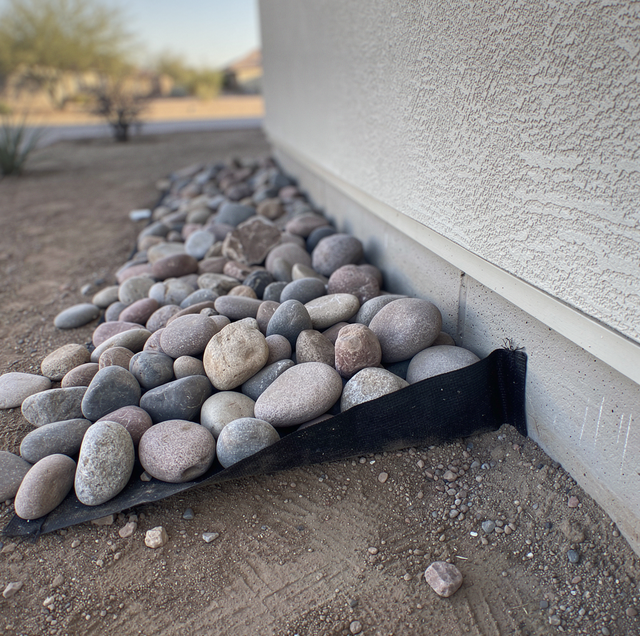
You run a UV flashlight across the side yard the week after a fresh bed of river rock goes in, and the beam turns up three glowing marks in ten feet where the bare dirt strip next to it turns up none. Nothing was sprayed, nothing changed indoors, and no scorpions were "brought in" with the rock. The bed itself, the material choice and what sits beneath it, did the work. That's the part homeowners rarely connect with: the yard isn't just where scorpions pass through on their way to the house. For many common landscaping choices, it's exactly where they want to live.
None of this is about sloppy yard care. A well-kept bed of decorative rock, a mature citrus tree on a drip line, a clean gravel border along the fence- these are ordinary, even admired, choices in warm-climate yards. The problem is what they create underneath and around themselves: voids to hide in, moisture to depend on, and a food chain of smaller insects to hunt. Below is a quick read on the choices that matter most, then the mechanism behind each one.
The Landscaping Choices That Hold Scorpions
| Landscaping feature | Why it holds scorpions | What it means for you |
|---|---|---|
| Decorative river rock over weed-barrier fabric | Rock sits unevenly on the fabric, leaving a network of small air gaps that stay cool, shaded, and humid | A surface spray never reaches the voids; the harborage survives underneath even after a treatment |
| Decomposed granite (DG) groundcover | Compacts tight with far fewer voids than loose rock, but gaps form at borders, edging, and where DG meets a rock bed | DG alone is a lower-harborage choice; the edges where it meets other materials are the weak point |
| Mature citrus and dense shrub canopy | Dropped fruit and leaf litter feed crickets and roaches, the scorpion's prey; the canopy holds shade and humidity underneath | The canopy is a food source as much as it's shelter; thinning it removes both |
| Untrimmed palm skirts (dead frond layers) | Dozens of dead, tightly packed fronds hang against the trunk in dark, insulated layers that barely move air | Cutting the skirt back removes an entire harborage structure in one pass, unlike a rock bed or basin |
| Drip emitters at the root zone | Each emitter keeps a small patch of soil and mulch saturated day after day, right where rock or bark cover already traps humidity | Moving or reducing the wet zone matters more than the plant itself |
| Flood or basin irrigation around citrus | A basin holds standing water for hours after each irrigation cycle, soaking the harborage ring right at the trunk | The saturation is intermittent but predictable, and scorpions key in on it |
| Block walls, stacked pavers and garden edging | Weep holes, mortar gaps and paver joints create the same tight, dark voids as a rock bed, right against the structure | These voids sit closest to the house, so they're often the last step before an indoor sighting |
Decorative River Rock Over Weed-Barrier Fabric
Rock beds look solid from above, but the actual structure is a rock layer resting on top of a fabric layer, and the two rarely make full contact. That mismatch leaves a network of small, irregular air pockets between the stones and the fabric: shaded, several degrees cooler than open ground in the heat of the day, and slow to dry out after any watering nearby. It functions something like the trapped air between the walls of a double-walled cup, holding a stable microclimate inside while the surface above swings hot and cold. Bark scorpions are built for exactly that kind of space. They're flat enough to squeeze through a gap about as thin as the edge of a credit card, so the same voids that look impossibly tight to a person are wide open to them.
The fabric itself isn't the problem; a torn or poorly seamed section is. Wherever fabric has split, sagged, or been cut around a plant, the gap widens and settles debris, giving scorpions a slightly larger, more stable pocket to work with. Rock depth matters too: a bed poured two to three inches deep leaves noticeably more void space than one raked thin and even.
Reaching bare-handed into a river rock bed to pull a weed or grab a dropped tool is a common way people get stung. Bark scorpions shelter in those voids and won't move until disturbed. Use a tool or glove instead.
Decomposed Granite Isn't the Same Material
Decomposed granite and river rock get lumped together as the same kind of low-water hardscape, but they behave differently underground. DG is crushed and compacted into a dense, mostly solid surface with far fewer internal voids than loose river rock, so a well-installed DG bed on its own holds less harborage than an equivalent rock bed. The trade-off shows up at the seams: wherever DG meets a metal or paver border or has settled unevenly next to a foundation, a gap opens the way it does under loose rock, just concentrated at the edge instead of spread across the bed. A yard that mixes DG in the open areas with rock along the fence line or foundation tends to concentrate its scorpion activity right at those transition lines.
Mature Citrus and Dense Shrub Canopy
An orange or grapefruit tree that's been in the ground for a decade does two things a young sapling doesn't. First, it drops fruit and leaf litter steadily through the year, and that litter feeds crickets, roaches, and other small insects. Scorpions don't eat citrus; they eat the insects the citrus feeds, so a productive tree is effectively running a prey base underneath its own canopy. Second, a full mature canopy shades the ground beneath it for most of the day, keeping the soil and any surrounding mulch or rock noticeably more humid than an open, sun-exposed bed nearby.
Dense flowering shrubs and ground-hugging junipers do the same thing on a smaller scale: shade plus litter plus the insects that litter attracts. A canopy that overhangs a rock bed compounds the effect, since the shade keeps the rock's own void network from drying out between waterings. None of this means removing mature landscaping; it means recognizing that a full, healthy canopy over a rock or gravel bed is feeding two different problems at once, shelter and food, in the same footprint.
Untrimmed Palm Skirts
A palm left untrimmed builds up a "skirt": years of dead fronds that never fall on their own, hanging flat against the trunk in overlapping layers. Each layer traps a thin, still pocket of air against the one below it, and the whole skirt shades the trunk from direct sun, so the innermost layers stay noticeably cooler and more humid than the fronds facing outward. That's a dense stack of dark, tight voids stacked vertically rather than spread across the ground, and it functions as a harborage the same way a rock bed does. Roof rats use the same skirts, and so do the crickets and roaches. A scorpion is there to hunt, so a palm holding one problem usually holds several.
Some palm varieties shed their fronds cleanly on their own and rarely build a skirt worth mentioning; others hold every dead frond indefinitely unless someone cuts them, and on a mature specimen that skirt can run several feet deep at head height next to a patio or walkway. Removing the skirt is the one item on this list that outright eliminates a harborage structure, rather than just reducing it.
Drip Emitters and Flood-Irrigation Basins
Water placement matters as much as water volume. A drip system delivers a small, steady amount of water to one fixed point at the base of a plant, day after day, on a schedule. That precision is efficient for the plant, but it also means the soil and mulch immediately around each emitter stays consistently damp in a way the rest of the bed doesn't. Where that emitter happens to sit under rock or bark cover, the moisture combines with the void network already there, and the result is one of the more reliably humid micro-spots in the whole yard.
Basin or flood irrigation, common around older citrus plantings, works differently but lands in the same place. Water fills a shallow, mounded ring around the trunk and sits there for hours before it fully soaks in or evaporates, saturating the ground right at the base of the tree on a repeating cycle. Crickets and roaches gather at that moisture too, so the basin ends up drawing both the food and the shelter to one predictable ring. A yard on drip or basin irrigation isn't doing anything wrong by watering that way; it's just creating a schedule of wet zones that scorpions learn to use.
Block Walls, Stacked Pavers and Garden Edging
Everything above happens out in the beds. This section is about the last few feet before the house. Concrete block walls have weep holes built into the base course to let trapped moisture escape, and those same holes, along with any cracked mortar joint, are sized right around that same credit-card-thin gap a bark scorpion can pass through. Stacked pavers, retaining block, and metal or plastic garden edging create smaller versions of the same thing: tight, dark seams where two hard surfaces meet without a solid bond between them.
The reason this row matters more than the others is proximity. A void three feet out in the yard is still a void the scorpion has to travel from. A void in the block wall two feet from a door threshold, or in the paver border that runs right up to the foundation, is a much shorter trip. This is a different mechanism from a tree branch physically bridging a gap over an otherwise sealed wall line; that's a structural bypass question on its own, worth understanding separately if overhanging trees touch the roofline. What sits low, right against the foundation, is a harborage question, and it's the one this piece is built around.
What the Pattern Actually Tells You
Line the rows up, and a pattern falls out: shelter, moisture, and food, stacked within the same footprint, close to the house. No single material or plant is the culprit alone; river rock without nearby irrigation dries out and loses most of its appeal, and a citrus tree on an open, sunny bed without cover holds far less than one that shades a rock border. It's the combination, specifically the combination sitting against the foundation, that turns an ordinary yard into reliable harborage. Reading a yard this way, as overlapping conditions rather than one bad choice, is the useful shift, and it's the difference between guessing at a fix and targeting the spots that actually matter.
Frequently Asked Questions
Not on its own, and it can make the moisture side worse. Organic bark mulch holds water longer than rock does and breaks down into the kind of loose, spongy layer insects thrive in, so a straight swap can trade one harborage material for another. The material matters less than depth, drainage, and what's watering it.
Yes, and sooner than most people do. A split seam doesn't just let weeds through; it lets the rock settle unevenly into the gap, widening the void at that spot. Fabric typically needs replacing every several years in a rock bed, faster in spots that see foot traffic or heavy watering nearby.
Considerably, and it's the one specification worth asking about before a bed goes in. Rounded river cobble in the two-inch-and-up range stacks into large, connected voids that a scorpion can move through rather than just hide in. Screened gravel in the three-eighths to half-inch range, especially an angular crushed product, interlocks and settles far tighter, leaving pockets that are shallower and less connected. Same look from ten feet away, different structure underneath.
No. The variable isn't the species, it's how much fruit and leaf litter accumulates on the ground and how far the canopy overhangs nearby rock or mulch. A tree that's regularly cleaned up underneath and pruned back from touching a wall or fence holds far less than one left to drop fruit into an unraked rock bed.
Different, not necessarily worse. Sprinklers broadcast water over a wider area and let it dry between cycles, while drip concentrates water at fixed points that remain continuously damp. A drip system isn't the wrong choice, but knowing exactly where each emitter sits relative to any rocks or mulch helps identify the specific wet spots to check first.
Mostly it helps, with one caveat at the edges. The turf itself is a bonded surface over a compacted base with very little void underneath, and it reduces the irrigation a live lawn needed, so it takes away both the moisture and most of the harborage in that footprint. The weak points are all at the perimeter: the nailer or bender board it's fastened to, the seams between rolls, and the transition where turf meets a rock bed or a block wall footing. Those edges open the same tight seams as any other hard-material junction, and they're the part worth looking at first.
Walk your own yard once with this list in hand, and rank what you find by how close it sits to the house rather than by how much of it there is. The rock border two feet off the foundation outranks the citrus tree at the back fence every time, and the block wall running past a patio door outranks both. Distance first, material second, water third: that order is what tells you which single feature on the property is worth doing something about before any of the others.
Have the yard read for harborage — a technician maps the rock, canopy, and irrigation conditions that hold scorpions on the property, then seals the routes they use to reach the house. Russell Pest Control serves the Phoenix Valley. Call (623) 469-7583.
