
Same-Day Bee Removal: When It’s Urgent and When It Can Wait
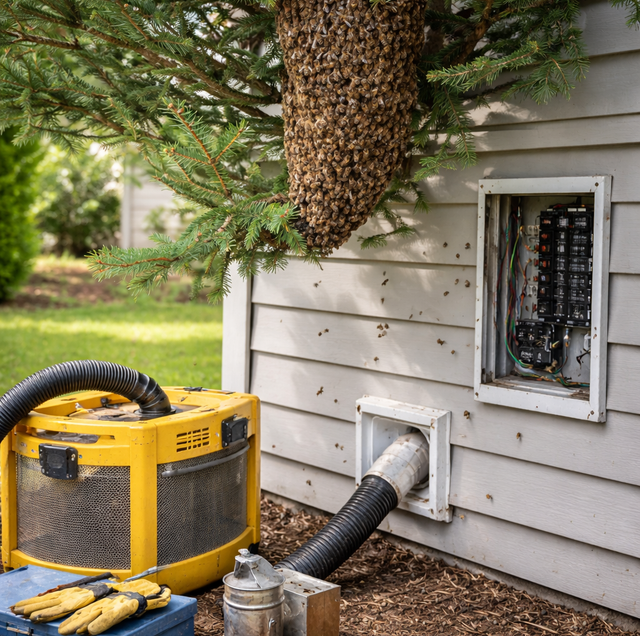
A clump of bees the size of a bike helmet hanging from a low branch in the yard and an identical-looking clump packed into the gap around a dryer vent can look, from ten feet away, like the same problem. Homeowners describe both the same way: a solid, moving ball of bees, louder than it should be. One of those two is often gone within a day or two on its own. The other has already found a cavity, started building comb, and is defending it. The difference isn't how large the cluster looks. It's where it is and who has to walk past it.
Call Today: When The Situation Won't Wait
A few situations move to the top of the list regardless of how calm the bees currently look.
A colony inside an enclosed utility space: An electrical panel box, a water meter box, an irrigation valve box, or the gap behind a dryer vent puts bees directly against wiring, plumbing, or ductwork inside a container nobody should be opening blind, whether that's a homeowner, a meter reader, or a utility crew. That's an access problem for whoever lifts the cover next, not a landscaping one.
Bees arriving inside a living space: Bees moving through a wall void and into a bedroom, closet, or attic hatch means the colony has already breached the interior, a different scale of problem than bees working an exterior wall from outside.
A colony entrance on a doorway, walkway, or play area: An established colony working a gap across the path to a front door, a mailbox, a pool gate, or a swing set forces repeated close contact every time someone uses that space. Distance is what keeps most encounters uneventful, and a permanent entrance in a high-traffic spot removes it. A resting swarm sitting in the same place is a different call, and it belongs in the third tier below, however alarming it looks.
A declared sting allergy in the household: If anyone who lives in or regularly visits the home has a known sting allergy, the calculus changes regardless of where the bees are sitting.
Do not open an electrical panel, meter box, or irrigation valve box to check for bees. Lifting the cover blind puts your hands at the colony's entrance with no protection between you and it, and no room to step back.
This Week Is Fine: When You Have Room To Schedule
Plenty of established colonies don't need same-day service. The tier below "call today" isn't "ignore it," it's "you have days, not hours."
A colony settled into a cavity in a side yard, a detached shed wall, or an eave nobody walks under regularly falls here, provided no one in the household has a declared allergy and the space isn't one people or pets pass through daily. The colony is real; it has comb and food stores worth defending, and it will keep growing, but the exposure that turns a colony into an emergency is missing. A visit within the week beats the pressure of a same-day dispatch; a few more days of nest-building matters far less than where the entry sits relative to foot traffic.
Watch It: When It May Resolve Itself
Not every bee sighting is a colony. A resting swarm, a mass of bees clustered on a branch, fence post, or parked trailer with no comb visible, is usually a temporary stop rather than a nest, and most move on within 24 to 48 hours without anyone doing anything to them. While scouts are still out looking, the swarm has nothing built and nothing stored to defend.
The instruction here is mostly hands-off: keep people and pets a reasonable distance away, don't spray it, and don't disturb the surface it's resting on. If the cluster is still there after two or three days, or if it thins while bees start working steadily in and out of a gap nearby, that's the signal it has stopped resting and started moving in.
What Moves a Situation Between Tiers
The same colony can sit in "call today" for one household and "this week" for another, because what matters is the people and the space, not the bees themselves.
A change in who uses the space: A colony quietly established in a rarely-used side yard moves up the moment kids start playing back there, a contractor is scheduled nearby, or a new pet starts patrolling the fence line.
A change in the swarm's behavior: A resting cluster that starts showing directional traffic, bees leaving and returning to one gap rather than just clustering in place, has likely found a cavity and begun the shift from swarm to colony.
A change in access: A technician who has to work at that wall turns a low-exposure situation into a higher one, even temporarily.
New information about the household: A newly diagnosed allergy or a grandchild who starts visiting regularly can move a colony up a tier without the bees doing anything different.
Frequently Asked Questions
Listen rather than look. From a safe standing position, an established colony carries a continuous low hum through a wall or a vent cover that keeps running after you stop moving, while a resting cluster falls quiet within seconds of being left alone. What the distinction decides is the clock, not the diagnosis. A cluster with nothing built behind it has little to defend and can be triaged; a colony with comb and brood behind it has something to protect, and its urgency is set by where the entrance sits relative to a door, a walkway, or a play area rather than by how large the bees look from the yard.
Not usually, and that has more to do with the work than the schedule. Same-day means the same calendar day, not the same hour. An after-hours call is still worth making so the situation is on the schedule before morning, but bee work is daylight work. Opening a void or boxing a colony in the dark means working by headlamp, in gear that already narrows vision, around bees clustered tightly on the comb at night that come off it all at once when disturbed.
It depends whether it's a swarm or a colony, and that distinction does more work here than the foot traffic does. A resting swarm near a mailbox or walkway is a short-term interruption: nothing built, nothing to defend, and usually gone within a day or two, so a note on the box and a little patience normally covers it. An established colony is a different matter. Its entrance is permanent, and its response is quicker, so a route someone has to walk past that entrance every day is what pushes it into the same-day tier, since a household can manage its own distance but not a carrier's route.
Yes, though it isn't the same bees returning. The scouts that found the cavity are not alive months later, and a later swarm is a different colony entirely. What persists is the cavity: a void that suited one group still suits the next, and leftover scent at the opening advertises it to whatever scouts pass by. Sealing the gap, not the departure of the original swarm, is what ends the cycle.
Three things help, and one common instinct hurts. Mark the spot with a cone, a chair, or a strip of tape so nobody walks into it on autopilot, move a pet's run line or water bowl away from the entrance since a tethered animal cannot retreat, and if bees are drifting into a room, close that door and lay a rolled towel along the gap underneath it. The instinct to avoid is plugging the exterior opening. Sealing a colony inside a cavity does not kill it; it tends to push bees through the interior wall into the living space instead.
It comes out with the bees and the gap gets closed after, and that sequence is the same whether the call is same-day or booked for next week. What changes with urgency is how long the slot has to be. Collecting the bees is often the shorter half of the visit; cutting the comb free, scraping the cavity down, and closing the opening fill the rest of it. A crew asked to come today still needs that block of time on the calendar, which is why the appointment gets sized against the cavity rather than against how alarming the entrance looks from the yard.
A Few Bees Don't Always Mean a Colony
Not every bee near the house is part of a nest, and not every nest is an emergency. A handful of bees working a blooming shrub or drinking from a birdbath is normal traffic. The three-tier way of thinking here- same-day, this week, or watch it- holds up because it's built on exposure and location rather than how many bees are visible at once. A cluster that looks alarming in a photo can still be the low-urgency case, and a quiet gap in a soffit nobody's noticed yet can be the one that needs attention first.
Describe what you're seeing to get help sorting the tier — the location and who's nearby matter more than how many bees are visible. Russell Pest Control serves the Phoenix Valley. Call (623) 469-7583.
