
Is Home Sealing Worth It for Keeping Scorpions Out?
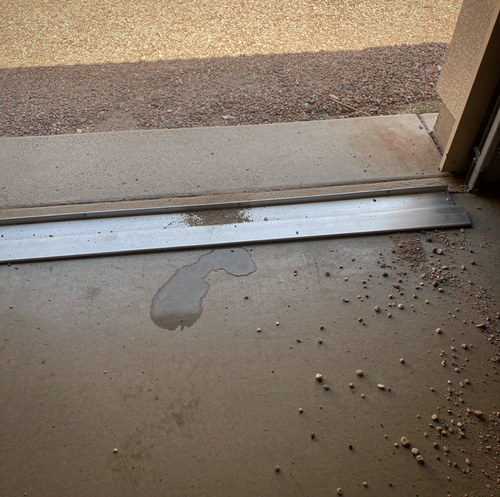
A technician kneels at your garage threshold with a UV lamp in one hand and a tube of sealant in the other, and you have a question that has nothing to do with either tool yet: Should this be happening at all? Not how much of the house needs it, not which room to start in. Just whether closing physical gaps in a wall is actually the right response to a scorpion problem, or whether it's a service that sounds reassuring without doing much.
That question deserves a real answer before anyone touches a tube of sealant. It's about what sealing mechanically does, what it doesn't do, and whether that combination matches the problem you actually have.
What Sealing Is Actually Claiming to Fix
A bark scorpion doesn't need a hole. It needs a crack, and a small one. Its exoskeleton is flexible enough to flatten and pass through an opening about as thin as a credit card held edge-on, roughly a sixteenth of an inch, which means the gap under a garage door threshold, the terminated end of a weep screed, or a hairline stucco crack near a window is a functioning entry point even where it looks purely cosmetic. Sealing is the work of finding those specific openings and closing them with a material matched to the gap: mesh at weep holes and vents, cement or mortar at cracks and joints, a sweep or brush seal at thresholds.
That's the entire claim. Sealing closes physical routes a scorpion can use to get from outside to inside, or from the ground to a wall void it can climb through. It doesn't kill anything, and it doesn't repel anything. It removes an opening. Whether that's worth doing depends on whether openings are actually your problem, which is a separate question from whether scorpions are your problem.
Worth flagging before going further: "sealing" isn't one single standard. A general home-sealing service and a scorpion-specific sealing service both close physical gaps, but they draw the line differently, and how those two compare is its own separate question this article isn't answering. What follows here treats sealing as a category, regardless of which standard ends up being right for your property.
Why Spraying Alone Leaves a Gap in the Plan
Chemical treatment and sealing address two different aspects of the same situation, and conflating them is where much of the "is this worth it" confusion starts. A liquid barrier changes the odds for a scorpion crossing treated ground; it doesn't close a hole. A property under chemical treatment alone can still see occasional indoor sightings, not because the treatment failed, but because the treatment was never designed to physically prevent entry in the first place.
Sealing addresses the specific coverage gap that chemistry alone leaves open, which is why the two are usually paired rather than treated as alternatives.
The Evidence a Seal Is Actually Built On
Whether sealing is worth doing on a given property comes down to one practical question: were the gaps it's closing actually found, or assumed? Those are different jobs with different outcomes, and the difference is the whole case for sealing as a service rather than a generic list of caulk points.
A black-light survey is what turns "probably has gaps somewhere" into an actual finding. Because a bark scorpion's cuticle fluoresces blue-green under ultraviolet light, a technician walking the exterior after dark can see where scorpions are actively climbing, sheltering, and moving on your property, beyond what a typical house checklist would assume. That distinction matters more than it sounds: a standard checklist of thresholds and weep screeds closes the openings that usually matter on a house like yours. A survey-based seal closes the ones that matter on your house specifically, evidenced by an animal actually using them that night.
If a sealing quote doesn't mention a warranty period, ask directly. Evidence-based sealing tied to a survey diagram usually carries its own coverage, separate from a pest-treatment guarantee, because each closed gap is a specific, traceable claim rather than a general impression.
That's also why sealing carries its own warranty coverage, distinct from a pest-treatment guarantee: a checkpoint marked on a diagram is a specific, traceable claim, so a callback points to a location rather than a vague impression that scorpions "came back." Evidence-based work is auditable in a way a generic seal never is.
How much of the exterior that survey ends up calling for, a handful of confirmed checkpoints or the full perimeter, is a separate question with its own answer. Targeted Scorpion Sealing vs. Whole-Home: What Decides It walks through exactly what the survey pattern needs to show before the job is sized one way or the other.
What Sealing Does Not Solve, and Why That's Not a Failure
Sealing has a real edge, and knowing where it sits matters as much as knowing what's inside it. A closed perimeter only stops crossing traffic. It does nothing to a population already established inside a wall void, under a stacked-rock border, or in a valve box when the last gap is closed. That population doesn't leave because the exterior was sealed; if anything, a sealed structure becomes a more stable, harder-to-leave shelter for whatever was already inside.
That's why sealing on its own, without addressing an existing indoor population first, can produce a result that looks like the seal failed when it actually did its job perfectly. The routes in got closed. The scorpions already past those routes didn't go anywhere, because sealing was never the tool built to remove them. Knockdown of an existing population and closing the routes forward are two separate tasks, and skipping the first one is the most common reason someone concludes sealing wasn't worth it when the actual gap was sequencing, not the sealing work itself.
Reading Your Own Situation
Whether sealing is the right call for your property depends less on how many scorpions you've seen and more on what kind of problem those sightings describe.
Sightings outdoors only, never past the threshold: This is close to the textbook case for sealing: the perimeter is under pressure and hasn't been breached yet, so closing the routes before one gets used does the most good.
Occasional indoor sightings despite regular pest treatment: This pattern is precisely what sealing was designed to address. Chemistry is managing the population pressing toward the house; the sightings are telling you a physical route survived that pressure. Closing it is the missing half of the plan, not a sign the treatment failed.
Frequent indoor sightings, especially near baseboards or upstairs: Before sealing goes in, this pattern is worth asking about specifically, because it can describe an established interior population, separate from fresh arrivals crossing in from outside, and that distinction changes what needs to happen first.
No sightings at all, older stucco or an unsealed new build: Sealing here is preventive rather than reactive. There's no evidence yet of an active route, which is exactly why a survey matters: it establishes whether there's anything to close before assuming the work is unnecessary.
Scorpion sightings alongside roach or rodent activity: This pattern points toward a broader home-sealing scope rather than a scorpion-specific one, since the routes at issue are usually shared among pests, and closing them addresses more than one problem at once.
Frequently Asked Questions
Mostly exterior. Weep holes, thresholds, expansion joints, and utility penetrations are all worked from outside the structure. The exception is when a survey finds an active route terminating at an interior point, such as a baseboard gap or a cabinet penetration under a sink, which is closed from whichever side provides better access. A homeowner rarely needs to clear a room out or plan around the crew being inside for long.
That depends on what the survey finds and how much material the job needs, but most properties are scheduled within a week or two of the survey rather than the same visit. The survey and the sealing are usually two separate stops: one to map the checkpoints, one to close them, which also gives you time to review the diagram before the crew comes back.
Not in a way that wastes the work. A property with no current sightings still benefits from a survey-based seal ahead of a seasonal shift in activity, since a route sealed before it's used works exactly as well as one sealed later. The only real inefficiency is sealing off a generic checklist with no survey to back it up at all.
It can, if the work disturbs a checkpoint or opens new construction gaps that weren't there during the original survey. A new patio slab poured against the foundation, a re-stuccoed wall section, or a relocated utility line are the kinds of changes worth a follow-up look, since they can either bury an old checkpoint or create a fresh one the original diagram never accounted for.
The routes differ more than the principle does. A bark scorpion climbs stucco and block readily, so a two-story structure has vertical routes, up an exterior corner, along a downspout, into a soffit gap, that a single-story survey doesn't need to account for. The gap-closing method is the same either way; what changes is how much of the vertical surface a survey has to cover.
Ask for one if it isn't offered automatically. A copy of the checkpoint diagram is what makes the warranty coverage meaningful to you directly. It lets you match a future callback to a specific, previously recorded spot instead of relying on the crew's own records, and it gives you a baseline to compare against if a follow-up survey is conducted later.
Sealing isn't a stand-alone fix, and it was never supposed to be judged as one. It answers a narrow, specific question that spraying and general treatment don't touch: whether the physical routes into your house are open or closed. Once that question is settled in favor of sealing, two more follow it naturally, and both are worth asking separately rather than assuming the first answer covers them. One is how much of the exterior actually needs the work, a handful of confirmed routes versus a full perimeter. The other is which standard fits the property: a general seal against the openings several pests share, or a scorpion-specific seal built around climbing and ground routes mapped to that animal alone. Neither changes what this question was about: whether closing physical gaps belongs in the plan at all.
Ask about a blacklight survey — it shows whether physical entry routes are actually open on your property before you decide to seal. Russell Pest Control serves the Phoenix Valley. Call (623) 469-7583.
