
What a Bee Hive Inspection Settles Before the Wall Opens
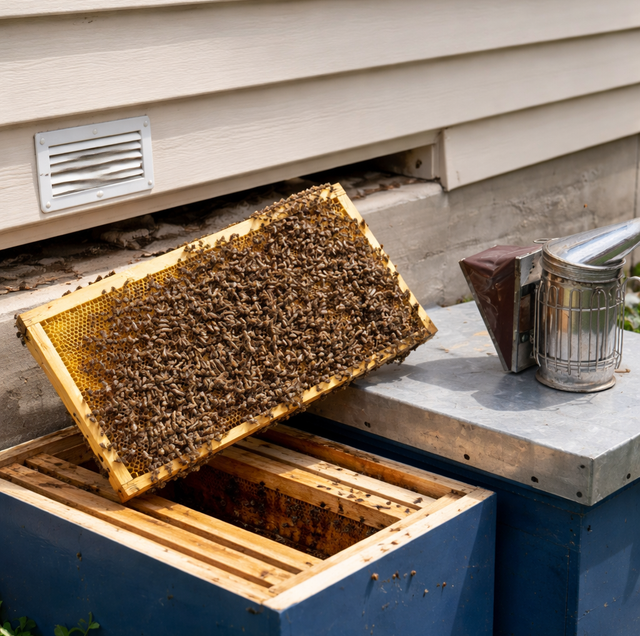
The useful part of a bee inspection starts about fifteen feet back from the house, with nobody standing anywhere near the gap. From there, a technician reads the whole face at once: which way it takes the afternoon sun, where the siding seams land, how the soffit returns at the corner, which vents and pipe collars break the plane. The bees crossing one seam are the reason for the visit. The elevation around them determines the size of the job.
By the time the visit ends, four things should be settled. Where the colony actually sits relative to the opening. Roughly how much comb is behind it. Which other openings on that same face could take a colony next. And whether there is a colony there at all. Each of those is a physical check with a method behind it, and each one changes what a removal would involve.
The Elevation Walk Comes First
A survey of the face is a list-making exercise, and the list runs longer than most people expect. The spots a technician records are the ones built to a tolerance a scout bee can work with: the end of a siding run where the last panel meets corner trim, the gap behind a rake board, the seam where a soffit returns and the two planes never quite close, a bath fan or dryer vent whose damper hangs part open, a hose bib or refrigerant line penetration where the collar of sealant has shrunk back, an unscreened gable vent, a soft section of fascia that has lost its paint film.
Each one is noted by position, height off the ground, and the void it leads into, because a gap at the eave and a gap at the sill lead to different places on the same wall. That list is what a sealing scope gets built from later. It is also why the walk happens before anyone gets close to the active opening: once a technician is standing at the gap with bees moving around, attention narrows to the one spot in front of them.
Placing the Colony Against the Framing
Comb rarely hangs directly inside the entrance, so the first measurement of the visit is offset: how far off the opening the nest runs, and in which direction. A wall provides real boundaries for work to be done inside before anything is opened. Stud bays are usually framed at sixteen inches on center, sometimes twenty-four, and each bay is closed at the sides by its studs and at the ends by the bottom and top plates. That puts a ceiling on the volume any single bay can hold.
The framing around the entrance narrows it further. A gap that sits under a window opens into a short bay boxed in by the sill framing and the cripple studs above it, so there is only so much room in there. A seam at the eave line can open into a soffit that runs unbroken from corner to corner, a much larger volume, and a colony in that space can be several feet along it from where the bees go in. Listening at points along the run helps, though the reading gets checked against where the framing actually allows a cavity to run.
The interior side of that wall matters at this stage too. A technician looks at what sits on the other side of the bay, whether that is open drywall in a bedroom, the back of a kitchen cabinet run, tile to the ceiling in a bathroom, or a plumbing chase. That determines whether an indoor access route is available at all, and it is settled during the check rather than on the day of the work.
Before the visit, write down the date you first saw bees at the gap and the times of day the traffic looks heaviest. Duration bounds the comb estimate, and nothing on the wall itself records it.
Sizing the Comb Behind the Gap
An estimate of how much comb is in there drives the physical shape of a removal: how much siding or soffit has to come off, how long a crew is on the wall, and whether a beekeeper can take the colony intact. It is built from several readings that agree, not from one that sounds convincing on its own.
How long the household has been seeing traffic is the strongest input, since comb-building starts within a day or two of a colony moving in and adds steadily from there. The lip of the opening carries evidence too: bare framing and clean edges read one way, and a darkened, waxy sheen where thousands of bees have polished the entrance with their bodies reads another. The framing sets an upper bound on volume, and the breadth of activity along the wall sets a rough lower one.
What that estimate changes is concrete. A few sheets of comb inside one bay means one section of siding off, one bay cut open and cleaned, and one patch to make good afterward. A run along a soffit means several feet of that soffit opened from below, working overhead, with much more of the cavity exposed at once. Establishing which of the two a wall holds is what keeps a job from surprising everybody halfway through.
Confirming There Is a Colony to Remove
Bees at a gap do not always mean a colony behind it, and the check has to settle that before anything else matters. A working entrance shows two-way traffic held steady for hours and repeated the following day: bees leaving empty, bees returning loaded, a line that re-forms after any interruption. Scout bees investigating a candidate cavity behave differently. They land, walk the edges of the opening, go inside briefly, come back out, and their numbers stay small across days.
Foragers are the third possibility and the easiest to mistake for the first from a patio chair. Bees crossing a wall on the way to an irrigation emitter, a leaking valve box, or a flowering shrub on the far side of the house produce steady traffic across the face without ever entering anything. Standing at a right angle to that traffic, so it passes left to right in front of you, separates bees that are crossing a wall from bees that are using it. A resting cluster hanging on the siding is its own situation, with its own handling and timeline.
Behavior narrows the answer. Wax visible inside the opening, or comb seen on a camera pass, confirms it.
What the Visit Itself Involves
Most of this happens outside, on foot, with a ladder for anything above head height and no part of the wall opened. The assessment is what a technician does while out at the house to look at the wall and put together a scope of work, and it happens during that visit. Whether any work follows on the same day depends on what the check turns up and on what the household decides.
The practical asks are small. Keep people and pets off that side of the house while a technician is at the opening, since anyone standing at an active entrance draws attention from the guard bees stationed there. Move a vehicle parked under the elevation being worked. Expect the technician to step away from the wall and return, because activity at a disturbed entrance takes several minutes to settle back into its normal rhythm.
Frequently Asked Questions
A second look at a different hour usually settles it. Traffic at a working entrance thickens through the warm middle of the day and thins toward dusk, while a few scouts investigating a cavity produce much the same light traffic whenever you check. If two readings still sit at odds with what the framing allows, the next step is a small access hole placed where a patch is easy, in a closet wall or an unfinished area, so the cavity gets confirmed without opening the exterior on a guess.
Partly, and it fills a gap the exterior cannot. A switch or outlet cover on the affected bay comes off in under a minute, opening a route into the existing cavity, allowing a technician to confirm which bay is occupied without cutting anything. Closet walls and cabinet backs sit on the same bays with less finish to protect. The flight picture is only available from the outside, so an interior look supplements it.
A borescope, a slim camera on a flexible cable, can go in through the existing opening or a small pilot hole and show what a flashlight alone can't reach around a corner. It confirms the comb and its position rather than removing anything.
Yes. The elevation is first read from the ground with binoculars, and the close work waits until a ladder can be footed on ground that will hold it, which is its own constraint on a sloped or heavily planted side of a house. Height also widens the range of what could be back there, because a soffit cavity, a rafter bay, and the attic volume above the top plate all meet near an eave, and the check has to establish which of the three the bees are actually using.
Not necessarily. A colony that outgrows one stud bay spreads into the next through the holes already there: wiring and plumbing penetrations bored through the studs, and gaps where the framing meets the top plate. Several entrances can lead back to one nest.
Yes. A hollow behind lap siding carries sound differently than a masonry wall or a stuccoed surface over lath, so the listening points and the depth a technician expects the cavity to run both shift with the material, which is part of why the check happens in person rather than over the phone.
An Inspection Can End With Nothing to Remove
Some visits finish with no work to schedule at all. A handful of scouts at a seam, a cluster resting on the siding with nothing built under it, or foragers crossing a wall on their way to water somewhere else on the property all look identical from a patio chair, and none of the three calls for a wall to be opened. Sending someone out to establish that is the same act as sizing up a removal. Only the answer is different.
What that leaves a household with is a short watch list. Note the date, and look at the same seam again several days on, in the warm part of the afternoon when traffic runs heaviest. Traffic that has thickened, held its line into a second week, or begun leaving a waxy sheen at the lip of the opening has answered the question the first look could not. A bee turning up on the wrong side of that wall, indoors, answers it faster than any of them.
Have the wall checked before any treatment is scheduled — a technician confirms what is actually in the void before work begins. Russell Pest Control serves the Phoenix Valley. Call (623) 469-7583.
