
How Far Will Africanized Bees Chase You? Sources Disagree
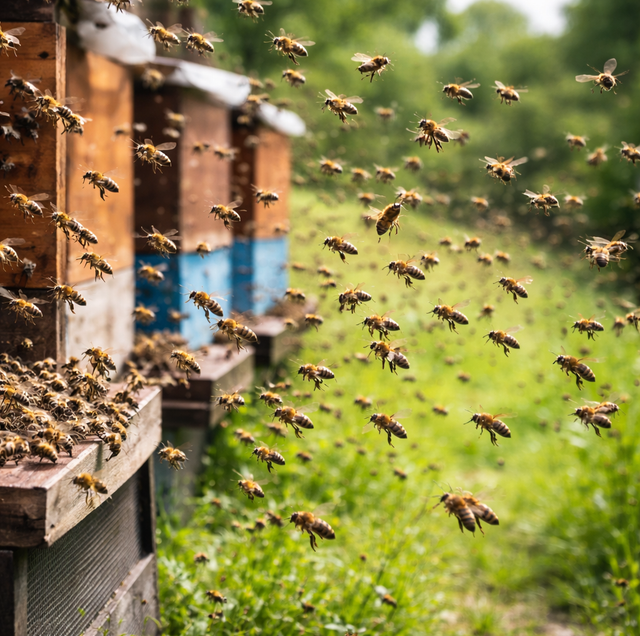
Ask four published sources how far a defensive colony will follow a person, and you get four different answers. The larger figures are all observations of Africanized-ancestry colonies; the smaller one is the total number of honey bees. A U.S. Forest Service field-safety publication says the bees may chase someone for more than a quarter mile. A university extension service puts the usual distance at several hundred feet. A National Park Service page allows up to half a mile. A national pest-control company's page settles on over 300 feet, roughly eight times below the top of that range. Three are safety publications with field observation behind them; the fourth is a company page with nothing shown, which is its own kind of information.
If you came for one number to plan around, that spread is the honest answer, and the more useful one once you know why the figures pull apart.
What the Published Figures Actually Say
Part of the spread the four appear to disagree about sits inside one of them: the extension page carries the several-hundred-feet and quarter-mile figures together, describing different colonies. The quarter mile, about 1,300 feet, recurs most often in federal and university materials as the far edge of what has been recorded.
A second number gets tangled up with these, and it measures something else. Forest Service material describes highly defensive guard bees patrolling a territory extending about 30 meters, roughly 100 feet, beyond the nest entrance, expanding and contracting with how often the colony is disturbed. That is the zone in which you can set off a response; how far the response travels once it starts is a separate measurement. A short figure quoted confidently is often this defended-zone number wearing the wrong label.
The zone itself resolves into more than one distance. Extension material separates it by stimulus: a colony can register a person or an animal from around 50 feet, and the vibration of power equipment from roughly twice that. Flattening those into one defended-zone number is a smaller version of the error that produces a confident 300-foot pursuit figure. Read any single number for the zone as an order of magnitude and nothing finer.
Every one of these figures comes from field observation and incident reports, gathered under conditions nobody would volunteer to repeat.
Why the Figures Disagree
Colony: Temperament is not fixed. Federal safety guidance notes that small or young colonies are less likely to be defensive than larger, older ones, and that behavior shifts with age and season.
Provocation: An extension service reports that nearly all attacks trace back to some provocation, most often noise or vibration. Walking past an entrance and running a string trimmer three feet from it will not produce the same pursuit distance.
Terrain: The figures partly record how far the person had to travel. Someone who reaches a truck cab in 40 feet contributes a 40-foot account; someone caught in open ground contributes a quarter-mile account. The bees' willingness and the person's options are baked into one number.
Definition: Sources are not measuring the same endpoint. Pursuit can mean where stinging stops, where the last few bees peel off, or where the person felt safe enough to stop. Recollection under that kind of stress is not precise.
What Does Not Vary Across Sources
The distances argue. The instructions do not.
Leave the moment you realize a colony is reacting to you, without waiting to see whether it settles. Run in a straight line away from the nest, since a loop keeps you inside the defended zone. Cover your face and airway; a shirt pulled over your head will do, because the extension service is direct that stings to the chest and abdomen are far less serious than stings to the face.
Do not swat or flail your arms. Crushed and alarmed bees release a scent that recruits more of the colony, so swatting buys a worse encounter than the one you already have. Do not stand still, and do not hide behind vegetation.
Get inside a closed building or a closed vehicle, and keep going until you are inside one. And do not get into water. The sources that raise it agree, which is not something they do often here: the bees hold position above the surface, and they wait longer than you can hold your breath.
Water is the one shelter that is not shelter. A colony holds position above the surface and outlasts anyone's breath, and every time you come up you are back in open air. Keep running for a closable door instead.
Getting Inside, and Not Stopping Short
Enclosed means a door that shuts. A covered patio, a tarp, a shed with an open bay: none of those separate you from the air the bees are in. If the nearest closable door sits farther off than an open structure, the door is still the target.
Expect a few bees in with you, and expect to be stung while you shut it. That is a general expectation rather than a measured finding. The ones that follow you in will head for the brightest window, and leaving them to it beats swatting in a closed room.
Do not go back for equipment and do not turn around to check whether it is over. A mower left running is a mower. Stopping early is the failure the whole spread of published distances warns about.
Once you are behind a door, get the stingers out and get medical attention. Call emergency services for anyone having trouble breathing, swelling beyond the sting sites, or with a history of reacting badly to stings. Children, older adults, and anyone with a known allergy should be seen regardless.
Then deal with the reason the question came up. A colony is living within reach of ground people use: a wall cavity, a roof space, a meter box, a block fence. Where Africanized ancestry has spread through the feral bee population, what a colony did yesterday predicts little about what it does while someone works at its entrance, which is why removal is done in sealed protective gear with respiratory protection. Treating the entrance yourself provokes exactly that response.
Frequently Asked Questions
A university extension service puts honey bee flight at roughly 12 to 15 miles per hour and adds that most healthy people can outrun them. The two sit awkwardly together, since very few people hold 12 miles per hour for any distance. You are covering ground toward a door while the colony's willingness to follow runs out, and direction matters more than speed.
Often. Forest Service material describes patrolling bees head-butting an intruder: flying straight at the target with legs trailing, wings buzzing at a higher pitch than normal flight. Being bumped without being stung is the warning, and standing still to work out what is happening spends the interval it just bought you.
Get down before anything else. Height outranks the bees: a fall from a ladder or a roof edge does more damage than a defensive colony will in the same few seconds, so come down deliberately at the first head butt. On a roof, move toward the ladder with a forearm across your face. In a vehicle, stay in it, shut the windows, and drive. On a riding mower, get off and go on foot; the machine is what is still producing the vibration.
Yes, and federal guidance says so directly: you may pass the same colony for weeks and provoke it unexpectedly one day. The part worth knowing is the tail. Published extension material describes a colony staying agitated for an hour or more after an incident, so a quiet doorway ten minutes later carries no information. Give it the rest of the day.
Get them out fast, and spend no time choosing a method. Federal first-aid guidance for outdoor workers says to scrape a stinger out and never to pinch it or use tweezers, on the reasoning that squeezing drives the rest of the venom in. A university entomology group that measured it, in a paper published in a medical journal, found the removal method made no measurable difference while delay did. Published guidance has never reconciled the two, so take the part they agree on: the clock is short. Most of a sting's venom goes in within roughly the first twenty to thirty seconds, so use whatever is in your hand, on the way to medical attention.
An animal on a run line, in a pen, or behind a fence has the exact problem this article is about: it cannot cover distance. Everything above assumes a person who can pick a direction and keep going, and a lead or a gate removes that assumption. So the planning happens ahead of the work: pets indoors before a removal is scheduled, animals off that side of the property for the day. If an attack is underway, stay out of it and call for help.
Planning to the Top of the Range
The two errors cost very different amounts. Running an extra 600 feet you did not need costs a hard minute. Stopping 600 feet early costs far more, and from inside the event there is no way to tell which colony you have. That asymmetry is why the disagreement between sources does not close if you keep reading. It is a range, and a range is a thing you plan against at its top. On a property you control, it collapses to nothing once the colony is gone, and the distance worth measuring is the one between an entrance and the path your family walks every day.
Have a bee colony removed before anyone has to find out which end of the range applies — sealed protective gear, comb and honey out, and the entry gap closed behind it. Russell Pest Control serves the Phoenix Valley. Call (623) 469-7583.
