
Bee Sting: What to Do First, and When It’s an Emergency
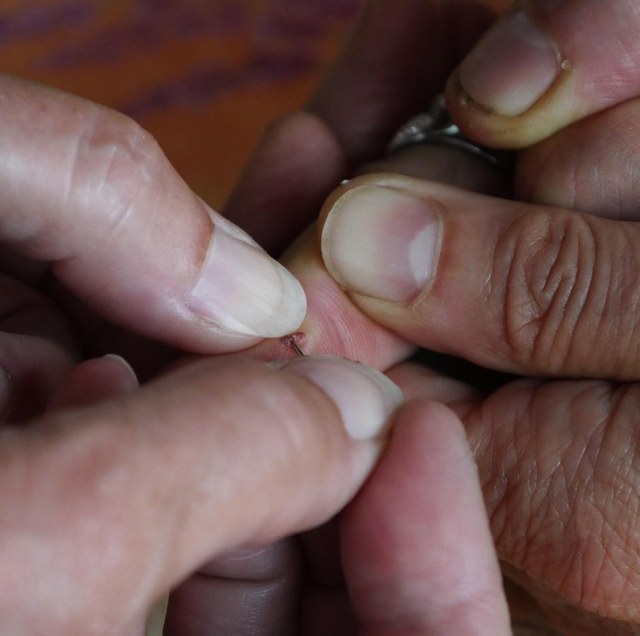
The first fifteen minutes after a sting have a shape, and it is worth knowing that shape before you are standing in it. The opening seconds belong to distance: where the bee came from, and whether anything else is still coming. The next minute or two belongs to the stinger, if one is sitting in the skin. From roughly minute three to minute ten the site declares itself: a hot point, a raised welt, then swelling that widens outward. By minute fifteen the two questions that matter have usually answered themselves: whether the reaction is staying where the sting is, and whether the person feels wrong in ways unrelated to it.
What follows sorts into those two questions. It is general information drawn from first-aid guidance published by major medical centers and federal bee researchers, and it is not medical advice: only a clinician who knows your history can tell you what your own reaction means.
Trouble breathing, tightness in the throat, swelling anywhere away from the sting site, dizziness, faintness, or a known severe sting allergy means emergency help immediately. Call 911, and follow your own emergency plan if a clinician gave you one.
The First Minute Belongs to Distance
One sting picked up in the open is usually the end of the matter. A sting taken within a few strides of a wall void, a shed or an irrigation box is a different event, because defensive behavior is organized around the nest.
That makes distance the first task, ahead of anything done to the sting itself. Move away and keep moving; cover your face and head with a shirt or an arm; get behind a closed door; and keep your hands still instead of swatting. Everything below assumes no more stings are landing, because that is what decides which of the two problems in this article you are dealing with.
Getting the Sting Out: Speed Over Technique
A honey bee's stinger is barbed. It anchors in skin and tears loose from the bee with the venom sac and its small muscles attached, and those muscles keep working after the bee is gone. That is why there is a clock on this at all.
The old advice was to scrape the stinger out sideways with a fingernail or a card edge, never to pinch it, on the theory that pinching squeezes the sac. When university researchers tested scraping against pinching, the delay mattered far more than the technique. Measurements of the delivery rate put the great majority of a sting's venom in within the first twenty seconds or so, and essentially all of it within thirty, so hunting through a wallet for a scraping edge costs more than the scraping saves. Federal first-aid material still says not to squeeze the sac, and the research finding claims only that the seconds spent hunting for a better tool cost more than a squeeze does. Use whatever is already in reach, including your fingers. A stinger found an hour later still comes out, but the urgency is gone.
Take rings, a watch, or a tight bracelet off a stung hand or arm in the first minutes. Swelling can build up over a day or more, and jewelry becomes much harder to remove the longer you leave it on.
Medical sources generally advise washing the site with soap and water and putting something cold against it. They are equally consistent that the baking soda pastes and vinegar soaks filling search results are not supported by evidence. One point of identification: only honey bees leave a stinger behind. Wasps do not, and they are a separate job.
What a Normal Reaction Looks Like Over the Days That Follow
The usual sequence is sharp pain fading to an ache within minutes, a raised red bump with a pale center, and itching that arrives as the pain leaves. Swelling does not peak immediately: medical sources describe it building over hours, often worst a day or two later, then subsiding over several days.
Some people get what is called a large local reaction, where swelling spreads well past the sting, across a joint or over much of a forearm or calf. It looks frightening, and major medical centers describe these large local reactions as not, on their own, the dangerous kind: the distinguishing feature is that the swelling stays continuous with the sting site, an unbroken path back to where the bee made contact. They describe them settling on their own over several days, and still worth a call to a clinician.
Redness that spreads and worsens two or three days afterward, especially with fever, suggests the puncture itself has become infected, which is a different problem from the venom and needs attention.
The Signs That Mean Emergency Help Now
A dangerous reaction announces itself somewhere the venom never reached, and medical sources treat that as the clearest line between a local reaction and a systemic one. Hives on the opposite side of the body, swelling of the lips, tongue or throat, wheeze or chest tightness, sudden stomach cramps or vomiting, lightheadedness, pale clammy skin, a sense that something is badly wrong: none of those are local effects, and none are answered by waiting.
Severe reactions typically begin within minutes of the sting, which is not enough runway to reassess twice. Medical sources generally advise calling emergency services rather than driving to a hospital, since nothing can be done for the patient in a moving car.
Someone prescribed an epinephrine autoinjector should follow the plan their own clinician gave them, and that plan almost always includes calling emergency services afterward, since a reaction that improves can return in a second wave hours later. If the person cannot speak or is losing consciousness, call emergency services without waiting for them to tell you it is needed. None of this substitutes for advice from a professional who can see the patient.
Allergy and Dose Are Two Different Problems
These get run together constantly, and they are different emergencies with different triggers.
An allergic reaction: The immune system is answering the venom proteins, not the volume of them. One sting is enough. The risk lies with the person's own immune system, which is why an adult can be stung once and be in serious trouble, while someone beside them can take several stings and go back to work. Same bees, different immune systems.
A dose reaction: Enough venom to act as a poison on its own terms, with no allergy involved. This is what a mass stinging incident is, and it is why a highly defensive colony, often called Africanized, is treated as a hazard rather than a nuisance. Medical sources describe nausea, vomiting, weakness, muscle pain, and effects on the kidneys that develop over the following hours in people whose immune systems are functioning normally. It is also why the standing advice after an incident involving many stings is evaluation, even when the person insists they feel fine.
What does not belong here is arithmetic. There is no count you should be running on yourself, a child, or a neighbor, and no published number should decide whether someone gets seen. The number of stings is one input a clinician weighs alongside age, health conditions, and how the person looks and behaves, and that weighing belongs to whoever is treating them. Any figure published as a threshold invites the wrong decision from whoever lands just under it. If the question "how many was that?" has come up at all, that is already the answer: have the person seen.
Frequently Asked Questions
Sometimes, but not reliably. Fabric can keep the barb from anchoring, so a sting through a sleeve often goes shallower and leaves nothing embedded in skin. What catches people out is the stinger left hanging in the weave, which, when leaning back against a chair, can press in a second time. First-aid guidance commonly says to take off a garment that bees are caught in, since brushing at it while it is still on presses the stinger home.
No, and it catches people both ways. How much a sting hurts tracks with where it landed: a fingertip, an ear, a lip, or the sole of a foot hurts far more than a forearm, because of what sits in the skin there. A barely noticed sting on the back can be followed by a systemic reaction, and an eye-wateringly painful knuckle can stay entirely local. Severity is answered by what the body does over the following minutes, and by where those effects show up.
Yes. Swelling in an airway is a mechanical problem regardless of whether anyone is allergic, so medical sources advise urgent care for stings to the lips, tongue, or throat. A common route is a drink left open outdoors with something inside it.
Yes. Allergy specialists note that sting sensitivity is not fixed for life. Most people who have a severe reaction had ordinary stings before it, and a past severe reaction does not guarantee the next repeats. That is why the follow-up belongs with an allergist, who can discuss testing and longer-term options.
Medical sources generally advise a lower threshold for older adults, for people with heart or lung conditions whose margin is thinner if a reaction goes systemic, and for anyone a clinician has already told is at higher risk. Children are a separate case for a separate reason: a child takes the same venom into a smaller body, which matters when several stings land instead of one. And anyone stung while alone, on a ladder, or behind the wheel has a second problem beyond venom.
Dogs snap at bees and take stings on the muzzle, tongue, and paws. Facial swelling, hives across the belly, vomiting, or an unsteady walk are reasons to call a veterinarian, who is also the one to ask about anything given afterward. Human medicines are not automatically safe for animals.
The Nest Outlasts the Sting
A sting is an event, and it is over in a day or three. A nest is a condition, and it does not resolve itself. What gets forgotten once the swelling goes down is that whatever stung you had an address, and if that address is a wall void beside a back door or a box where children play, the same fifteen minutes are available again next week. Being stung twice in one corner of a yard is information about the yard.
Have the colony located and removed — relocation where a beekeeper can take the bees, and the entry gap sealed afterward. Russell Pest Control serves the Phoenix Valley. Call (623) 469-7583.
