
What Actually Kills a Scorpion, and Why Store-Bought Spray Often Doesn’t
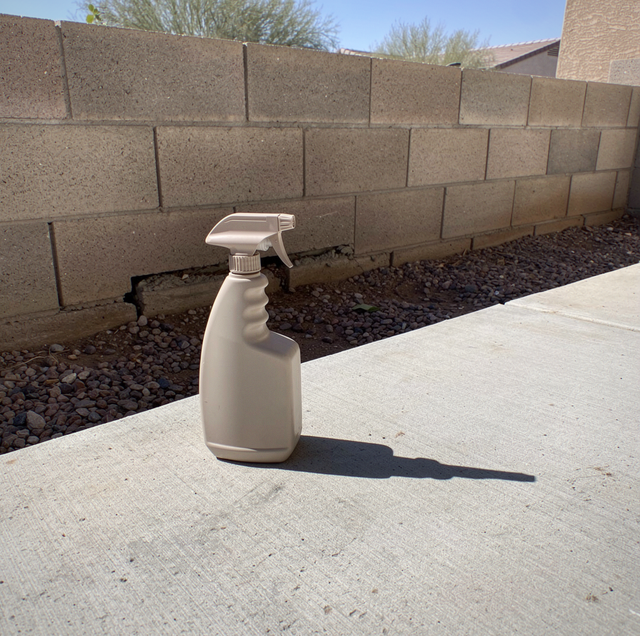
The can worked in the store demo. It's a residual pesticide, and on a clean, dry, non-porous test surface, it kills what it's supposed to kill. Then it goes on a block wall, a stretch of stucco, or a bed of decorative rock at home, and two weeks later a scorpion turns up a few feet past the treated line, as if nothing had happened there at all. The product didn't change between those two situations. The surface did, and that's usually where the real explanation lives.
Most over-the-counter scorpion sprays are contact residual insecticides: a synthetic pyrethroid, typically, that disrupts a scorpion's nervous system on contact and keeps working for a stated window afterward so anything that walks across the treated area later picks up a lethal dose too. That part of the chemistry works. Killing the scorpion was never the hard part.
The hard part is getting an effective dose onto a surface the scorpion will actually touch, and keeping it there long enough to matter. That depends on three things going right at once: the surface has to hold the product instead of absorbing it away, the product has to survive long enough in the Arizona sun to still be active when a scorpion crosses it, and the surface itself has to be one the scorpion actually contacts, not just one that's nearby. A can of spray applied correctly to a favorable surface, painted trim, sealed concrete, or a clean patio slab, performs close to what the label promises. The same can applied to a hot, porous, cavity-riddled wall is fighting all three problems simultaneously, which is why identical products produce such different results a few feet apart on the same property.
Porous Surfaces Absorb the Product Instead of Holding It
Concrete block, unpainted stucco, mortar, and unsealed masonry are porous in a way that painted trim, glass, or a sealed patio slab is not. A liquid applied to one of these surfaces doesn't sit on top as a film the way it does on something sealed. It wicks into the surface pores and the material's capillary structure, spreading downward and inward rather than staying concentrated on the outer face, where a walking scorpion would actually touch it.
That matters because a contact or residual product depends on a scorpion's legs and underside picking up enough of it to be effective. A film sitting on a sealed surface delivers a full dose on contact. The same volume, absorbed a fraction of an inch into a porous material, spreads that dose thin across a much larger volume and leaves less of it available right at the surface. This is a difference in surface chemistry, not product strength, and it's a big part of why two nearly identical spots on the same property, a painted section of wall next to a bare one, or a sealed patio slab next to an exposed footing, can produce very different results from the same application.
Mortar joints on a block wall make this worse still: the horizontal and vertical joints between blocks are typically more porous than the block face and wick liquid sideways along the joint line instead of letting it pool. A band that looks evenly wet right after application can be unevenly distributed within the hour.
Heat and Sunlight Cut the Effective Window Short
Any exterior surface facing south or west spends a summer afternoon absorbing direct sun, and surface temperatures on sun-struck masonry, stucco, or stone can run well above the surrounding air temperature. That heat does two things to a residual pesticide film: it accelerates the physical breakdown of the active compound and accelerates volatilization, meaning some of the product moves off the surface as vapor rather than remaining as residue. Ultraviolet light adds a second breakdown pathway alongside heat, since most residual chemistries are somewhat light-sensitive.
A treated surface that gets full sun most of the day is being worked against by both mechanisms at once, which is a very different environment than the inside of a north-facing eave or a shaded breezeway. Put that together with a hot, sun-exposed, porous surface, and a treatment may hold up for days rather than the weeks printed on the label; on a shaded, sealed, or painted surface, the same product typically lasts considerably longer. The label's stated window assumes reasonably favorable conditions, not the most demanding surface on a property.
The Product Never Reaches Where the Scorpion Actually Lives
A surface spray treats a two-dimensional plane, whatever the nozzle was pointed at, and that's the mechanism that fails hardest against any structure with hidden interior space. A standard concrete block isn't solid; most have hollow cores running the full height, and stacked into a wall those cores line up into a continuous cavity that stays cooler and more humid than the sun-baked face outside it. A gravel bed, a stacked-rock border, or a woodpile works the same way at a smaller scale: cover on top, open space underneath. Picture any of these less as a solid surface and more as a row of straws stood on end: coating the outside of the straw does nothing for whatever is living in the tube running through the middle of it.
That's a structural mismatch, not a strength problem. The scorpion sitting two or three inches deep in a hollow cell, under a rock, or inside a woodpile was never on the surface a spray application reached. It comes out through a weep hole, a gap, or an unfilled top course, crosses the treated face for a few seconds, and returns to a space that was never part of the application at all. No amount of extra product on the outer surface changes that geometry.
Spraying more often or more heavily than a product's label directs will not fix porosity or hidden-cavity problems underneath it and only adds pesticide load around a home with pets or kids, without addressing why scorpions keep coming back.
A Quick Way to Tell Which of These Is Yours
You don't need lab equipment to narrow this down, just some attention to when and where sightings happen relative to where you sprayed.
If scorpions show up on the treated area within the first day or two, then stop, then start reappearing a week or more later, the residual is likely breaking down on the schedule you'd expect for a hot, sun-exposed, porous surface — that points toward the heat and UV problem. If sightings never really stopped, even in the first days after application, and they cluster near a weep hole, a gap under a rock border, or a woodpile, that points toward the hidden-cavity problem: the product never touched where the scorpion actually lives. If the surface is unpainted or unsealed masonry and you can watch a splash of water vanish into it in a couple of seconds instead of beading and running off, absorption is probably taking a share of every application before it can do anything.
Most properties that keep producing scorpions after a spray are dealing with two or all three of these at once, which is exactly why doubling the amount of product rarely closes the gap.
Matching the Fix to the Actual Problem
A porous, absorbent surface calls for sealing it (paint or a masonry sealer) before a residual product can hold the way it does on a favorable surface. A short-lived residual window calls for treating on a schedule that matches how fast heat and UV actually degrade it on that specific surface, not the label's best-case number. A hidden cavity calls for closing the openings that connect it to the outside, since no surface treatment was ever going to reach the inside of a wall, a rock pile, or a woodpile. Most properties need some combination of the three, which is why a professional inspection usually starts by identifying which of these is actually happening before deciding what to do about it.
Frequently Asked Questions
Yes, meaningfully. A painted or sealed surface behaves much more like the non-porous surfaces against which a residual product is tested, holding a film on top rather than absorbing it into the material. An unpainted, unsealed surface keeps drawing product into itself for as long as it stays dry enough to wick. The catch is that the coating has to be intact: hairline cracks or peeling patches reopen the very pores they were covering, so an older paint job that looks fine from a distance may already be behaving like bare material up close.
Not usually. A higher concentration still faces the same three problems: it still absorbs into a porous surface, still breaks down under heat and UV on the same schedule, and still never reaches a hidden cavity it was never applied to. More concentrated product on the wrong surface just means more pesticide load around the property for the same result.
It depends heavily on the surface. On a shaded, sealed, or painted surface, a residual product commonly holds close to its labeled window. On a hot, sun-exposed, porous surface, expect meaningfully less, sometimes under half that window, since heat, UV, and absorption are all working against it at once. If sightings return well before the label's stated window is up, the surface is very likely the reason, not a bad batch of product.
The biggest difference isn't a stronger version of the same surface spray. A technician identifies where the actual harborage is, whether that's a hollow wall, a rock bed, or a gap under a structure, matches the treatment to that surface, and pairs it with closing the specific openings scorpions use to move between that space and the outside. A homeowner spraying the visible surface, by definition, treats only the part they can see and reach.
It can, beyond simple washing off. Water landing on a porous surface drives whatever product is still there deeper into the material through the same wicking action that absorbed it in the first place. A surface that gets regular sprinkler overspray or sits in a spot that stays damp after a storm is losing residue through multiple routes at once.
Because "the same treatment" usually isn't the same surface. A painted section next to bare block, a shaded stretch next to one in full afternoon sun, a sealed patio slab next to an exposed dirt footing: each pair can receive an identical application and still end up with very different amounts of active product actually available on the surface a scorpion touches.
A can of spray isn't failing you on purpose. It's built to perform on a favorable surface, and most of the surfaces scorpions actually use- hot masonry, absorbent stucco, rock beds, hollow block- aren't that. Once the surface itself becomes part of the diagnosis rather than an afterthought, it's much easier to see why a product that worked in the store isn't holding up three feet from where it was applied.
Get a scorpion control inspection — find out which surfaces on your property are actually holding a treatment and which ones need a different approach entirely. Russell Pest Control serves the Phoenix Valley. Call (623) 469-7583.
