
HOA Bee Removal: The Four Common Areas Bees Keep Choosing
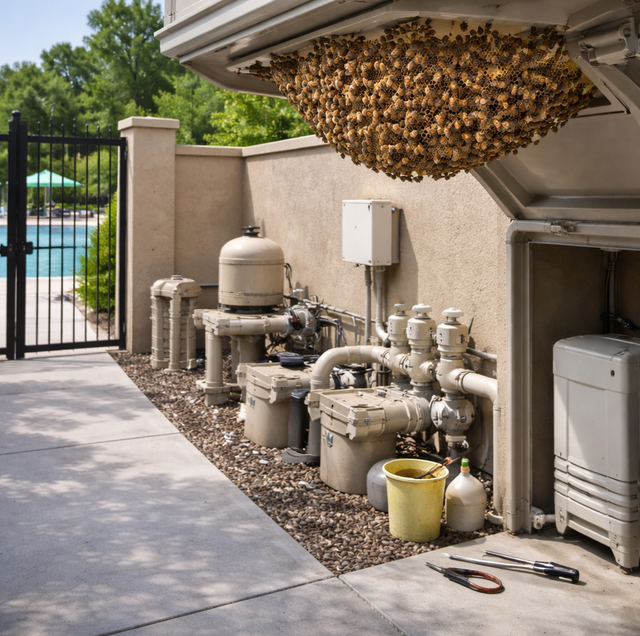
The concrete apron between a community pool gate and the pump enclosure gets crossed all day on a warm Saturday and looked at by nobody. Residents cross it with towels over their shoulders, and their weekend guests cross it knowing nothing about the property. The pool technician comes through on set days. The crew that mows and edges runs a trimmer where the slab meets the block wall. Every one of them is on the way to something else, and none of them is there to stand still and read that wall.
That is the difference between a bee call on shared property and one at a single house. One household passes the same wall face daily and eventually connects the same few bees to the same seam. Shared space spreads that across everyone who uses it, each of them seeing it once.
The Pool Surround and Its Equipment Enclosure
Water is the draw, and a pool deck is the most reliable water on a shared property: wet coping, an autofill's trickle, a backwash line that never quite drains. Bees turn up at the waterline whether or not the nest is anywhere near it.
That is what makes the pool the hardest place on a property to get a useful report from: everyone crossing the deck sees bees at the water, so the report says that. The nest is often the equipment enclosure just off the deck, a shaded box around the pump and filter, with a conduit penetration or an unfilled block core giving a way in.
So the location has to be re-pinned before a date is set, and you want that walk done on a quiet weekday rather than the Saturday it was reported.
Perimeter Runs, Shared Walls and the Cores Inside Them
A masonry perimeter wall is a stack of hollow units whose vertical cells line up into columns of empty space. Not all of them stay empty: cells at the ends, at corners and at intervals along the run are filled with grout and steel. The ones left open run continuously from the footing to the cap, dark and dry, with one small way in. Scout bees inspect a cavity before a swarm commits to it, and the opening they find need not look like one: a cracked mortar joint at a cap seam, or a core left open at the top of a run.
That is also why a colony settles in one cell and not the next one along. A wall like this is a single unit thick, so its core is shared by both faces, and there is no near side or far side to search. The offset that matters is vertical and along the run: on a wall that bakes for half the day, comb tends to hang several courses below the opening people report, or some distance along it, where the column holds its temperature most evenly.
A report of bees in the wall near the pool gate can describe several hundred feet of run, so you pin the entry point by walking it. Reaching both faces may mean being let through on the far side at the same hour the crew works the common side.
Entry Gates, Mail Kiosks and Light Columns
These are the small standalone structures nobody thinks of as buildings, and they sit at a community's highest-contact points. A gate pilaster is a masonry column, solid in places and hollow in others. A mail kiosk sits on a block base under a boxed overhang. A light column is a hollow shaft with a wiring void and a hand hole near the base. None of them backs onto anyone's living room, so nothing is ever heard from inside.
What people notice is the encounter itself: somebody at the kiosk with a key in the lock and their head under that overhang.
These are also the places a community cannot route around. A back gate can stay locked for a morning; the mail kiosk and the entry gate cannot, so an alternative has to exist before a date is set.
The person most likely to reach one of these openings first is a vendor on a fixed schedule who was never told: a pool technician lifting an enclosure lid, a grounds crew edging a wall base blind.
Shade Structures and Ramadas
A ramada is a roof on posts with almost nothing solid about it, which is why it works. The roof deck has a boxed underside. Steel posts are tubes, and a post with a damaged base plate or an uncapped top has a long dry shaft inside it. The barbecue island beside it has an enclosed cabinet with a penetration at the back. A shaded structure sits cooler than open ground in the hot months and holds warmth better in the cool ones, suiting a colony either way.
Residents notice this one differently, because a ramada is where people sit for an hour at a time. A family at the table with bees working a beam overhead produces a far more detailed report than a passing glance, and often a later one.
The work is overhead, above the seating, so the approach is from a ladder in open ground with no wall to work off. Ramadas also sit on a reservation calendar, so a date has to clear both a booking and a crew.
The Case for a Single Reporting Route
The reports that arrive without one are all partial. Each person describes the piece of the property they happened to be standing on at the hour they stood there, and no two of those pieces overlap enough to place a colony. Days go by before anyone can say whether the property holds one colony or three.
A single route fixes most of that, and it needs nothing elaborate. What you want back is short: where the bees go in and out, what fixed object that opening is nearest, how long it has been going on, and whether anything has been sprayed at it. That last item changes the job. A can of hardware-store spray emptied into an opening does not reach a colony sitting in a void and takes out no comb.
Two things are worth leaving out of the ask: nobody needs to get close, and nobody needs to identify the insect. A good share of what gets reported as bees under a ramada roof is a paper wasp nest, a separate insect and a separate job.
One expectation is worth setting straight early. Same-day response means the same calendar day, not a time measured in minutes, so a plan built on an hour's notice will fail.
The grounds and pool vendors are worth telling before residents are, and a narrow ask holds better than a broad one: one structure left alone until the work is done, the rest of the route run as normal.
Frequently Asked Questions
Sometimes. What decides it is the colony itself. The policy here is relocation where a beekeeper can take the colony, and removal where it behaves defensively, cannot be reached intact, or sits where people are at risk. That is plainer than an unconditional no-kill promise.
No. A recurring plan runs on a set cadence, monthly, bi-monthly or quarterly, and works the grounds and exteriors. A colony inside a masonry core or a boxed roof deck is a structural job: the void gets opened, the colony comes out with its comb, and the way in gets closed.
A hollow limb or trunk cavity works for a colony much the way a block core does, and can run far deeper inside the limb than the entry hole suggests. There is no wall to open, but a tree crew may be needed to reach it, and the tree's condition shapes the approach.
No, which surprises boards that have just replaced their plantings. What a site supplies is the cavity and the water. Forage comes from wherever the foragers find it, so a community with almost nothing in bloom can still hold a colony in a wall core, and one planted corner to corner can go years without.
It cannot. Structural removal is daylight work, so the window sits inside the day, whatever the space is used for. What gets closed off is a stand-off area around the structure, wider than the structure itself, so a pool deck usually loses the whole deck for the visit. The lever worth using is which day rather than which hour: a weekday morning empties a pool surround or a ramada more reliably than a weekend.
Closing the ways in, once the colony and its comb are out. The entry and the sibling gaps found during the work get closed as part of the removal, so a cleared cavity is not left open for the next scout to find. On a pump enclosure or a light column, that means the conduit penetration and the hand hole cover. Masonry is the one part that can run into another day, since capping open cores and repointing a cap seam are different trades.
Keeping a Record of Where It Has Happened Before
Colonies do not choose at random across a property. They keep landing on the same handful of structures, because whatever made a cap seam or a hollow post work the first time is still there when the next swarm goes looking, and closing one opening on a light column says nothing about the others along the same run. The most useful thing a community can carry forward is a short written list: which structures have held a colony, which openings were closed, and when. Held for a few years, that list becomes a map of the property's own habits, and the next report arrives with something to check against.
Have your common areas walked before the next report comes in — a scheduled visit beats a scramble at the pool gate. Russell Pest Control serves the Phoenix Valley. Call (623) 469-7583.
