
Found a Scorpion in the House? Here’s What to Do Next
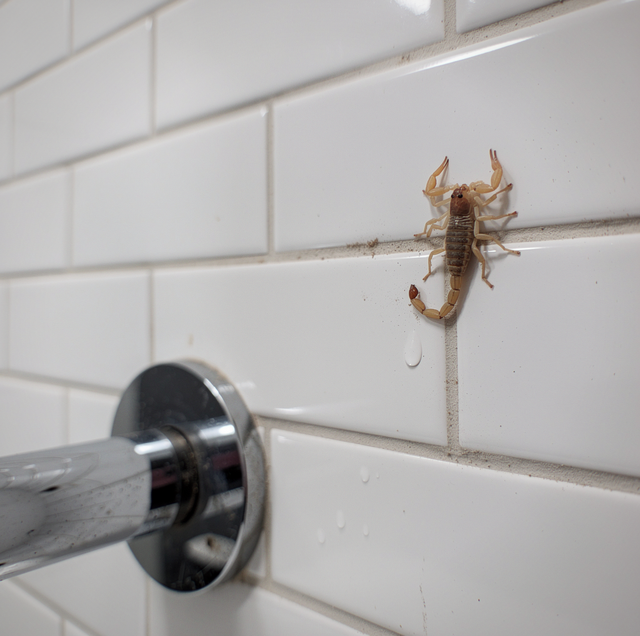
The light goes on, and there it is: pale tan, a couple of inches long, sitting dead still on the bathroom wall a few inches above the tile, or flattened against the bedroom carpet by the nightstand leg. You freeze. It doesn't move either. For a few seconds neither of you does anything, and that stillness is the exact moment that decides what happens for the rest of the night.
Most people's first instinct is to deal with the scorpion. That's backward. The next several minutes go better in a specific order, and the scorpion is not step one.
Move People and Pets Away Before You Move the Scorpion
Get bare feet off the floor and hands away from the wall first. Anyone standing barefoot steps onto a bed, a chair, or a pair of shoes they've already checked. A dog or cat gets called or carried out of the room instead of left to investigate on its own. None of this is about the scorpion escaping. It's about nobody closing the distance to it by accident while everyone's attention is on where it went.
Don't reach blind under a bed, into a closed shoe, or behind furniture to check on it or grab something you dropped near it. A hand moving into a dark gap is a common contact pattern behind indoor stings.
Once the room is clear of anyone who could stumble into it, you can actually look at what you're dealing with without the added pressure of someone else wandering back in.
Why It's Still Sitting There
A cricket or a roach caught in a light beam usually bolts. A scorpion often doesn't, and the reason is worth understanding before you decide what to do next. It reads its surroundings mostly through vibration picked up by fine sense hairs on its legs, not through sharp eyesight, so a light switching on doesn't register as danger the way it does for a roach. What it reacts to is nearby motion and touch, which is why a light beam alone rarely moves it, whereas a sudden hand does. It isn't guarding the spot or waiting for anything; staying still is simply the more common response, and it buys you time to act deliberately. It can still start moving again without warning, so treat the pause as useful rather than permanent.
The Container Trap, Step by Step
If it's on a flat, reachable surface, a rigid container is the safest way to handle it without making contact. A drinking glass or a hard plastic tumbler works better than a flimsy cup, which can flex enough at the rim to leave a gap. Before you get close, put on closed-toe shoes and a pair of thick gloves if they're within reach; neither is required for the container method to work, but both cut the odds of contact you didn't mean to make down to almost nothing.
- Set the container down: Lower it straight over the scorpion so the rim meets the surface on all sides at once, in one motion, rather than chasing it sideways.
- Slide something stiff underneath: A piece of cardstock, a thin cutting board, or a laminated card works. Push it flat against the surface, the same motion as sliding a spatula fully under a pancake, so nothing can slip through the gap at the edge. Lift container and card together as one piece.
- Carry it out sealed: Keep the card pressed to the opening until you're outside, then release it well away from the house and away from the foundation.
This works because a scorpion is slower and less agile than most people expect, not because it's been startled into staying still. Nothing about this step requires touching it, and nothing about it requires anything you'd spray or apply.
When You Can't Reach It, Contain the Room Instead
Sometimes it's up a wall, out of arm's reach, behind a dresser, or gone before you can find a container. When trapping isn't realistic, shift to containing the space. Shut the door to that room. Roll a towel against the bottom gap so nothing crosses under it. Keep people and pets out until you can come back with better light and, if needed, a longer tool to reach the spot safely.
This isn't giving up on catching it. It's choosing the version of control you can actually execute, not the one that puts a hand somewhere you can't see into.
If Someone Got Stung Instead of Just Seeing It
If the scorpion made contact and someone's actually been stung, stop reading this and call the Arizona Poison and Drug Information Center. Call 911 instead if there's trouble breathing, drooling, or roving eye movements, especially in a young child. That situation moves faster than this one and has its own order of steps. What follows below is only for the situation where a scorpion has been spotted, and nobody has been touched.
What to Skip in the Next Few Minutes
Don't try to pin it with a shoe or grab it barehanded to move it faster. A scorpion can angle its tail forward and sideways quickly, so cornering it with your foot puts your ankle exactly where the tail can reach. Don't shake out bedding or clothing near it with your bare hand either; nudge fabric with something else first. And don't assume it came alone just because you only see the one. That's a separate question worth thinking about later, not one to solve at midnight.
One Scorpion Tonight, and the Question for Tomorrow
Once it's contained, whether that's in a sealed jar headed for the yard or a closed door with a towel against the gap, the adrenaline drops fast, and the room looks ordinary again. The scorpion is dealt with. The gap it used to get in is not, and that gap doesn't care what time it is. It found a route once, which means the route will still exist tomorrow morning exactly as it did tonight, waiting for whatever finds it next.
Frequently Asked Questions
Either is fine once it's contained and outside; nothing about the situation requires one over the other. If you'd rather not deal with it directly, tip the container out over a patch of ground away from the house and let it move on. Freezing the container for a few minutes first is a common way people prefer to handle it without a direct kill.
It's a reasonable option for one out of reach on a wall or ceiling, but treat the canister as still occupied afterward. A scorpion can survive in a vacuum long enough to climb back out later, so empty a bagged unit outside right away, or seal and remove a bagless canister, rather than leaving it sitting in the closet overnight.
Fix the last spot in your mind: a specific tile, the base of a lamp, the seam where the carpet meets the baseboard. A scorpion that's just been disturbed usually doesn't travel far or fast in the first few minutes, so a slow, low-angle light check within a couple of feet of that landmark finds it more often than scanning the whole room does.
Nothing changes about how you sleep safely. Close the door to any room you can, keep shoes and bedding checked before you use them, and treat the sighting as information for the morning rather than an emergency that has to end in a capture tonight.
Not by itself. A single sighting often just means one scorpion found a gap and came in. It's a pattern across several nights, not one animal, that changes the read.
Often to the same general area rather than the exact spot, since it followed a scent and moisture trail to get there in the first place, and that trail doesn't disappear because you moved the scorpion. That's the practical reason to note where you found it, rather than just dealing with it and moving on.
Finding one indoors at night rattles most people more than it should, given how small the animal actually is. The routine that gets everyone through it calmly is short: clear the room, trap or contain, skip the barehanded shortcuts. Note where you found it. That spot is the one piece of information worth keeping past tonight, because it points at the entry point still open in the morning.
Get an after-dark scorpion inspection — a UV search maps where they're getting in tonight and which routes need to be closed. Russell Pest Control serves the Phoenix Valley. Call (623) 469-7583.
