
Bee Flight Line Into the House: What the Traffic Reveals
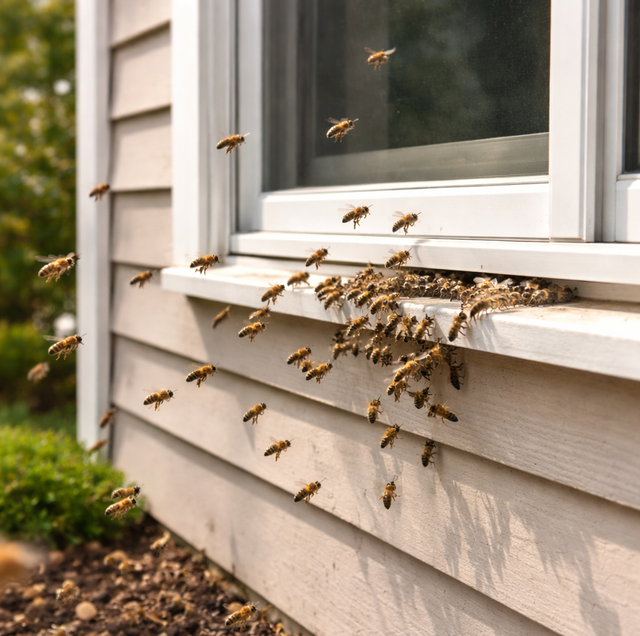
From the patio it reads as a thread of moving air against the fascia, thin enough that you have to catch it against a pale background to see it at all. It runs to one spot and back, to one spot and back, and it has been running there since mid-morning. Nothing about it looks urgent. What makes it worth reading is that the thread has an address: every bee in it is going to the same few square inches of the house, and coming back out of them.
Direction and Whether the Traffic Runs Two Ways
A flight line is defined by a fixed origin rather than by the presence of bees. One bee at a window, a porch light, or an open garage door has no origin to fix, so it tells you almost nothing: it's a forager off course, or a scout checking a spot it has no intention of staying in. What separates a real flight line from stray activity is direction that holds still, with bees arriving at one specific point and leaving from the same point, over and over, without the origin ever shifting to another crack or vent.
Count arrivals for a full minute, then repeat the count an hour later at a different time of day. A one-time glance can catch a lull and make an active colony look quiet.
Watch long enough, and the two-way pattern separates into lanes. Outbound bees tend to leave low and fast, peeling away from the gap in a straight shot toward open air. Inbound bees fly slower and heavier, correcting their approach in the last few feet before they commit to the opening. If you only ever see bees leaving, or only ever see them arriving, you're probably watching a single flight path rather than a working entrance, and it's worth a longer look before assuming the worst.
The Pace and How It Changes Through the Day
Traffic at an active gap isn't constant. It usually builds from a scattered handful of early bees to a steady, overlapping stream within an hour or two, then holds through the day at whatever rate the weather allows. On unusually hot afternoons, the pace can flatten out or even dip for a stretch as foraging shifts toward the cooler edges of the day; on mild days it stays steadier from mid-morning through late afternoon. Either way, the shape of the change matters more than the count at any single moment. A gap that goes from a trickle to a dense, overlapping stream and back to a trickle by evening is describing a working colony's daily rhythm, not a fluke.
Pollen Loads Going In
This is the single clearest thing you can read from a distance, and it's worth watching for specifically. Foragers carry pollen home on the outside of their hind legs, in small basket-like structures called corbiculae. From even a modest distance, a loaded leg shows as a visible ball of color: pale yellow, deep orange, dusty green, sometimes near-red, depending on what's blooming nearby. A bee carrying one of those loads straight into a gap is not investigating, resting, or passing through. She's provisioning, and provisioning only happens when there's brood inside being fed.
That distinction matters more than almost anything else you can observe from outside. A cavity with no brood has no reason to draw in pollen at all; the traffic you'd see would be nectar foragers at most, or none. A cavity taking in even modest, regular pollen traffic has committed workers rearing young inside it, which puts the colony well past the point of deciding whether to stay. Not every returning bee will be visibly loaded on a given pass, since plenty of trips are for nectar alone, but if you watch a few dozen arrivals and see loaded legs on a consistent share of them, that's not incidental. That is a colony with a population to plan around rather than a passing visitor, and you established it without leaving the window.
The Height and Angle of the Approach
Where the line sits in the air, and how it bends on the final approach, both tell you something about what's happening at the gap itself. A line that arcs up from yard height toward the eaves is describing an entrance near the roofline; a line that stays low and level, closer to fence height, points to a gap near grade, a meter box, or a low wall void. Either way, the final few feet are the tell: a committed colony's foragers make a short, direct final approach, straightening out and dropping into the gap without circling, because they already know exactly where the opening is. A looser, more circling approach with bees hovering, backing off, and trying again suggests something less settled, worth watching over a longer stretch before drawing conclusions.
Do not stand under a flight line or block it for a closer look. Foragers treat a hovering body in their path as an obstacle, and a defensive colony can respond before you're within arm's reach of the gap.
What Time of Day Tells You
Activity at a gap tracks daylight and temperature more than the clock. In the first hour of light, traffic tends to run mostly outbound as the day's first foragers leave; the two-way pattern fills in as those bees start returning, usually within an hour or so. Traffic generally peaks somewhere between mid-morning and mid-afternoon, though on the hottest days that peak can shift earlier, with a second, smaller wave in the cooler last hour before dusk. By full dark, flight stops entirely; anything you see moving after sunset at the same gap is worth a second look, since it likely isn't foraging bees at all. None of this needs a stopwatch. A rough sense of "busy midday, quiet at dawn and dusk" is enough to describe accurately over the phone.
Frequently Asked Questions
There's no fixed threshold, but the useful range is narrower than people expect. A few bees a minute at one fixed point, holding up across two counts an hour apart, is already consistent with an occupied cavity; one or two bees across that same span is not. What rules it in isn't the peak count, which swings with weather and time of day, but whether the count survives the second look.
Paper wasps and yellowjackets can form directional traffic to a nest opening, but the flight tends to look more erratic, with more hovering and darting near the entrance rather than a smooth, direct approach. Paper wasps also don't carry visible pollen loads the way honey bees do, which is one of the fastest ways to rule them out from a distance.
Yes. Foragers generally stop flying in steady rain and in wind strong enough to make flight inefficient, so a gap can look completely quiet during rough weather even with an active colony inside. Traffic typically resumes within an hour or so of conditions clearing, which is worth remembering before assuming a line has disappeared for good.
Just some, and the color is worth noting when they do. Pollen loads run from pale yellow through orange to grey-green and near-black depending on the plant, and two or three distinct colors going into one gap over a single watch means foragers are working several sources at once, which takes a workforce a young colony doesn't have. A single color arriving sporadically fits a smaller colony working one nearby bloom.
Yes, particularly around midday on a wall or roofline that's been in direct sun for hours. Heat distortion near a hot surface can make a flight line appear to waver or sit higher than it actually does. Watching from directly in front of the gap rather than at a sharp angle, and rechecking during a cooler part of the day, gives a truer read.
It could be robbing at a void that still holds honey, which reads differently right at the opening and is a separate question. What the line itself tells you is simpler: robbers arrive empty. Watch the legs of twenty or thirty bees going in, and a provisioning colony puts pollen on a good share of them, while a robbed-out void almost never does. The approach differs too. Foragers from a resident colony converge on one bearing and hold it, and bees working a cavity that isn't theirs drift across the face of the wall before committing to the gap.
Reading It Before You Call
Put those six signals together and you have a description a technician can actually use before anyone sets foot on the property: a fixed point of origin, traffic running in both directions, a pace that builds and eases through the day, visible pollen loads going in, a daily rhythm that tracks daylight rather than the clock, and a line that approaches from a particular height and angle. One more thing worth noting: a hum or faint vibration you can feel through an interior wall near the same spot, even without seeing a single bee from that side, is consistent with everything above and worth mentioning in the same breath. You don't need to get closer to say any of it with confidence.
Describe what you're seeing and get a free estimate — a technician can often tell what's happening from your description alone. Russell Pest Control serves the Phoenix Valley. Call (623) 469-7583.
