
Bees in a Playhouse or Swing Set: What Parents Should Do First
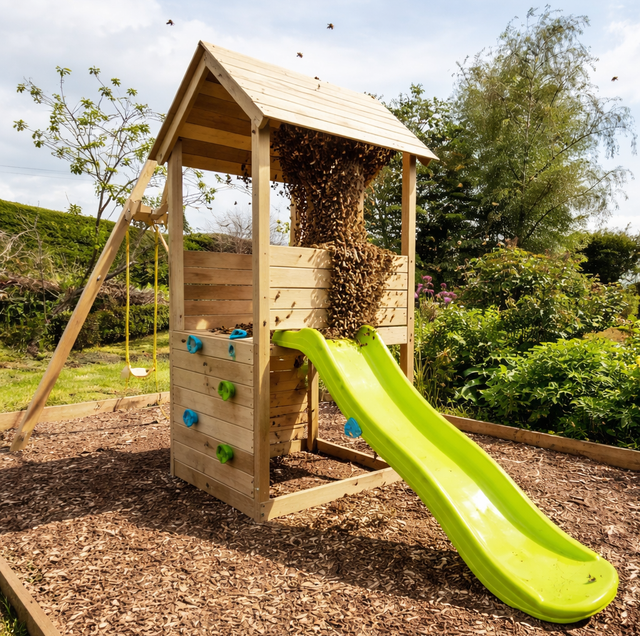
Nobody touches a playhouse for days at a time. It gets twenty minutes on a Saturday morning, maybe half an hour before dinner, and then it stands in the corner of the yard through every weekday afternoon with nothing bumping it and nobody looking at it closely. That quiet is the qualification. Scouts inspect a cavity before a swarm commits, and a hollow, shaded, undisturbed structure reads well to them, which is why a bee problem in a yard so often ends up at the one object bought for children.
If that is where yours are, the rest of this is a sequence. Most of these situations end with nobody stung, and they stay that way because the people move first and the structure is left alone.
What To Do in the First Minute
Bring children and pets indoors first: Walking pace, normal voice. Speed and noise change the situation; someone standing in the yard does not.
Talk a child off the equipment rather than grabbing them: A sudden pull off the platform and a hard landing send a jolt straight into the frame. Ask them to come down the ladder as usual, and walk in with them.
Leave the structure untouched: no spray, no hose, no tarp over it, no plugging the gap for now. Each of those makes the next hour worse and the removal harder.
Close the door or gate behind you: A four-year-old or a dog will let themselves back out in minutes if a latch is the only thing stopping them.
Watch from a window for a minute: Note whether bees are using one opening or several, and whether the traffic looks steady or scattered. That is what a technician will ask on the phone.
A known sting allergy in the family raises the priority immediately: Keep that person indoors, keep their prescribed medication where you can reach it, and follow the plan their doctor gave you. Any question about a sting or a reaction goes to a medical professional, never to a calculation you run yourself.
Where the Opening Usually Is on a Play Structure
Whether a mass of bees is a resting cluster or a colony that has already moved in is a subject of its own and worth reading separately. On play equipment there is a more immediate question: where is the traffic going, and at what height?
Lower than most people look, usually. A set built on a raised deck, or one with a floor panel sitting a foot or two off the grass, often takes its traffic in at the floor line, under the lip where the decking meets the wall. Adults scan at eye level, find nothing at the roof peak, and decide the bees are passing through on their way somewhere else. A phone camera zoom from the back door settles it without anyone crossing the grass.
Two other spots account for most of the rest: the bolted seam where two molded panels meet, which is a manufacturing joint and rarely tight along its whole length, and the dark end of a tube slide, a smooth shaft with one mouth and no draft running through it.
What To Check on the Rest of the Yard Before Anyone Goes Back Out
Play equipment is rarely the only sealed void in a yard. Stay at the edge of the lawn and check the other candidates from there: a fence post with a missing cap, the hollow frame tubes of a trampoline, the weighted base of a basketball hoop, an unused grill, an irrigation valve box, the space beneath a shed floor. Note where the traffic crosses the yard, so you know which path from the door stays clear.
Before you start counting every bee out there, one distinction saves a lot of worry. Bees at the dog's water bowl, along the pool edge, or working the flowers are foraging or collecting water. They are away from home carrying nothing they need to guard, and they behave that way. Defensive behavior belongs to the nest and the few feet around it.
Why the Structure Must Not Be Moved, Shaken or Opened
A play structure is a single rigid assembly. The ladder, the platform, the roof panel, and the swing beam are bolted into one frame, so an input anywhere in it arrives everywhere else. That is what children do to play equipment by design: a swing arc loads and releases the beam again and again, a jump off the platform hits the whole frame at once, the little door slams. Where a colony is living in a void inside that frame, all of it arrives as repeated knocking on the ceiling.
Moving the structure is the worst version of it. Dragging a swing set to the far corner of the yard means minutes of continuous shaking, with someone holding the thing that shakes.
Taking a panel off is a different mistake with the same root. The comb is fixed to the inside face of whatever it was built against, so unscrewing the panel tears it loose, and the only barrier between the colony and the yard is now in your hands.
Sealing the entrance and spraying it both fail here the way they fail on any structure, and a play set adds a reason of its own: whatever gets sprayed settles on a rail, a slide lip, and a floor panel that a child will have their hands on again the week after.
What To Tell Children and Everyone Else Who Uses the Yard
Children hold a boundary better than a measurement. "The whole back yard until I say otherwise" works where "stay ten feet from the playhouse" does not, because the second version asks a small child to estimate ten feet while excited. Pair the boundary with one action rather than a list: if a bee comes near you, keep walking and go inside. No swatting, no waving arms, no running. One practiced instruction survives contact with a startled six-year-old. Five do not.
Give the reason in a sentence and keep it mechanical: the bees are living inside the walls of the playhouse, and they react to those walls being hit or shaken. A child can act on that. It also spares you a warning with nothing behind it, which is the kind children test.
The outsider who has to be told is the one who cuts the grass. A mowing crew works to a route, and a clock, and the corner with the play structure in it is exactly the corner nobody slows down for. If a visiting child has a sting allergy, mention it to their parent before the visit so they can bring their usual supplies, and nobody has to improvise.
A string trimmer or blower held near the frame delivers contact and sustained vibration, a different input from footsteps. Leave that corner uncut until the work is done: a few weeks of long grass does no harm.
Frequently Asked Questions
The removal itself is typically a single visit, and the yard and the play structure come back into use at different moments. The open yard is usually fine again as soon as the technician says the work is finished. The equipment waits longer, because whatever was unbolted to reach the void has to go back on properly first. Ask before the truck leaves, from the person who has just had it open. Returning foragers circling the old entrance the next morning are normal and thin out over a day or two.
It changes what you can inspect without tools. A molded plastic set is double-walled, so nearly every candidate opening is a factory seam or a bolt hole, with no way to look behind it without backing a fastener out. A wooden set gives you more to work with: the floor deck and the roof framing usually have open ends you can sight along from the side. It also gives a colony more room. A panel void on a plastic set is a narrow sleeve; a floor deck runs the length of the platform.
Possibly, and it is worth having identified before anyone works near it. Bees using a hole in the ground, an old rodent burrow, or a gap under a floor deck may not be honey bees at all, and a nest that turns out to be bumble bees is a different job from a honey bee colony in a cavity. That is not what bee removal covers, and it is handled differently. What you do first does not change: keep back, keep the children in, and have someone identify it.
Usually not. What decides it is which parts had to come apart to reach the colony. On a wooden set, a floor panel or a roof board comes off and goes back on, and the thing to watch is that hardware backed out once rarely returns to the same torque by hand, so check those fasteners before a child puts weight on the panel. Molded plastic is less forgiving: the bolt passes through a hollow wall rather than into solid material, and a boss that gets over-tightened on the way back in will spin rather than hold. A washer and a slower hand fix most of that.
It changes what can be done on-site, so say it over the phone rather than at the door: what you used, where you put it, and roughly when. A cavity that has been treated is a different starting point from one that has not, and it affects the options available when someone opens it. It does not make the situation unfixable, and nobody who does this work every week is surprised by it.
An endpoint helps more than reassurance does. Lift the boundary out loud and specifically: the playhouse is finished, the whole yard is open, and here is the part where the bees were living. Walking them past the spot once, with an adult, does more than describing it from the kitchen. Some children want the job rather than the explanation, in which case give them the walk-around and let them check the underside of the platform when you mow. A child who was told plainly what happened is often the one who spots the next one first.
Putting the Play Structure Back in Use
Most play equipment has one more chapter after the children outgrow it. It gets taken apart, loaded into a truck, and handed on to another family, and that is the moment those voids get opened by someone thinking about bolts and daylight and nothing else. Worth remembering years from now, whether or not this set ever had bees in it. The same applies in the other direction, to a set arriving second-hand into your own yard: standing in a driveway for a season is the long undisturbed stretch that makes a structure attractive in the first place, so the first thing to do with a donated swing set is look inside it before the children do.
Book a bee removal estimate before anyone uses the play equipment again — a technician can confirm what is inside the structure and clear it out. Russell Pest Control serves the Phoenix Valley. Call (623) 469-7583.
