
Bees Coming Into the House From the Wall: What It Signals
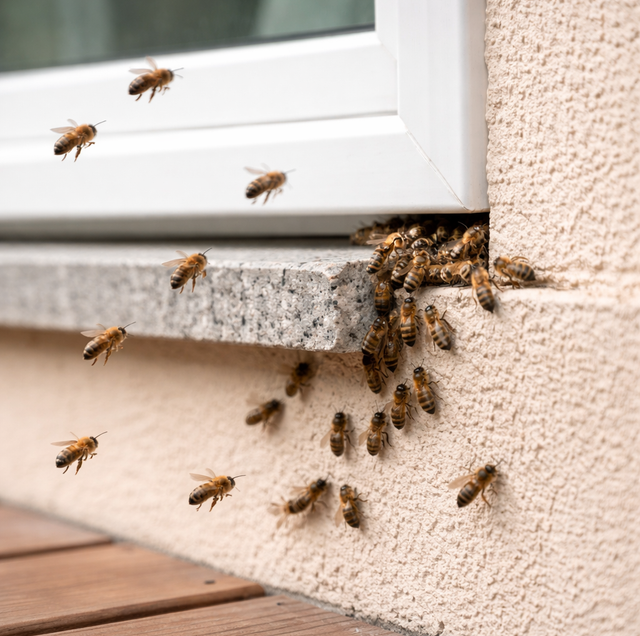
Three bees, three evenings, the same eighteen inches of windowsill behind the kitchen sink. The first two got cupped in a glass and carried out the back door without much thought. The third one is already dead when it turns up, legs curled underneath, wings dry and stiff against the paint.
The third one is the one that means something. A bee that wanders in is a coincidence, and a schedule is not. Three arrivals in the same room, at roughly the same hour, on three consecutive evenings is a pattern, and the pattern carries information that no single bee does. Nothing about one insect tells you whether a colony has reached the inner face of that wall. Frequency does, and so does what happens to the bees once they are inside.
One Bee Indoors, on Its Own
A single bee inside a house, on its own, is rarely a sign that anything has changed structurally. Bees are drawn to light and to the smell of anything sweet left open on a counter, and an open garage door at dusk, a screen door propped for the dog, or an HVAC return pulling air, and anything riding it, from just outside the wall are all ordinary paths in. None of that requires a colony living anywhere near the house. It just requires one forager taking a wrong turn.
The useful comparison is what's happening outside at the same time. A scatter of a few dead bees on a patio, a pool deck, or a windowsill facing the yard, with nothing alive turning up indoors, is normal. Worker bees spend the back half of their short lives flying miles a day to forage, and wing wear and age catch up with them out in the field rather than at home. Worn-out foragers drop wherever they happen to be at the end, which is often a yard, a pool deck, or a patio near a flight path. That's routine turnover for a colony, not a warning sign.
What matters is whether the single indoor bee repeats. One bee, one evening, gone the next day, sits closer to a housefly getting in than to an infrastructure problem. Repetition is what changes the reading.
A Few Bees Over Several Days
Once bees start showing up more than once, two or three over the course of a week, usually in the same room or along the same wall, the odds shift. A repeat appearance in the same location usually means something at that spot is drawing them in specifically, not randomly: a gap around a window frame, a gap where a pipe or wire penetrates the wall from the outside, or a vent that terminates behind the drywall rather than outside the house.
This stage doesn't yet say much about the colony's size. A small, young colony that only just settled into a void can produce this pattern just as easily as an older one, because the behavior depends on where the opening sits relative to where the bees are working rather than on how many bees there are. What it does say is that the opening is real and repeatable. Bees inside a void orient to any light leaking through a gap, so an opening on a wall with a lit room behind it is a more likely indoor path than one on a shaded, closed-off side of the house. The same opening can start producing indoor traffic again months later, in cool weather, once the temperature gradient across the wall reverses and air moves the other way through it.
A Daily Trickle That Doesn't Stop
A trickle is different from a few bees: it's the same one or two bees, roughly the same time of day, day after day, for a week or more. At that point the opening has stopped being incidental and started working as a second entrance, one the colony uses alongside whatever gap it originally came in through from outside.
What separates this stage from the previous one is not the number of bees indoors, which stays small either way, but its regularity. A colony that can lose a worker or two to a wrong turn every single day without the loss showing anywhere else is a colony with surplus, and surplus generally arrives after the first few weeks, once there are enough bees to cover the outdoor entrance, the foraging runs, and the brood at the same time. A brand-new colony has nobody to spare for a detour that repeats.
A daily trickle is also worth checking against other causes before assuming the worst. See whether the pattern lines up with a specific stretch of the day, like mid-afternoon when a west-facing wall is at its hottest, or whether it holds steady regardless of weather. A pattern tied tightly to heat suggests bees riding thermal air movement out of an uncomfortably warm wall cavity; a pattern that keeps going in cool weather, too, points more toward a plain, established access route than a heat-driven one.
When It Means the Colony Has Broken Through the Wall
The clearest sign of an actual breach isn't the live bees at all. It's what collects where they can't fly away from: several dead bees gathering on an interior windowsill, along a baseboard, or by the bottom of a door, day after day, in a room where nobody's leaving food or water out. Live bees can make a wrong turn and find their way back out. Dead ones piling up on the inside mean the space behind that wall is now connected closely enough to the room that both traffic and a colony's ordinary die-off are spilling into living space instead of staying in the void.
That combination, dead bees accumulating while live ones keep arriving, generally means one of two things: comb has grown or failed to the point that it's pressing against or has broken through the interior finish (drywall, plaster, or the back of a built-in cabinet), or heat has softened and partly collapsed a section of comb, opening a gap that wasn't there a month earlier.
A honey stain spreads slowly with a soft amber edge, not a hard ring like water leaves. Touch it with a damp cloth: a true water stain rinses lighter, while a honey stain stays tacky and darker.
Either way, it points to an established colony rather than one still finding its footing, because reaching the interior finish takes both time and a comb structure substantial enough to need the room. This is no longer something to schedule for whenever it's convenient. An opening straight into a living space, used daily by an established population, changes the calculation. In the meantime:
Close the interior door to that room: It won't stop bees already inside, but it keeps the rest of the house from becoming part of the pattern.
Don't swat: A crushed bee releases an alarm scent that draws others nearby to investigate or defend, which is the opposite of a calm room.
Do not seal the opening yourself while bees are still using it. Trapped, agitated bees search for another way out, which can mean a new hole through drywall or bees working into a different wall void altogether.
Frequently Asked Questions
Almost always, yes, and the giveaway is where the bee ends up. A bee that came in through a door or a vent orients to the brightest glass in the room and works that one window over and over, because light is the only reference it has. A bee that came through the wall behind you tends to appear in the same room repeatedly, at the same hour, and often nowhere near a window at all. One is lost. The other is commuting.
It can be an early warning, and the smell usually arrives long before any real melting does. Comb loses rigidity in sustained heat well short of a true melting point, and softening wax and warm honey both give off scent, so a room can smell sweet for days before a bee or a stain shows up. The scent also travels differently from the bees: it moves with air, so it often turns up first in the room with the return-air grille rather than the room nearest the wall the colony is in.
It kills the bee, and it makes a second problem out of a small one. The alarm scent a crushed bee releases stays inside the canister and comes back out of the exhaust the next time the machine runs, which is why a vacuum used repeatedly near an entry point tends to draw a livelier reaction each time. A glass and a piece of card are slower and leave nothing behind.
Honey bees are fuzzy, banded amber and brown, and rest with their wings folded flat along the body; paper wasps are smooth and narrow-waisted with tented wings. Moths are the easiest of the three to rule out: the wings are scaled rather than clear-membraned, they leave a fine powdery dust on the sill when handled, and the body tapers to a soft point with no banded abdomen and no waist at all.
If the room shares a duct system with the rest of the house, yes. Closing the vent or register in that room, in addition to the door, keeps a bee that gets past the door from riding airflow into another part of the house.
Because the cavity is overhead rather than beside them. A recessed can light is a hole cut through the ceiling plane into the space above it, and the trim ring covering the hole is not a seal. Bees working a colony in a ceiling void or an attic drop through the fixture and end up dead on the floor beneath it by morning. Where they land narrows the search considerably: bees at a sill point to a stud bay; bees under a fixture point to the plane above the room.
The Room as Evidence, Before and After the Work
None of this requires guessing alone. The pattern (one bee versus several, occasional versus daily, live bees versus a body count on the sill) tells most of the story before anyone opens a wall. Worth knowing for after the work: residual foragers circling the old entrance for a day or two afterward are normal and not a sign the job failed. The indoor side is the part to watch once the void is closed. A room that stays clear for a full week, with no fresh bodies on the sill and no sweet smell at the return-air grille, says more about whether the cavity is actually empty than anything visible from the yard does.
Request same-day bee removal — a technician relocates the colony where possible, removes it where safety requires it, and seals the entry point afterward. Russell Pest Control serves the Phoenix Valley. Call (623) 469-7583.
