
Why You’re Suddenly Seeing Scorpions After Years of None
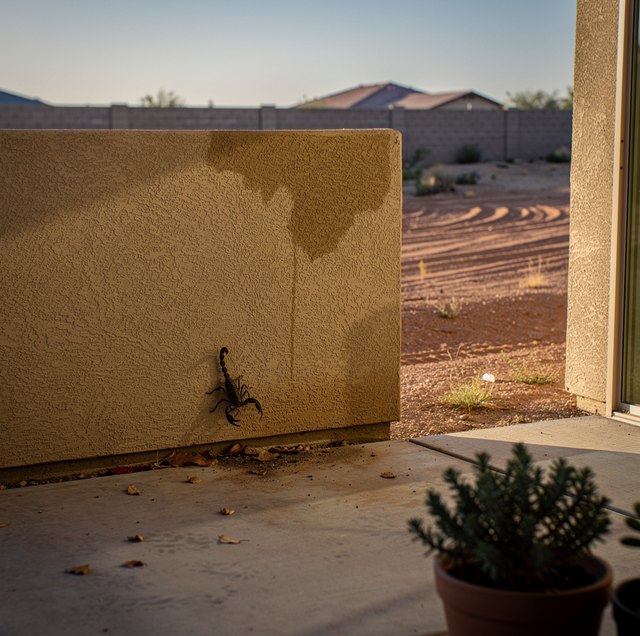
Two decades in the same house, and you could count the scorpions you'd seen indoors on one hand. Then, over the space of a few weeks, that changed: one under the kitchen sink, one on the patio wall at dusk, a nymph you nearly stepped on hauling out the trash. Nothing about your house changed. You didn't skip a treatment, tear out a rock bed, or leave a door propped open. The timing doesn't line up with anything you did, and that's the part worth paying attention to. When a household with no scorpion history suddenly has one, the cause usually isn't sitting inside your own fence line.
That's different from why some homes simply carry a heavier scorpion load from sitting close to open ground, which can run high for years without anything "changing." What's happening here is narrower: something near you shifted recently, and the timing of your first sighting points back at it.
Twenty Years of Nothing Doesn't Mean Nothing Changed
A stable stretch of surrounding land, built out, landscaped, quiet, doesn't generate a rising scorpion problem on its own. Scorpions don't multiply out of nowhere; they hold roughly steady wherever shelter and prey insects hold steady. So a sudden jump in sightings after two decades of nothing almost always traces back to a disruption in that surrounding stability, not a slow buildup that finally reached your door. Something nearby stopped being stable ground.
The list of what qualifies is shorter than it feels from your kitchen window. It's not every stray sighting or every warm week. It's an actual physical change to land within roughly a block or two: ground getting cleared, dug, burned, flooded, or stripped of the cover it held the week before. Once you're looking for that kind of change specifically, instead of a vague sense that "there are more of them lately," the pattern usually turns up fast.
Displaced, Not Destroyed: Where a Population Goes When Its Ground Disappears
A patch of undisturbed land can support a small, steady scorpion population for years without it ever growing or shrinking much, as long as the shelter and the prey it holds stay in place. Strip that land bare in a matter of days, through grading, excavation, fire, or flood scouring, and the population doesn't die off with the habitat. Most of it survives the disturbance and simply relocates; the way tenants evicted from a condemned building don't vanish, they move into whatever's next door.
"Next door" is the operative detail. A scorpion displaced from cleared ground doesn't set out looking for a new patch of open, undeveloped ground somewhere else in the neighborhood; it moves toward the nearest cover that still offers shelter, shade, and something to eat, which is very often the closest yard still holding a rock bed, a shrub line, or a shaded foundation. If that happens to be yours, the disturbance a few hundred feet away shows up as scorpions on your patio wall.
A Vacant Lot Getting Cleared or Graded
This is the most common trigger and usually the easiest to confirm: survey stakes, flagged tape, a dumpster staged at the curb, or fresh equipment tracks across what used to be raw ground, appearing within a week or two of sightings starting to climb. If your property backs directly onto the ground in question, whether it's a wash, a preserve, or a lot that's sat vacant for years, the mechanics of that specific pressure, and what changes once the lot is finished. What matters here is narrower: even a lot you don't back onto directly, one or two properties over, can push a short-term spike your way while it's actively being cleared, simply because displaced scorpions travel toward the nearest remaining cover, and that's sometimes your yard rather than the yard next to the construction.
Excavation or Construction on a Neighboring Property
A different version of the same mechanism plays out when the disruption occurs next door, on a property that's already built, rather than on empty ground. Trenching for a utility line, digging a foundation addition, or excavating for a neighbor's own project tears through the soil layer where burrows and moisture sit, and the noise of equipment running throughout the workday pushes anything that shelters nearby to move at night while the site is quiet. That's a separate scenario from work on your own property, which runs on its own set of causes; what matters here is a disturbance on land you don't control, close enough that its effect crosses the property line.
Watch for open trenches, exposed soil piles, staged equipment, or work trucks parked at a neighboring address for more than a day or two. If the timing of your first sighting lines up with when that work started, treat that as a strong signal worth confirming.
A Wash, Preserve, or Common Area Getting Disturbed
Open space that's stayed untouched for years, a wash channel, a preserve boundary, an HOA common area, can still get disturbed without anyone building on it. A brush fire strips ground cover overnight. A heavy summer storm scours out a wash bank, collapsing burrows that had held for seasons. A new access road cut for trail work or fire mitigation removes vegetation along a stretch that previously had continuous cover. None of these put up a construction sign, so they're easy to miss as a cause, but each destroys harborage in days rather than years, and the population living there moves the same way it does off a graded lot: toward whatever ground nearby still offers shelter.
A displaced population moving through your yard means more nighttime activity than usual for a few weeks. Wear closed-toe shoes outdoors after dark and use a flashlight rather than crossing the patio from memory.
A Neighbor Removing Mature Landscaping
The smallest-scale version of this trigger happens one yard over. A neighbor tearing out a mature rock bed, a dense line of shrubs, or an overgrown citrus tree removes the shelter and food supply that patch of land was holding, and whatever was living in it has to go somewhere. This is a different situation from simply sitting near established landscaping for years without it changing: a rock bed or shrub line standing in place is a fixed condition, while its removal is an event, and it behaves like one, producing a short window of heightened activity right around when the work happens and settling back down once the yard resettles into its new state. A shared wall changing hands works on a related but separate mechanism worth its own look if that's what's actually different on your property line.
Matching When Sightings Started to What Changed Nearby
Lining up the timing of your first sighting against what's visible nearby narrows the list fast.
| What Changed | Typical Timing of the Spike | What to Look For |
|---|---|---|
| Vacant lot cleared or graded | Days to a couple of weeks after equipment first appears | Survey stakes, flagged tape, cleared vegetation, fresh equipment tracks |
| Construction or excavation next door | During the active digging or trenching phase | Open trenches, exposed soil piles, staged equipment, work trucks |
| Wash, preserve, or common-area disturbance | Within days of a fire, a heavy storm, or clearing work | Charred or scoured ground, downed brush piles, a new access cut |
| Neighbor's landscaping or wall change | Within one to two weeks of the removal | Bare dirt where a rock bed or shrub row used to be, a wall section missing or freshly rebuilt |
Confirming the Trigger Before You Assume It's Something Else
A few checks in order turn a guess into an answer.
- Note the date your first sighting happened, as close as you can pin it down, and compare that date against anything visibly different along your property line or within a block or two.
- Walk the perimeter in daylight and look specifically for the signs in the table above: staking, cleared ground, an open trench, missing landscaping, a gap where a wall used to stand.
- Check for a posted building permit if construction is underway nearby; most jurisdictions require the permit to be visible at the site, and it will usually confirm what's being built and when the work started.
- Run a black-light check after dark along your own patio and wall line. Bark scorpions glow blue-green under UV, and counting what shows up gives you a real number for tonight, one you can compare against a second check in a couple of weeks to see whether the count is still climbing or has already leveled off.
Frequently Asked Questions
Warm-season activity does run higher across the board, since scorpions and their prey are both more active once temperatures climb. The way to tell the difference is to compare against your own history: a seasonal rise tends to track roughly what your household saw in the same weeks the year before, while a change-driven spike breaks from that pattern and climbs past what a normal warm stretch produced in past years at the same address.
Some triggers aren't visible from your own property line. A disturbance on the far side of a wash, a lot two streets over connected by an unbroken run of open ground, or work that already finished before sightings picked up can all produce the same effect without a sign in sight. A city or county parcel-lookup tool will usually show recently issued grading or building permits within a block or two, even for work you never saw happen.
Activity typically peaks in the weeks right after the disturbance, then eases as the displaced population settles into new cover or gets thinned by predators and further dispersal. A multi-phase project, grading followed by foundation work followed by landscaping, can reset that clock more than once, so a spike that seems to fade and then return isn't unusual on a site that's still under construction.
Less than the path between the two properties does. Scorpions move along continuous, shaded routes rather than in a straight line, so a disturbance two doors down connected by an unbroken run of shrubs or a shared wall can move more activity toward you than a change immediately next door separated by open, exposed yards on both sides.
The source of the disturbance isn't something you can fix yourself, so the practical response shifts to what is controllable on your own property: treatment and entry-point maintenance, held a little more closely through the weeks the disturbance is active. Pressure from a nearby project typically eases once the site is fully built and landscaped, since a maintained lot doesn't support the population a raw one did.
Not usually. Once a displaced population settles into new harborage, whether that's your rock bed, your block wall, or your woodpile, it tends to stay there rather than return to the original site, because the original site is typically a driveway, a foundation, or a maintained yard by the time the work wraps up. That's the part that turns a short-term disturbance into a lasting change in your baseline unless it's addressed directly.
Twenty years without a scorpion problem was never a guarantee; it was a snapshot of conditions that happened to hold steady for a long stretch. Somewhere nearby, ground that had been undisturbed for just as long stopped being that way, and the population it supported went looking for the next best option. Finding out what changed, and roughly when, turns a confusing spike into a specific, explainable event, and specific problems are the kind you can actually respond to.
Schedule a scorpion control visit — get your outdoor areas pressure-treated and your entry points checked after a nearby change has pushed activity toward your house. Russell Pest Control serves the Phoenix Valley. Call (623) 469-7583.
