
Scorpions Getting Through Your Sliding Door? Check the Track Ends
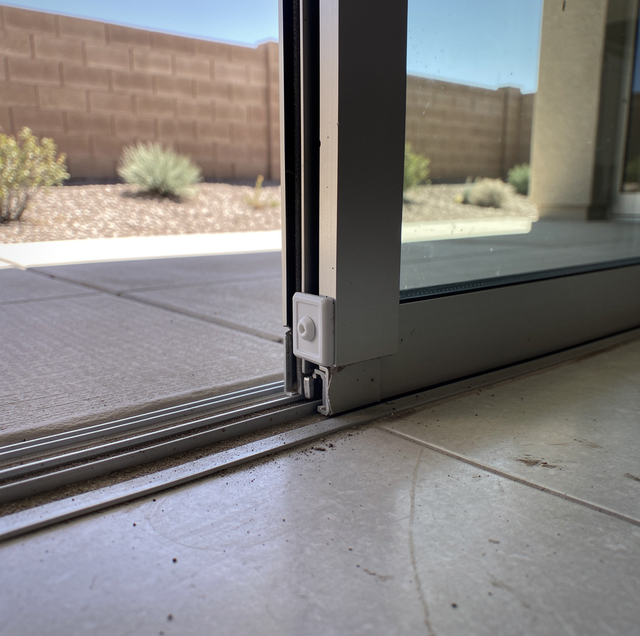
You caulked the window frames, put a sweep on the front door, and you're still finding a scorpion parked on the carpet a few feet from the sliding glass door. That pattern- repeat sightings clustered near one specific door- points to the door itself instead of the wall around it. A sliding door isn't a single sealed unit the way a hinged door is; it's a moving panel riding in a track, and the places where a moving part meets a fixed one are exactly where gaps live, especially at the two ends of that track where the mechanisms that are supposed to close the door don't quite reach.
A hinged exterior door seals by being pulled shut against a fixed frame on all four sides, with a sweep at the bottom finishing the job. A slider works differently: the moving panel lands against a fixed jamb on *one* side and interlocks with a second panel down the middle, while the other three sides depend on brush weatherstrip riding in a track. That track has two ends, and a scorpion built to flatten itself into a thin gap treats an open track end the same way it treats an open door.
Where the Gap Actually Is: A Track Map
Before you re-caulk anything, walk the door and check these four zones. Each one fails for a different reason, and treating them as the same problem is why sealing efforts on sliders so often miss.
| Location on the door | Why the gap forms there | What it means for sealing |
|---|---|---|
| Interlock at the meeting rail (where the moving panel overlaps the fixed panel) | The interlock is two hooked metal or vinyl profiles designed to hook together as the door closes; if the door isn't closing fully square, the hook only partially engages | Check that the door latches all the way, not just that it "looks shut": a partial hook leaves a vertical sliver a scorpion can flatten into |
| Bottom track, full run | The track itself is an open aluminum or vinyl channel; dust, sand, and dead insects build up in it over years and prop the rollers slightly high, which lifts the weatherstrip pile off the sill | This is a cleaning-and-adjustment problem before it's a sealing problem: a clogged track defeats weatherstrip that's otherwise fine |
| Track end caps (both ends of the bottom track) | The track has to stop somewhere, and the end cap that closes it off is a separate small part, often plastic, that cracks, shrinks, or was never seated fully during manufacture or installation | This is the specific gap most homeowners never check, because it's hidden behind where the door panel sits when closed |
| Weatherstrip pile along the vertical jamb and header | The fuzzy brush strip (the "pile") that the panel slides against wears thin exactly where the door travels most, and compresses permanently at the point it sits when the door is left closed most of the year | Pile that looks intact from a few feet away can be crushed flat in the one spot that matters; check it with a flashlight and a stiff card, not a bare hand |
The Track End: The Gap Nobody Checks
Pull the door fully open and look at the bare ends of the bottom track, the six inches or so of channel that's normally hidden behind the door panel when it's closed. That's the track-end gap, and it's the piece this door type owns that a hinged door simply doesn't have.
Here's the mechanism: the roller track is an aluminum or vinyl channel screwed into the sill, and it has to terminate somewhere at each end, usually against the jamb. Manufacturers cap that termination with a small plastic or rubber end piece, sometimes called an end plug or track stop, whose only job is closing off the open channel so the track doesn't funnel outside air, dust, and insects straight into the wall cavity. That end cap is small; it's often friction-fit rather than screwed, and it's the first thing to go missing during a reglaze, a track cleaning, or a DIY roller replacement, because nobody thinks to reinstall a part that small.
Even with the cap in place, the channel profile rarely closes flush against the jamb. Aluminum track has a specific cross-section, and the jamb it butts against is flat, so there's routinely a residual gap at that junction. The difference here is that this gap sits at floor level, in a shaded, humidity-buffered spot behind glass, on the exact side of the house where a patio slab, a shade tree, or landscaping often keeps the ground damp. It's a gap and a good hiding spot in the same six inches.
Check the track and weatherstrip pile with a flashlight and a stiff card, not a bare hand. A track end that's a good scorpion route is also a good hiding spot.
Slide the door open and run a flashlight along both bare track ends. A missing or shrunken end cap shows up as visible daylight or a gap wide enough for a business card, and that is the actual fix.
When the Door Itself Widens the Gap
A track-end gap that was tight when the door was installed doesn't necessarily stay tight. Sliding doors carry real weight, and the rollers underneath wear the way any bearing wears with years of use — the same way a shopping cart wheel that rolled straight for years starts pulling to one side once it's worn unevenly.
As rollers flatten or lose their factory adjustment, the panel rides slightly lower or cants a few degrees off square in the track. That small shift does two things at once: it can pull the interlock at the meeting rail out of full engagement even though the door still appears to latch, and it can drag the panel's edge weatherstrip away from the jamb at the exact end where the track-end gap already exists, adding a second gap on top of the first. A door that sealed acceptably in year two can leave a measurable gap by year eight or ten, purely from roller wear, with no visible damage anywhere on the glass or frame.
Roller wear is a slow, permanent slide. A faster, temporary one rides on top of it: aluminum track and frame expand in summer heat and contract again once temperatures drop, and that daily and seasonal movement can open the track-end gap wider during the hottest stretch of the year than it measures in December. A door that seals acceptably most of the year can run looser through the hottest, stormiest stretch of summer, exactly when cricket and roach activity, and the scorpions hunting them, are also climbing.
Most sliders have adjustment screws at the bottom corners of the panel, usually accessible through small covers, that raise or lower the roller height. Turning those to bring the panel back up snug in the track, so the interlock hooks fully and the edge weatherstrip contacts the jamb along its whole length, resolves a gap that no amount of caulking the surrounding stucco will touch. If the door is old enough that the rollers themselves are shot, adjustment alone won't get you there, and that's a roller replacement rather than a sealing job.
The Bottom Track Is Its Own Leak Point
It's worth separating two things that are often treated as one: the door panel's seal and the track it rides in. Sealing the panel edges (interlock, jamb weatherstrip, header) closes the gaps that open and close with the door. The bottom track is different. It's a fixed channel, screwed to the sill, and it's a leak point on its own regardless of how well the panel seals against it.
The channel is open by design, since it has to guide the rollers, and that means it's porous to whatever is small enough to travel along it: dust, wind-blown sand, and insects, scorpions included, moving along the base of the door instead of approaching it head-on. A track packed with years of grit doesn't just look dirty. That debris props the panel a hair high off the sill weatherstrip across its entire run, not just at the ends, which turns a full-length seal into a full-length gap you can't see because the door still looks closed. Vacuuming the track and running a stiff brush along the full channel before assuming the weatherstrip itself has failed catches a surprising share of "why is this door leaking" cases.
Sealing the track ends with a proper end cap or a bead of flexible sealant at the jamb junction, keeping the channel clear, and confirming the panel rides at the correct height are three separate maintenance items, not one. Skipping any of the three leaves the door only partially sealed even if the other two are done right.
French and Double Doors Fail at a Different Spot
If your problem door swings on hinges instead of sliding, this doesn't apply the same way: French and double doors fail at the meeting stile between the two panels, not at a roller track, and that's covered separately.
Frequently Asked Questions
Not by itself. Weatherstrip replacement addresses the pile along the jamb and header, the parts that brush against the moving panel, but it does nothing for the open channel end or a missing end cap, since those aren't weatherstrip at all. A door can get all-new weatherstrip and still leak at the same track end six months later if the cap was never replaced.
Check the sliding door track ends and the meeting-rail interlock first, since a door problem produces sightings clustered right at that threshold, often on the carpet or tile within a few feet of the slider. If scorpions are showing up further into the room or in multiple rooms at once, the entry point is more likely elsewhere in the structure, and the door may be a coincidence rather than the cause.
A missing or damaged end cap can often be replaced with a hardware-store part matched to the track profile, and a bead of flexible sealant at the jamb junction is a reasonable DIY step. Where it gets harder is diagnosing roller wear versus a bad cap versus a dirty track, since all three produce a similar-looking gap, and a misdiagnosed fix, like new weatherstrip on a door with worn rollers, won't hold.
The screen door track has the same end-of-channel design and the same failure mode, but the screen mesh itself is the bigger variable; a torn or poorly fitted screen defeats the point of a tight track seal. Treat the screen door track ends the same way you'd treat the glass door's, and check the mesh for tears at the same time.
Often, yes. Because the end cap is a small, loose-fitting part rather than a sealed seam, a gap of an eighth of an inch or wider isn't unusual once a cap has shrunk, cracked, or gone missing, and that's easily wide enough for an adult bark scorpion and wider still for a nymph.
It closes one route, and often a significant one, but a house usually has more than one entry point.
Track ends and roller wear are the kind of gap that quietly gets worse, a little more each year, until a door that used to keep scorpions out stops doing that job without anyone noticing the moment it happens. Catching it usually just takes pulling the door open and actually looking at the bare channel, instead of assuming a door that "looks fine" is sealed fine.
Schedule a scorpion sealing evaluation — get your sliding-door tracks, end caps, and every other entry point properly checked and sealed. Russell Pest Control serves the Phoenix Valley. Call (623) 469-7583.
