
Bees in the Soffit: The Roofline Gaps Wide Enough to Enter
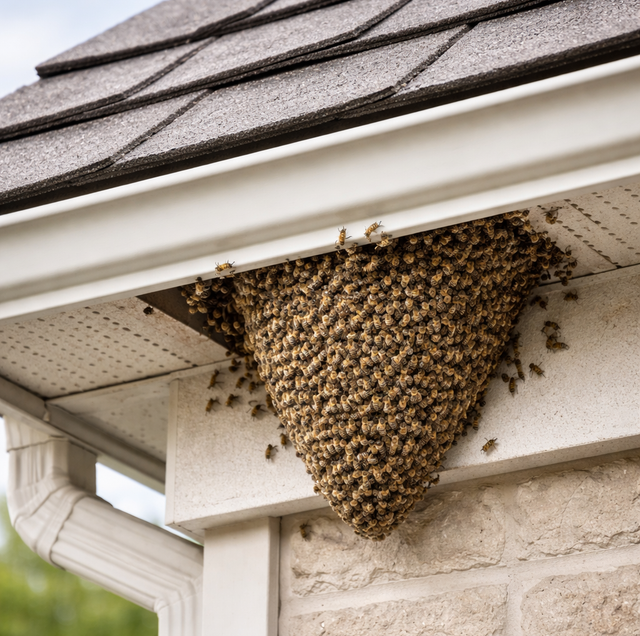
Stand at the edge of the yard and look up at where the roof meets the wall, where the roofline stops reading as a single surface. It's a stack of different materials fastened together, not fused: a fascia board nailed to the rafter tails, a soffit panel under the overhang, a vent cut into the deck, a course of roof tile lapped over a wood batten. Each seam was built to shed water and move air rather than to be airtight, and the caulk, foam, and fasteners closing the gaps between them were sized for that job, not for keeping out something that can flatten itself and slip through a slot a fraction of an inch wide.
A colony doesn't need a hole a person would notice from the ground. It needs one opening, checked and approved by a handful of scout bees before the rest of the swarm commits, and the roofline offers more of those candidates than almost any other part of the house. Walking that seam section by section, the way a scout would, is the fastest way to understand where a colony is likely sitting and why patching the one gap you can see rarely finishes the job.
The Eave and Fascia Gap
The eave is the roof's overhang, and the fascia is the board capping the rafter ends along its edge, with the soffit panel tucked underneath to close the underside. In theory, the fascia sits tight against both the roof deck above and the soffit below. In practice, heat cycles wood and vinyl fascia through daily expansion and contraction until fasteners work loose, seams open at the corners, and a board that was flush at installation pulls a visible reveal at one end.
That reveal is a seam rather than a hole, opened by movement instead of damage, and a seam is already more than a scout bee needs. Once found, the gap behind the fascia usually isn't an isolated pocket: it tends to run the length of the eave, connecting to the space above the soffit and whatever cavity sits behind it. An entrance no deeper than that seam can open onto a corridor several feet long, part of why sealing the exact spot where bees are seen coming and going doesn't always stop the traffic; the opening two feet down the same eave is just as usable.
Vent and Screen Openings
Roof, gable, soffit and ridge vents move air through the attic, and the screen or louver covering each is sized for that job: keeping out birds and larger debris while letting air pass. Standard vent screen is rarely fine enough, or rated, to stop an insect looking for a cavity, and years of UV exposure make plastic louvers brittle, and metal mesh corrode, bend, or pull loose from its frame.
Scan the roofline from the ground with binoculars rather than a ladder. Bees loading into a vent or gap show a repeated straight flight to one spot, easier to read from thirty feet back than up close.
A powered attic fan housing, a static vent with a cracked louver, or a ridge vent whose mesh wasn't sealed tight during installation are all doing their airflow job and failing at one they weren't designed for. The failure point is often the frame around the vent rather than the opening itself, where the housing meets the roof deck; a scout bee doesn't need the louver to fail, only the trim around it.
The Space Under Concrete or Clay Roof Tiles
Concrete and clay tile roofing isn't laid flat against the deck. Each course sits raised above the roofing felt on a run of wood battens, leaving an air gap under the tile roughly the depth of the batten itself. That gap is intentional: it lets water from under a cracked or lifted tile drain back out, and it buffers some of the heat the tile absorbs before it reaches the deck. Sealing it would defeat the purpose it was built for.
At the bottom edge of a tile field, where the last course meets the fascia, that gap is often left open, sometimes covered by a strip of foam or metal called a bird stop that blocks larger animals and does nothing reliable against something that can compress itself flat. Where the bird stop was never installed, has come loose, or wasn't run the full width of the eave, the gap under the tile is a wide opening into a channel running back under the entire roof slope.
The Batten Cavity Behind the Tiles
Once past the tile edge, a colony isn't working in a single pocket; it's working in a run of narrow channels formed by the battens nailed across the deck to carry each tile course. Those battens create parallel horizontal cavities, connected wherever a batten has a gap or a tile has slipped, so a colony can build along one channel and expand sideways into the next without ever coming closer to the eave opening you'd spot from the ground.
That cavity runs hotter than most other places a colony settles. Tile absorbs solar heat across an entire roof slope and re-radiates it into the air gap underneath for hours after direct sun has moved off, well past the point where a shaded wall cavity has already cooled. That is heat that a stiff comb does not tolerate well, and it is one reason a tile-roof colony can behave differently from one in a shaded wall void even when the entrance looks identical from the driveway.
Why Roof Work Over a Live Colony Becomes an Emergency
A roofer or solar crew working on a tile roof isn't inspecting for bees; they're checking underlayment and flashing, or drilling mounts for panel standoffs, and none of that starts from the ground, where a colony's traffic pattern is easiest to read. From on top of the roof, a small, steady entrance at the tile edge is easy to miss, especially early in a job before anyone has reason to look there.
Lifting tile or drilling for solar mounts over a live colony can expose comb without warning. A crew has no retreat off a sloped roof and often no protective gear. Confirm there's no colony before roof or solar work begins.
Solar installations add a specific version of this risk: mounting hardware is often anchored straight through the tile and batten into the rafters below, so the installer is drilling into exactly the kind of cavity a colony favors, with no visual cue from the surface. A crew member who breaks into a batten run mid-colony is standing on a pitched, dusty tile surface with no level ground to retreat to and, depending on the roof, no fast way down. That combination of unstable footing and an already defensive response is what turns a routine repair into an emergency call.
Frequently Asked Questions
Tile is usually undamaged. The damage shows up in the batten and roof deck: comb and stored honey trap moisture against wood that's supposed to stay dry, and over months that moisture can soften or rot the batten a tile course is nailed to, a separate repair from anything involving the bees.
It can, though not from the ground and not with expanding foam. A retrofit bird stop has to be worked in at the tile edge without closing the drainage gap the batten run depends on, because a strip that seals the gap completely traps the water the gap exists to shed. That trade-off, drainage against exclusion, is why roofline exclusion gets fitted to the tile profile rather than caulked, and why the retrofit versions come in shaped pieces matched to a specific tile rather than as a continuous strip.
Its entrance sits higher, and its flight line leaves at a steeper angle, but the difference that matters is contact. Work that reaches a roofline colony arrives through the structure the colony is gripping: a ladder footed against the fascia, a boot on the tile course below the entrance, a drill bit into a batten. Contact with the structure itself is what draws the response, which is why the working distance that feels safe from the yard means little on a ladder.
More than closing the hole, because the run is longer than the fix usually is. A fascia gap that reads as a two-inch reveal at one end can open onto a channel the length of the eave behind it, so a seal that stops at the visible opening leaves the channel intact. Doing it properly means closing the ends of that run and its connections into the vent and batten cavities, and it is fitted work: the materials have to hold a fastener in wood that may already be soft.
Far enough ahead that the cavity is empty rather than merely quiet. A removal takes the comb and stored honey out along with the bees, and the batten and deck underneath usually need a stretch of dry air before anything gets closed back over them, so it is realistically same-week work rather than something squeezed in the morning of. A crew already on the roof when a colony surfaces has two poor options, and the worse is to foam the entrance to buy time: sealed in, the bees work toward whatever other opening the roofline offers, which is often one that leads inside.
The mesh spec is the part people get wrong. Insect-rated screening is specified by the size of its openings rather than by wire gauge, so a screen fine enough to stop a wasp is not automatically fine enough for a bee working at a corner. Fastening is the other half: a retrofit screen stapled over an existing louver leaves a gap at every staple line, which is why screening is normally fitted behind the louver rather than laid over it.
What This Means for Timing a Roof or Solar Job
None of this requires a formal inspection to check. A property owner who walks past the same roofline daily is in the best position to notice a new, repeated flight path at the eave or tile edge, long before a contractor sets a ladder against the house, and that's the one piece of information a roofing or solar crew usually doesn't have going in. Passing it along costs nothing, and it determines whether the crew climbs up to a standard repair or something they weren't prepared for.
Schedule a roofline bee check — a look at the eave, vents, and tile edges before a roofing or solar crew finds a colony mid-job. Russell Pest Control serves the Phoenix Valley. Call (623) 469-7583.
