
What Does a Scorpion-Sealing Warranty Actually Cover?
Quick Answer: A scorpion-sealing warranty typically covers the material installed at each numbered checkpoint against coming loose, cracking, or separating. It does not promise an absence of scorpions, reach ground that was never sealed, or cover openings that appeared after the survey.
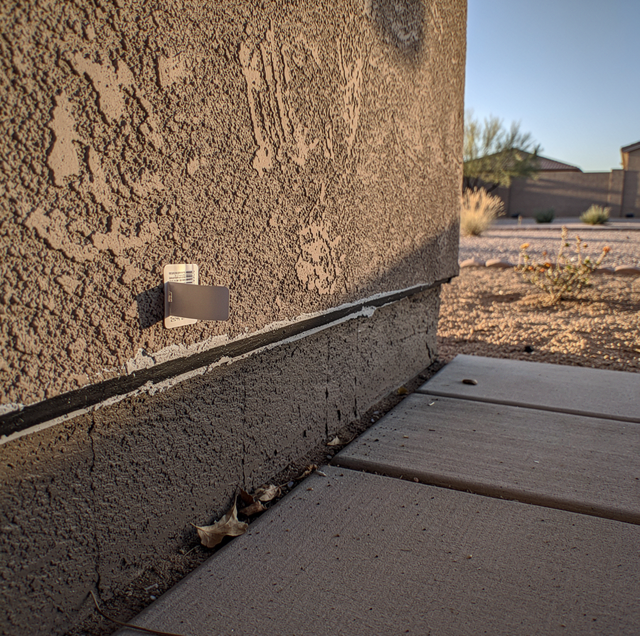
Two years after the sealing crew packed up, you notice a thin line of daylight where a stucco patch meets the original wall. It sits at one of the numbered spots on the checkpoint list still in the folder with the invoice, and the warranty page is stapled behind it. You read that page for the second time in your life, and the question you are asking now is narrower than the one you asked the first time: does this particular spot, in this particular condition, fall inside what the page describes?
A Sealing Warranty Attaches to a Material at a Place
What a Scorpion-Sealing Quote Includes covers this same idea from the buying side as a single line item to check before work starts: whether the quote's warranty language names locations at all. This article picks up from there, once the work is done and a checkpoint list already exists, and works through what that location-based coverage actually responds to over time.
Most of the confusion comes from the word "warranty" itself, which people carry over from appliances and roofs, where the covered item works or fails as a single unit. Sealing has no single unit. It is a set of small, separate repairs, each closing a specific opening with a specific material, and the coverage follows each repair individually.
That is why the page says nothing about how many scorpions you see. A bark scorpion needs roughly a sixteenth of an inch of clearance to get through, which means a survey spends its time cataloging openings nobody would call a hole: the underside of a gate where the soil has washed out, an unscreened attic or dryer vent, the shrink gap around a conduit sleeve, a slab-to-stucco joint that has opened a hair, a valve box lid that no longer seats flat. The list that comes out of that walk is finite. The property around the list keeps producing new surface every year.
So the coverage answers one question, repeated at each numbered spot: is the material that went in there still in there, still closing the same gap it was installed to close? A scorpion crossing a patio that never appeared on the list has no bearing on that question in either direction.
Two Instruments on One Property, Answering Different Questions
A house on a full scorpion program often carries two separate promises, and reading one as if it covered the other's ground is how a promise working exactly as written ends up feeling like it failed.
A re-treat guarantee sits on the recurring chemical side. The companion article "How to Read a Scorpion Re-Treat Guarantee: What It Covers and What It Never Will" walks through its triggers, its window, and its edges. What matters here is only its shape: the event that sets it in motion is a live scorpion, and the response is a return visit and more service on the property.
A sealing warranty sits on the physical side. The event that sets it in motion is a material problem at a numbered location: a mesh panel worked loose at one edge, a mortar line reopened, a sweep no longer meeting the slab. The response is a repair at that spot. Whether anyone has seen a scorpion recently does not enter into it. A checkpoint can fail with no sightings at all, and you can have a sighting with every checkpoint on the list intact.
That gives you a sorting rule for the evening a question comes up. A live scorpion in the garage is a re-treat question. A garage door sweep that has taken a permanent set and no longer touches the slab is a sealing question. One evening can produce both, and they get reported the same way but land in different places.
How Sealed Material Comes Out of Position
A complete quote names these failure modes in passing as something the warranty language should reference. Recognizing them on your own wall, months or years later, takes more than a passing mention:
| Material and where it goes | What drives it out of position | What the spot looks like when it has |
|---|---|---|
| Flexible sealant around a pipe or wire penetration | Daily expansion and contraction working a joint between two materials that move at different rates | A thin line of shadow along one edge, usually the stucco side, where the bead has released |
| Mortar or hydraulic cement in a stucco crack or expansion joint | Continued settlement reopening the same line of weakness the first crack followed | A new crack tracking the old repair, often finer than the original and running the same direction |
| Stainless mesh at a weep hole or vent | Vibration, a knock from yard equipment, or corrosion loosening one edge of the fastening | A corner standing proud of the wall, or a panel that moves under a fingertip |
| Door sweep or brush seal at a threshold | Foot traffic and ultraviolet exposure taking the elasticity out of rubber or the spring out of a brush | Daylight under the closed door, widest at the corners |
The first row is the one that surprises people, because nothing visible happens on any given day. Stucco and a sealant bead sit at slightly different temperatures over a daily cycle and change dimensions at different rates, so the joint between them is worked open and closed by a few thousandths of an inch at a time, every day, for years. It is the same fatigue that breaks a paperclip you keep bending back and forth: no single cycle does anything you could point to, and then the bond releases all at once along one edge. A checkpoint that looked perfect at the one-year mark can show a line of shadow at the two-year mark with nothing having happened in between.
Walk the ground-level checkpoints in early morning, with light raking sideways across the wall. That angle throws a shadow into a separation of a few thousandths of an inch that flat midday light hides completely.
Where the Coverage Stops, and Why Each Boundary Sits There
Three things fall outside a sealing warranty, and each for a different reason.
The first is an opening that was not there, or was not found, when the list was written. Houses keep moving. A settlement crack appears where the wall was sound at survey time. A trade cuts stucco to run a new line and patches the opening loosely on the way out. A gate sags on its hinges until the bottom rail rides an inch higher than it did the day it was measured. None of that is installed material failing, because no material was installed at that spot to fail. Because no material was ever installed there to fail, there is nothing on the existing warranty page for a claim to attach to; a route like that gets scoped and priced as its own piece of work.
The second is a change made to the conditions the seal was built for. A downspout extension rerouted to discharge along a sealed foundation line keeps ground damp that was dry when the checkpoint was surveyed. A new paver path poured against the wall raises grade enough to bury a threshold sweep at the height it was fitted for. A trellis or shade sail anchored into a sealed band adds fastener holes nobody sealed. None of those are material defects. They are new conditions, not material defects, and naming the change when you report a spot points a technician at the actual cause on the first visit.
The third is structural repair, and it is the cleanest boundary of the three. Sealing closes a gap in a wall that is otherwise sound. It does not rebuild a crumbling stucco field, replace a rotted door frame and jamb, or reset a slab that has separated from the foundation by more than a joint can bridge. When a checkpoint turns out to need work at that scale, it comes off the sealing list and becomes its own job with its own scope.
Do not run bare hands along weep screed gaps, gate bottoms, or under rock at ground-level checkpoints. Those voids are exactly where bark scorpions shelter through the day. Use a light and gloves, and move rock with a tool.
Telling a Material Failure From Ordinary Weathering
Not everything that changes at a checkpoint is a failure, and knowing the difference saves you a call and saves a technician a trip.
Sealant and mortar both change appearance outdoors. Sealant chalks and lightens. A mortar patch cures to a slightly different shade from the surrounding wall, then weathers at its own rate. Mesh dulls. A brush seal loses its factory sheen. All of that is surface, and none of it changes whether the opening is closed.
Separation and displacement are the conditions that matter. A line of daylight visible through a joint, a mesh corner you can lift, a sweep that no longer touches the slab across part of its width: each of those reopens a route, and a gap the width of that daylight line is all a bark scorpion needs. Photograph the spot, note the checkpoint number and the date, and report it. Cosmetic change is worth marking on your own copy of the list and nothing more.
Why a Location-Based Promise Needs a Location Record
A warranty that attaches to places can only be used while the places are written down somewhere both sides can find. That record consists of the numbered checkpoint list from the original survey and the accompanying diagram.
The record only grows more useful the longer it sits unused. A year or two on, nobody remembers which of the four weep holes on the north elevation were screened and which had already been closed with mortar by a previous owner. The list remembers. A question about a spot on the list is a comparison somebody can actually make: this material went in here, this is the condition here now. A question about a spot that never appeared on the list has no baseline to measure against, which is why it usually starts a fresh conversation about scope.
Keep your copy where you keep the appliance manuals. It is the part of the work that stays readable long after the crew and the truck are a memory.
Frequently Asked Questions
A sighting on its own is not a coverage event, because coverage attaches to the condition of installed material and a sighting says nothing about that condition. Report it anyway, since where you saw it narrows which checkpoints to re-walk. One on an upstairs wall points at climbing routes and wall-void entries near the roofline; one crossing a floor near a door points at thresholds and sweeps. If that re-walk turns up a failed spot on the list, the spot is what gets addressed.
After, wherever the schedule allows. Painters, stucco patchers, irrigation crews, concrete contractors, and anyone mounting equipment to an exterior wall all work across surfaces that sealing has already closed. Going last means the checklist describes the wall in its finished state. When that ordering is not possible, tell the sealing crew what work is coming so the affected spots get noted before anyone touches them.
That depends entirely on how the paperwork for your job was written, so ask at the time of the work rather than during a sale. Either way, put the checkpoint list, the survey diagram, and the warranty page with the documents that stay with the house. A future owner holding that list can at least see what was done and where, whichever way the coverage question lands.
Twice a year suits most houses, plus a look after anything that disturbs an exterior wall: a re-stucco, a new irrigation run, a mounted fixture, heavy yard work along the foundation. Walk it in the same order every time and mark the date on your copy. Dating each pass gives every spot a short history, which is far more useful than a vague sense that something looks different than it used to.
The checkpoint number if the list is in front of you, a photograph of the spot as it looks now, the date you first noticed the change, and one line describing what changed: bead released along one edge, mesh corner lifted, crack reopened. Shoot from the same distance and angle each time if you have been tracking the spot. That set of details is usually enough to schedule the right work without a separate diagnostic visit first.
Ask two things while the repair is being scheduled. Whether the repair gets written onto the same numbered list, so the record stays continuous and does not split into two documents nobody can reconcile later. And whether the repaired checkpoint carries the remainder of the original term or starts a term of its own. Both answers vary by how the page was written, and both are far easier to get now than a year from now.
What the Page Is Actually For
A sealing warranty is a narrow promise, and the narrowness is the point rather than a shortcoming. It names materials, it names places, and it names the handful of ways those materials come out of position. Everything else on the property stays outside it, scorpions included, because scorpions were never the thing being warranted. Read on those terms, the page in the folder stops looking like a guarantee about pests and becomes what it always was: a maintenance record for a set of small repairs somebody made to your house, with a clock running on it and a list of addresses to check them by.
Ask what your sealing quote's warranty language actually attaches to — the material, the location, and its limits. Russell Pest Control serves the Phoenix Valley. Call (623) 469-7583.
