
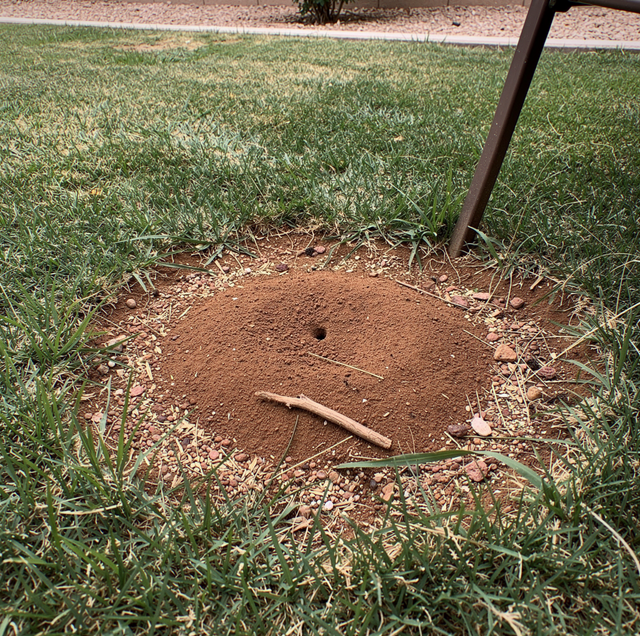
A harvester ant mound is the entrance to a single colony's nest: a cleared, bare patch of soil, ringed with seed husks and chaff the workers carried out, with one main opening at its center. Below that opening, a network of tunnels runs several feet deep, housing the workers, the brood, and the queen. Whether a mound is worth treating now, worth treating soon, or worth simply watching for a while turns less on how big the bare patch looks and more on where it sits and who crosses that ground. A mound tucked in a corner of the yard and a mound three feet from a swing set are the same colony doing the same thing underground, but they are not the same decision.
Where a mound sits changes how soon it needs attention:
| Where the Mound Sits | What It Means for the Decision |
|---|---|
| Beside a play area or swing set | Treat now: the bare apron sits inside ground kids use every day |
| Along a path or a gate people walk through daily | Treat now: foot traffic crosses the entrance regularly |
| In a pet run | Treat now: a dog or cat investigating the hole is at nose and paw level |
| Against a wall's base or a slab edge | Treat soon: the cleared apron keeps widening against the structure |
| Several mounds across one lawn | Treat soon, once they are confirmed as separate colonies: more than one colony has established in the yard |
| In an unused corner of the yard, off any path | Watch: reassess if the apron widens or a new mound opens nearby |
Telling a Harvester Mound from Other Ant Nests
Several ants dig into open ground, so the mound itself is not enough to identify what built it. A harvester mound reads a specific way: one clear entrance hole sits at the center of a bare, cleared patch that can run from a few inches to a few feet across, with visible husks, stem fragments, and other plant debris scattered around the rim where workers have discarded what they stripped from the seeds they carried in. The workers themselves are large for a yard ant, reddish-brown to black, and move in a deliberate, single-file traffic pattern.
Other diggers build mounds too, including fire ants, whose mounds are loose, domed piles without a single obvious opening. Confirming which species is on the ground comes before any treatment decision, because bait and approaches that reach one species do nothing for another.
The apron itself is worth a closer look before making a decision. A young mound can be the size of a dinner plate, with a thin scatter of husks around a small hole. An older, established mound looks different: the bare ring has pushed outward season after season, the entrance sits lower and wider, and the debris pile at the rim has built up into a visible mound of its own. That difference in scale roughly tracks how long that colony has held the same ground, and it is worth noting before comparing what the mound is doing to the ground around it.
What a Colony Does to the Ground and Plants Around It
The cleared apron around the entrance is not an accident of foot traffic. Workers actively strip vegetation from the ground near the opening, clipping grass, low weeds, and small plants back to bare soil in a ring that widens as the colony grows and needs more room to move seed and debris in and out. Left alone, that ring can spread across a section of lawn or a garden bed over successive seasons, thinning the turf and crowding out whatever was planted near the entrance.
Seeds are the colony's main food source, and workers forage from the mound into the surrounding ground, gathering grass and weed seeds and carrying them back in a steady column. A mound near a garden bed or a seeded lawn patch is drawing directly on what is growing there, on top of the bare ground it has already claimed.
None of this happens on a fixed radius. The distance workers travel to forage depends on what is available near the entrance: a mound in the middle of a thick, seed-heavy patch of weeds can work a tighter circle, while a mound in sparse, well-kept turf sends workers farther out to look for something to gather.
The Sting and Why It Matters Where Kids or Pets Play
Harvester ants sting in a defensive response to mound disturbance rather than as something they seek out. A mound that sits where children play, where a pet runs, or along a path someone crosses without looking down raises the odds of an incidental encounter with the entrance itself, which is the moment a sting happens.
An active mound stays off-limits to children and pets until it is treated. Anyone stung who then has trouble breathing, swelling in the face or throat, or dizziness needs 911 right away.
Why Kicking, Flooding, or Raking a Mound Doesn't End It
The bare patch on the surface holds only a sliver of the colony itself. The tunnels below run several feet deep, and the queen and brood stay in that lower network, well past where a kick, a rake, or a bucket of water can reach. Disturbing the entrance without reaching the colony below can end two ways: the workers rebuild the same opening, or they dig a fresh entrance a short distance away and abandon the damaged one, which can make a single mound look like it has spread into two.
Gasoline, solvents, and boiling water poured on a mound can ignite, scald skin, or soak into soil where children play, and digging a mound out puts hands and ankles among stinging workers; a technician treats the colony instead.
How Treatment Reaches a Mound Colony
Reaching the colony starts with confirming the species, because harvester ants are seed-gatherers, and the bait carried down to the queen and brood has to be something foragers will collect as food in the first place. A bait matched to that diet gets picked up at the entrance, carried into the tunnel network as a seed would be, and shared throughout the colony until it reaches the queen and brood below the reach of anything poured or sprayed at the surface.
Where the bait ends up matters as much as what it is. Bait set along the foraging routes workers already use, rather than dumped directly on the entrance, gets picked up as part of normal foraging. Treating the whole colony this way takes time, and that is the tradeoff: a bait that reaches the queen and the brood is what closes the mound down.
Reading the mound's activity before placing anything matters too. A colony that looks quiet at one point in the day can still be active underground, working the tunnels rather than the surface, so a technician checks for traffic at the entrance and along the routes leading away from it before deciding where bait will be carried in.
Keeping a New Colony from Moving into the Same Spot
A cleared, bare patch of ground is attractive to a new colony for the same reason it was to the first: it is already open, sunlit, and easy to dig into. Once a mound is treated and the original colony is gone, that same footprint can draw a newly mated queen looking for a place to start a nest if the ground is left bare and undisturbed.
Reestablishing groundcover over the old footprint, whether that means reseeding turf or letting low-growing plants fill back in, removes the open soil a founding queen looks for. Checking that same spot periodically for a fresh apron or a new entrance catches a second colony while it is still small, before it widens back into the same problem as the first mound.
A single treated mound is also worth reading as a sign to walk the rest of the yard, not just the one spot. A yard that produced conditions right for one colony to settle in, whether that is open soil, a seed-heavy patch of weeds, or ground that goes largely undisturbed, can produce the same conditions for a second colony somewhere else on the property. A walk of the fence lines, the edges of garden beds and any bare or thin patches of turf, repeated from time to time, catches a new mound while its apron is still small.
Frequently Asked Questions
It can be the same one: a single long-lived queen keeps the colony on the same nest year after year, so a mound reopening in the same spot after cooler months is the original colony resuming surface work.
No. Harvester ants do not chew into framing, siding, or wiring. What they affect is the ground itself, through the cleared apron and the tunnels beneath it, and the risk to people is the sting, not the structure.
They forage outdoors for seed and do not set up indoor food trails; ants trailing across a kitchen counter belong to a different species and a different treatment.
On certain days, an established colony releases winged reproductive ants, males and future queens, that take flight together to mate and start new colonies elsewhere. That is a different event from the wingless workers seen coming and going day to day, and it is a sign that the colony is mature enough to reproduce.
Mowing close to a mound does not reach the colony underground, but the vibration and disturbance from the mower can bring defensive workers up to the entrance. Trimming from a distance and leaving the mound itself alone until it is treated is the safer approach.
Not right away. Because bait works through the colony over time rather than killing on contact, the bare entrance and apron can remain visible after activity has dropped off, so an entrance with no worker traffic is a sign that treatment has worked, while the bare patch stays until cover grows back over it.
Set up ant control for a harvester ant mound — species identification and bait placed where the colony will carry it down. Russell Pest Control serves the Phoenix Valley. Call (623) 469-7583.