
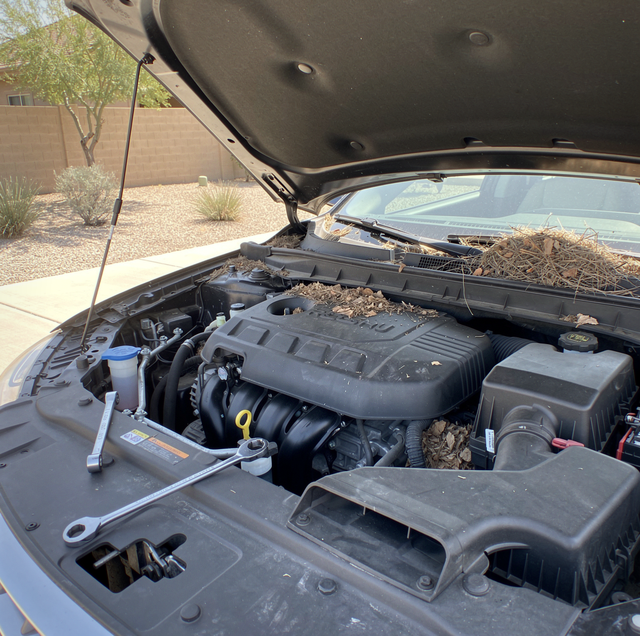
A packrat climbs into an engine bay looking for a cavity that stays out of the weather, holds still, and keeps some warmth after dark, and a parked car offers all three. The animal is a nest builder by instinct: it hauls in sticks, dry leaves, thorny twigs, and other debris it can carry, and packs that material into open pockets around the engine, the air filter box, and the wheel wells. Wiring gets chewed along the way as a by-product of constant gnawing. A car that has just been driven and still carries some engine heat, then sits untouched overnight in the same spot, gives a packrat the shelter, stillness, and warmth it is already looking for.
Each sign under the hood marks a different stage of that move-in and shows how settled the packrat already is:
| Sign | What It Suggests |
|---|---|
| A mound of sticks, leaves or debris on top of the engine or packed into the air-filter box | The packrat has already started building in that spot |
| Chewed insulation on wiring, or bite marks on rubber hoses | Gnawing on parts within reach of the nest site |
| Droppings scattered on the engine or on the ground under the hood | Activity in that specific space recently, not just passage through the yard |
| A vehicle that has sat unused for several days or longer | Stillness that lets nest-building continue night after night without interruption |
| A nest that reappears after being cleared out once | Harborage nearby, an open route in, or scent left at the old site can each bring a packrat back |
What Makes an Engine Bay So Inviting
An engine that has just been shut off retains heat for a while, enough to make the space under the hood warmer than the surrounding night air. The engine block and exhaust parts retain heat in their mass and release it gradually after shutdown. Add to that a largely enclosed cavity, gaps around the hood and fender liners that block wind and light, and a spot that goes undisturbed once the driver walks away, and a packrat scouting a property for shelter has little reason to look further.
A car that moves every day still sits overnight; one that sits idle for days gives a packrat those nights in a row to haul material in. A vehicle that sits idle for a stretch, in a driveway, an open carport, or an unsealed garage, gives the pile time to build up undisturbed. A vehicle parked inside a fully sealed garage, with no gap for a packrat to get through in the first place, does not face this problem the same way one parked in the open does.
Constant Tooth Growth Behind the Chewing
A packrat's front teeth, like every rodent's, grow without stopping through its life, and gnawing is what keeps them from overgrowing into the jaw. That fact accounts for the damage found under a hood: the animal isn't after the copper inside a wire; it's testing anything solid enough to resist its teeth, and a bundle of wiring loom built into the middle of a nest is within easy reach. Hoses and hard plastic clips near the nest wear down the same way, for the same reason. The enamel on the front face of each incisor is harder than the material behind it, so wear keeps a chisel-shaped edge on the tooth rather than wearing it flat, and gnawing on something solid drives that wear.
The Midden Under the Hood
The pile a packrat builds under a hood is called a midden, and it builds up a load at a time: sticks, insulation scraps, and whatever debris is close by, worked into gaps around the engine and the air-filter box. Under a hood, that pile is more than clutter, since it packs in against whatever engine component happens to sit closest, hot or not. The pile also carries droppings and urine, a health hazard on contact or once disturbed dry, so any cleanup near it is a wet-cleaning job, not a dry sweep.
Nest material packed against a hot exhaust manifold or catalytic converter can ignite once the engine runs, a fire hazard to anyone in or near the car, so it stays parked until the material is cleared and a mechanic confirms the wiring.
Where Packrats Set Up Around a Property
Packrats build outdoor middens close to whatever shelter already exists: under a dense shrub, inside a stacked woodpile, along a fence line, or inside a shed. A parked car near any of those features is within an easy nightly trip, and the vehicle becomes an extension of that same territory rather than a separate target. A midden a few feet from where the car parks puts the engine bay inside the same nightly trips the packrat already makes. Clearing the visible mound does not remove the reason to return if the woodpile or the shrub stays in place nearby. An adult packrat lives alone at its nest, so the nest in one car can be traced back to a single animal rather than to a group moving in together.
Breaking the Pattern with Control and Exclusion
Trapping at the exact spot the pressure is showing up, along the parking area and the harborage near it, removes the packrats working that specific car rather than the wider population on the property. Exclusion does the other half of the job: closing the gap a packrat uses to reach a garage, screening a vent, or sealing the gaps under and around a garage door removes the route to begin with, so a trapped area doesn't refill from next door. Removing the woodpile, shrub, or debris pile the midden sits against does the rest, since a packrat with no nearby cover has nowhere convenient to retreat to between trips to the car. Bait placement stays away from the engine bay itself: a poisoned animal that dies inside the vehicle creates its own odor and cleanup problem, so trapping in that specific spot works better than baiting it. Exclusion material has to stand up to gnawing on its own, since sheet goods thin enough to block movement but not resist a packrat's teeth get worked through given enough time at the same spot.
Handing the Repair to a Mechanic
Pest control stops at the animal and the nest site. Once the nest material is cleared and the fire risk with it, chewed wiring, damaged hose covering, and any part that shows bite marks are a mechanic's diagnosis and repair, not a pest-control job. A mechanic traces each chewed run for a break in continuity and replaces or splices the damaged section, checking the nearby connectors and grounds as well, since the wires in a loom run bundled together and a midden that reached one wire sat against the others in the same bundle. Urine residue left on a nearby connector can corrode the contacts even when the insulation itself was not chewed, so a mechanic checks connections near the damage as part of the same repair.
Frequently Asked Questions
Yes. The wiring that runs into the cabin passes through the firewall, and the same gaps a packrat uses to reach that wiring can lead to the cowl area at the base of the windshield, where the fresh-air intake for the cabin blower sits. An animal that finds that gap can end up nesting in the blower motor housing or the ductwork instead of stopping at the engine bay.
The filter element sits in the same droppings and urine as the nest and is replaced rather than shaken out, and the intake duct beside it is checked for material pulled deeper toward the engine. That is part of the mechanic's work on the car.
Not on its own. As the pile sits, the packrat's urine dries into a crust that cements the sticks and debris together, allowing an established midden to hold its shape, and a packrat returning to the spot starts again from whatever base is left.
Cached food. Packrats stash seeds and other plant material inside the same pile they nest in, sometimes tucked into a separate pocket from the bedding itself. Packrats also carry off small shiny objects, and one hauling an item can drop it where it picks up another, the swapping habit behind the nickname “trade rat.”
The animal is gone, but the scent marking is not erased with it. Packrats mark their runways and their midden site, and an empty midden that still carries that scent reads to the next packrat working the same yard as an available, already-proven shelter, not as empty space to avoid. Removing the debris pile along with the resident takes that signal away.
No. Soft materials such as foam insulation, weatherstripping, and cabin air filter media get shredded and hauled off whole to line the nest rather than gnawed down in place.
Secure packrat control for the parking area and garage — trapping near where the car sits and exclusion sealing of the garage. Russell Pest Control serves the Phoenix Valley. Call (623) 469-7583.