
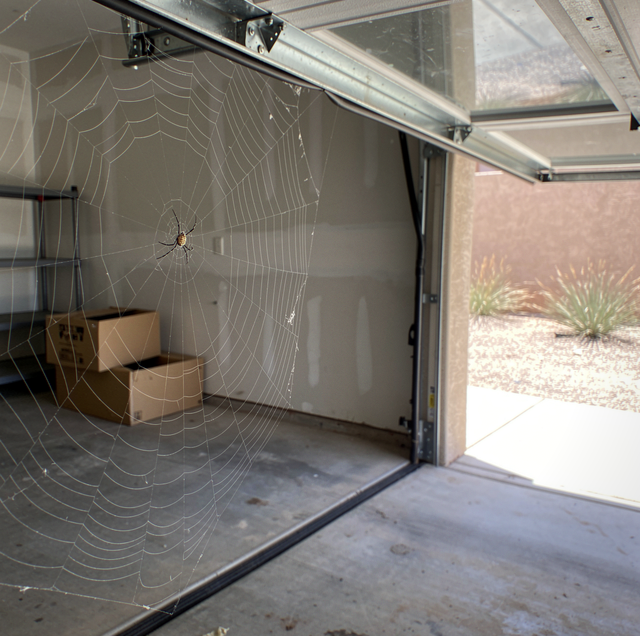
You spot the web across the garage door track on your way out one October morning. By Friday it holds a spider the size of a fingertip, strung between the frame and boxes you haven't touched in weeks. What changed isn't the garage. It's the air outside it, cooler by early evening than a month ago, and that shift is enough to send a spider looking for somewhere steadier to spend the night.
You didn't invite this spider in, and nothing about your habits pulled it through that gap. Dropping overnight temperatures move spiders toward your neighborhood whether or not you notice. This piece covers what pulls them inside, where they settle in your wall, and the one condition that sends them back out.
The Mechanism Behind an Indoor Migration
Spiders don't migrate the way birds do, moving as a group on a set date. Each one responds on its own to a drop in the temperature immediately around it, and a night that dips into the fifties reads differently to a spider than a night that stays in the seventies. Once its immediate surroundings cross that line, a spider that has spent the warm months in a woodpile, under a rock, or inside a shrub starts testing closer structures for a sheltered retreat, one gap or crack at a time.
Two separate pressures point the same direction at once, and that overlap is what makes the fall push so noticeable. The first is temperature: a spider is cold-blooded, so its body runs at whatever the air around it runs at, and a body that runs cooler moves more slowly, digests more slowly, and catches less. The second is food: crickets, moths, and other insects that spiders eat are drawn toward buildings for the same reason, and a spider that follows its prey ends up wherever that prey goes. A garage that stays a few degrees warmer than the yard outside it, already holding a few crickets working the light under the door, gives a spider two reasons to cross the threshold, and neither has anything to do with what you did or didn't clean up.
The spiders that make it inside are usually the ones already living closest to the building, with a woodpile or ivy on the siding putting one a gap away. Two draws pull a spider through a crack: prey insects around a house, and warmer temperatures. A second driver runs alongside both: the fall rise in spider encounters also ties to males leaving their webs to search for mates and females laying eggs.
What Snaps a Warm Evening Into a Search for Shelter?
There's no calendar date this runs on. What actually starts it is the overnight low holding below the range a spider's outdoor retreat can no longer buffer, night after night, not as a single cool evening. A run of cooler nights is what finally pushes a spider to test somewhere warmer.
It's the run of cooler nights that matters, rather than any single cool evening early in the season. A garage door left cracked, a torn weatherstrip, or a gap where a utility line enters the wall all read the same way to a spider testing the air: warmer in here than out there. What's new each fall is how hard a spider will actually search for one now.
Where Spiders Concentrate Once They're Inside
Not every spider indoors arrived from outside, and the ones that did don't spread evenly through a house. Each settles where three things line up: still air, a corner or void it can anchor a web to, and a nearby food source. A garage checks all three at once, which is why it holds more webs by November than any other room, especially near the door track, along shelving that doesn't get moved, and behind stored boxes that sit untouched for months at a stretch, sometimes well past the season that put them there.
Inside the living space itself, a spider gravitates toward that same kind of stillness instead of open rooms with regular foot traffic: a closet shelf, behind a headboard, under a bathroom vanity, or a window frame that catches a few insects drawn to the glass at night. Rooms that get used and moved through daily rarely hold a web for long, because a web that gets brushed down gets rebuilt somewhere quieter.
Attics and crawlspaces draw a smaller but steadier population, since both retain warmth long after the sun goes down and experience little disturbance from one month to the next. A web built there in October can still be there in February, undisturbed except by whatever insects wander into it, or by whoever finally opens that access panel to take a look.
What Snaps a Cautious Spider Into a Riskier Choice?
Most of the spiders that end up indoors this way are harmless, more useful than not, since each one is quietly working through the insects sharing that same warm corner. One kind is worth learning to recognize on sight, because its bite is medically significant for children and pets: a shiny black spider with a rounded abdomen, often marked with a red or orange shape on its underside, favoring exactly the still, cluttered spots described above: block walls, stacked patio furniture, garage corners, and pool equipment.
In a climate that doesn't see a hard freeze most winters, that population never gets thinned out the way it does in places that drop below freezing, so the same corner can hold this spider through every season. That's a reason to treat any unidentified spider in a stacked or cluttered space with some caution, not a reason to assume every spider you find indoors is one.
Telling that spider from the several harmless look-alikes sharing the same corners is usually a matter of a few visible traits on the body itself, not a guess.
Which Sign Points to Which Spider
Not every web or spider sighting means the same thing. The table below lines up what you're likely noticing against what's actually behind it, so you know which of the mechanisms above applies before deciding what to do about it.
| What You're Seeing | What It Usually Means |
|---|---|
| A new web in a garage corner overnight | A spider testing a warmer space as the temperature drops |
| Several small webs near one door or window | Insects gathering at a light or gap, with spiders following the food |
| A spider in a stored box or under furniture | A retreat chosen mainly for stillness, not for any drawn-in prey |
| A web that keeps reappearing after being cleared | An entry gap nearby that hasn't been closed off |
| A shiny black spider with a red marking underneath | A spider worth identifying carefully before it's disturbed |
A single sign rarely tells the whole story on its own. Two or three of these showing up together in the same corner of a garage or storage room point to a spot worth checking with a flashlight after dark, when spiders that hide by day are actually out, sitting in their webs.
A black widow's bite is medically significant for children and pets. If a spider can't be identified confidently, leave the corner alone and have a pest control technician confirm it.
What Changes Once the Nights Warm Back Up
None of this indoor movement is permanent from a spider's perspective. A spider that crossed into a garage or a closet in October is there because the air outside stopped being the better option, not because the house became somewhere it wanted to stay.
Once overnight lows climb back into the range an outdoor retreat can buffer on its own, usually as the season turns back toward warmer nights, the pressure that pushed spiders toward buildings eases, and new arrivals slow from a steady stream to just a trickle. Spiders that have already settled indoors tend to stay, since a corner with a working web and nearby food gives a spider little reason to leave for someplace less established.
That's the one condition that turns the advice around: as long as overnight lows keep dropping, checking corners and closing gaps is worth doing regularly, but once those lows start climbing again, the same corners empty out on their own and checking them stops turning up anything new.
Frequently Asked Questions
It helps some, but indirectly. Outdoor lights draw the flying insects spiders eat, so a porch light you leave burning on all night gives a spider good reason to build near your door, regardless of the outdoor temperature. Switching to a motion-triggered light instead cuts that draw, though it does nothing about spiders already testing your own garage before you notice.
Most house spiders hide in a retreat during the day and only sit out in the open part of their web after dark, so a daytime walk-through of your garage misses animals that are actually present. Checking in the first hour after sunset with your flashlight from a few feet back shows you the same quiet corners that the spiders on your daytime pass missed.
Sealing gaps around doors, vents, and utility lines removes most of the paths spiders use to reach your garage or attic, and doing so every fall protects your house. It won't close every opening your house has, since a gap as wide as a pencil is enough for some species, so treat it as a way to cut your numbers, not a promise of zero.
Not as a group. The same species that live outside also live inside, and moving indoors doesn't change what a spider is capable of. What changes is your own exposure to whichever ones sit closest to you, which is why recognizing the one worth caution matters once you're sharing your garage with it.
An indoor web often gets rebuilt on the same anchor points, in a spot nothing disturbs, since wind and rain never reach it outside your door. Layer on layer from several nights of repair piles up in the same corner, which is why your garage can carry a thick, tangled mat while a web you'd see outside still looks like a single fresh sheet, because it never survives a windy night out there for you.
Look at build and posture before anything else. A wolf spider is bristly, brown to gray, and moves fast across the floor at night, since it hunts on open ground and never waits in a web, while a black widow is glossy black, round-bodied, and hangs still, belly up, in a loose tangle near its retreat. If the spider in front of you is moving quickly across open floor at real speed, it isn't the one worth your extra caution tonight; if it's motionless in a web instead, look closely for the red marking on its underside before you decide either way, and leave it undisturbed until you do.
Schedule a fall pest inspection now, before overnight temperatures actually keep dropping — a technician walks the garage, eaves, attic access, and door thresholds where spiders concentrate, then seals the gaps actually letting them through before the problem quietly rebuilds itself. Russell Pest Control serves the Phoenix Valley. Call (623) 469-7583.